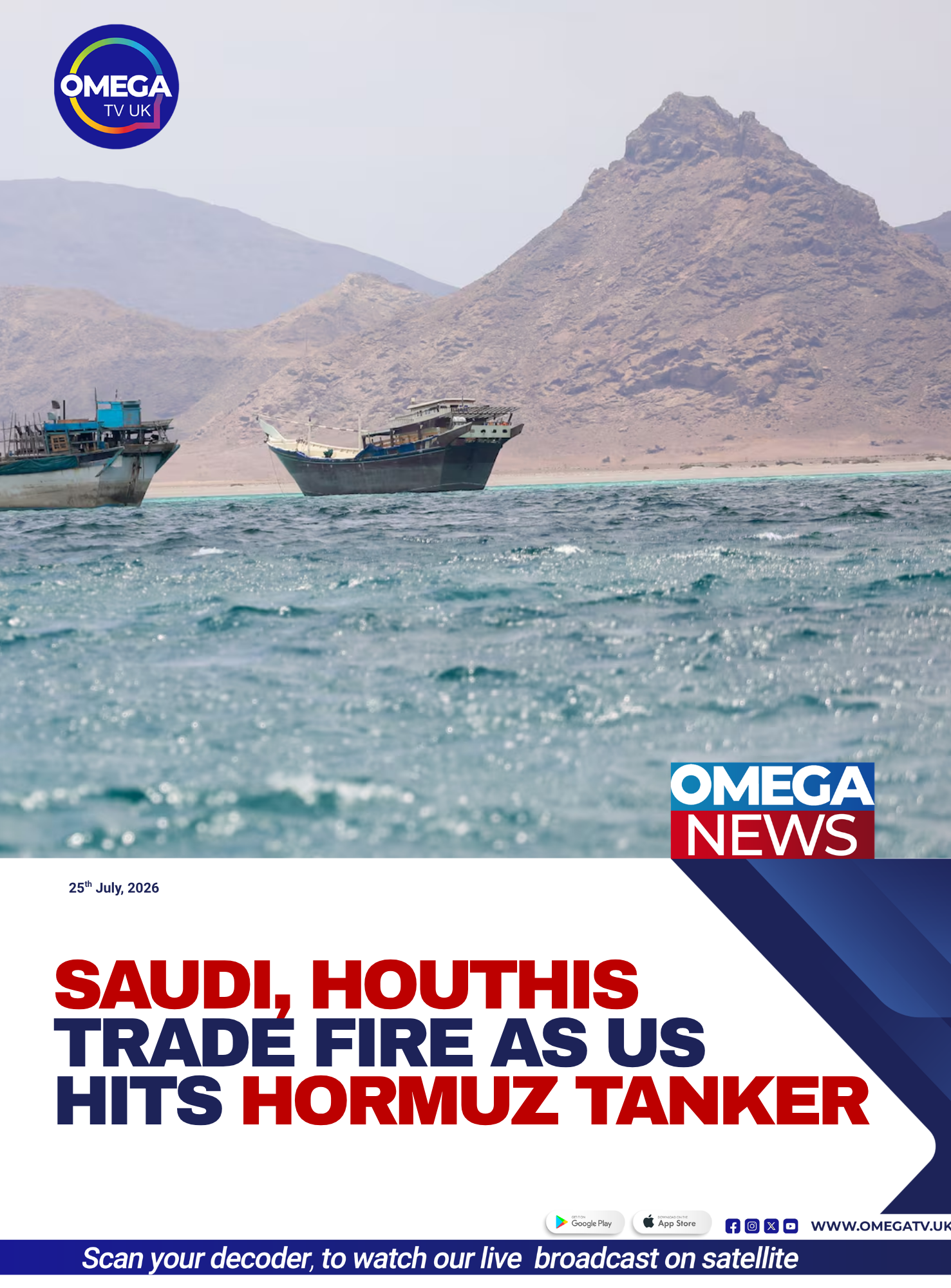
Airstrikes, Missile Attacks and Shipping Disruptions Escalate Regional Crisis
Saudi Arabia and Yemen’s Houthi movement exchanged military strikes after renewed violence in the Red Sea region, while the United States said it disabled a tanker in the Gulf of Oman that allegedly attempted to breach its blockade on Iranian ports.

Saudi forces carried out airstrikes on Houthi targets in the Yemeni port city of Hodeida and on nearby Kamaran Island after the Iran-backed group announced a maritime blockade and claimed attacks on Saudi-linked vessels.
Hours later, Saudi authorities issued emergency alerts for the southern province of Jizan after the Houthis said they had launched a missile attack on the area.
Houthi-affiliated media later reported that the strike caused fires in Jizan, although Saudi officials had not immediately commented on the claim.
US Disables Tanker Near Strait of Hormuz
Meanwhile, the US military said it disabled a commercial tanker in the Gulf of Oman after the vessel allegedly ignored repeated warnings while attempting to reach Iran.
According to US Central Command, the ship was stopped after its crew failed to comply with multiple requests to change course.
US officials said the vessel is the second commercial ship disabled since Washington reintroduced its blockade on Iranian ports earlier this month.
The incident has further increased tensions around the Strait of Hormuz, one of the world’s busiest oil shipping routes.
At the same time, a delegation from Oman travelled to Tehran for talks related to the strategic waterway. Oman shares control of the southern coastline of the Strait of Hormuz and has often acted as a mediator during regional disputes.
US and Iran Continue Exchange of Threats
The latest developments come as military tensions between the United States and Iran continue.
Iran said it had carried out drone attacks targeting US military facilities across the Middle East in response to ongoing American military operations.
Speaking at the White House, US President Donald Trump said negotiations with Iran were continuing but warned that military action remained an option if diplomacy failed.
Trump said the United States could either continue military operations or pursue what he described as a smarter strategy through negotiations.
He also stressed that US forces remained fully prepared for further action if necessary.
Oil Prices and Global Shipping Affected
The renewed conflict has raised concerns about the security of international shipping routes through both the Red Sea and the Strait of Hormuz.
Growing fears over attacks on commercial vessels recently pushed global oil prices above $100 per barrel before prices eased later in the week.
Market analysts linked the decline to the successful passage of two Chinese-chartered supertankers through the Bab el-Mandeb Strait without incident.
Following the Saudi airstrikes, Houthi media accused Saudi Arabia of targeting civilian facilities in Hodeida and Kamaran Island, warning that the attacks would not go unanswered.
Diplomatic Efforts Continue
Despite the military escalation, diplomatic efforts remain underway.
The United States and the United Kingdom are expected to hold a conference in London next week to discuss security in the Strait of Hormuz, with senior military officials from both countries expected to attend.
Israeli Prime Minister Benjamin Netanyahu is also scheduled to meet President Trump at the White House in the coming days as regional security remains a key topic.
Earlier this year, the United States and Iran agreed to a memorandum aimed at reducing military tensions and reopening the Strait of Hormuz. However, that agreement later collapsed following renewed attacks on shipping and subsequent military responses.
The latest exchange of fire has heightened concerns that instability across the region could continue to threaten international trade, energy supplies and diplomatic efforts.