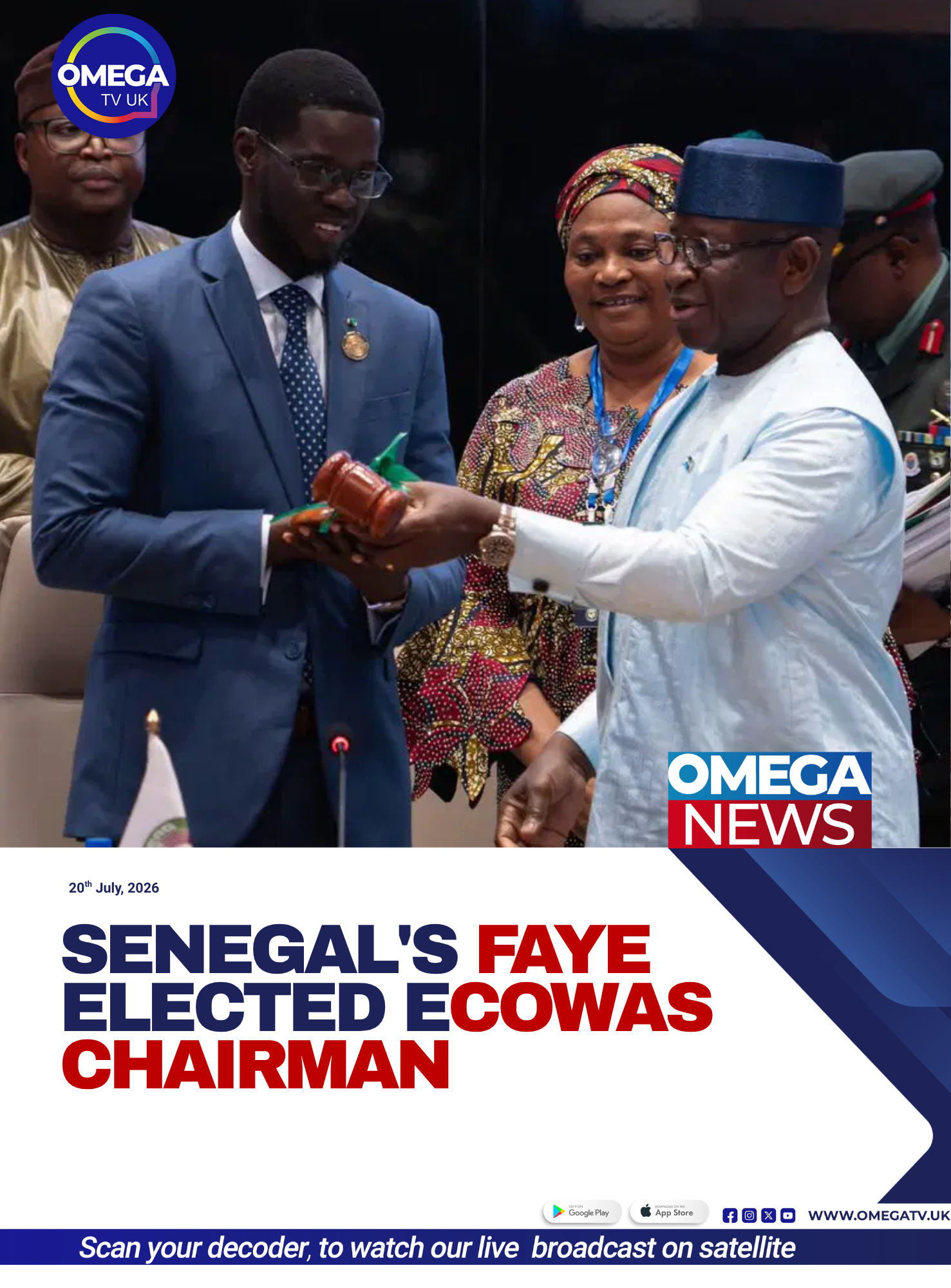
Young Senegalese leader takes charge of regional bloc amid security and political challenges in West Africa
Senegal’s President Bassirou Diomaye Faye has been elected the new chairman of the Economic Community of West African States (ECOWAS), taking over leadership of the regional bloc at a crucial moment for West Africa.

The 46-year-old leader was chosen during the ECOWAS summit held in Sierra Leone’s capital, Freetown, replacing outgoing chairman and Sierra Leone President Julius Maada Bio.
Faye’s appointment comes as ECOWAS faces some of its biggest challenges in recent years, including rising insecurity, military coups, political instability and growing divisions among member states.
The new chairman inherits a region dealing with strained relations following the withdrawal of Mali, Burkina Faso and Niger from ECOWAS after disputes over sanctions and the bloc’s response to military takeovers in those countries.
A new leadership test for West Africa
As chairman, Faye is expected to prioritise rebuilding unity within the regional organisation and finding diplomatic solutions with the three breakaway nations.
His leadership will be closely watched as ECOWAS attempts to maintain regional cooperation while addressing concerns over democracy, governance and security.
The Senegalese president is also expected to push reforms aimed at strengthening accountability, improving institutional effectiveness and increasing youth participation in political decision-making.
West Africa has experienced a wave of political instability in recent years, with several countries witnessing military interventions that have challenged ECOWAS’s role as a defender of constitutional rule.
Faye’s election signals an opportunity for a younger generation of African leaders to influence the direction of regional politics.
Focus on cooperation and reform
Since taking office in Senegal, Faye has promoted a message of political renewal and stronger public institutions.
His approach to ECOWAS leadership is expected to focus on dialogue rather than confrontation, particularly in rebuilding relationships with Mali, Burkina Faso and Niger.
The three countries created the Alliance of Sahel States after leaving ECOWAS, raising concerns about regional fragmentation and cooperation on issues such as counterterrorism, trade and economic development.
Faye will face the challenge of balancing ECOWAS’s commitment to democratic principles while keeping communication channels open with governments that have distanced themselves from the bloc.
A new era for ECOWAS
Faye’s election represents a generational shift within West African leadership and comes at a time when millions across the region are demanding stronger governance, economic opportunities and greater political inclusion.
The success of his chairmanship will depend on his ability to unite divided members, address security threats and restore confidence in ECOWAS as a key force for regional stability.
As West Africa navigates a period of uncertainty, Faye’s leadership will play an important role in shaping the future direction of the 15-member bloc.