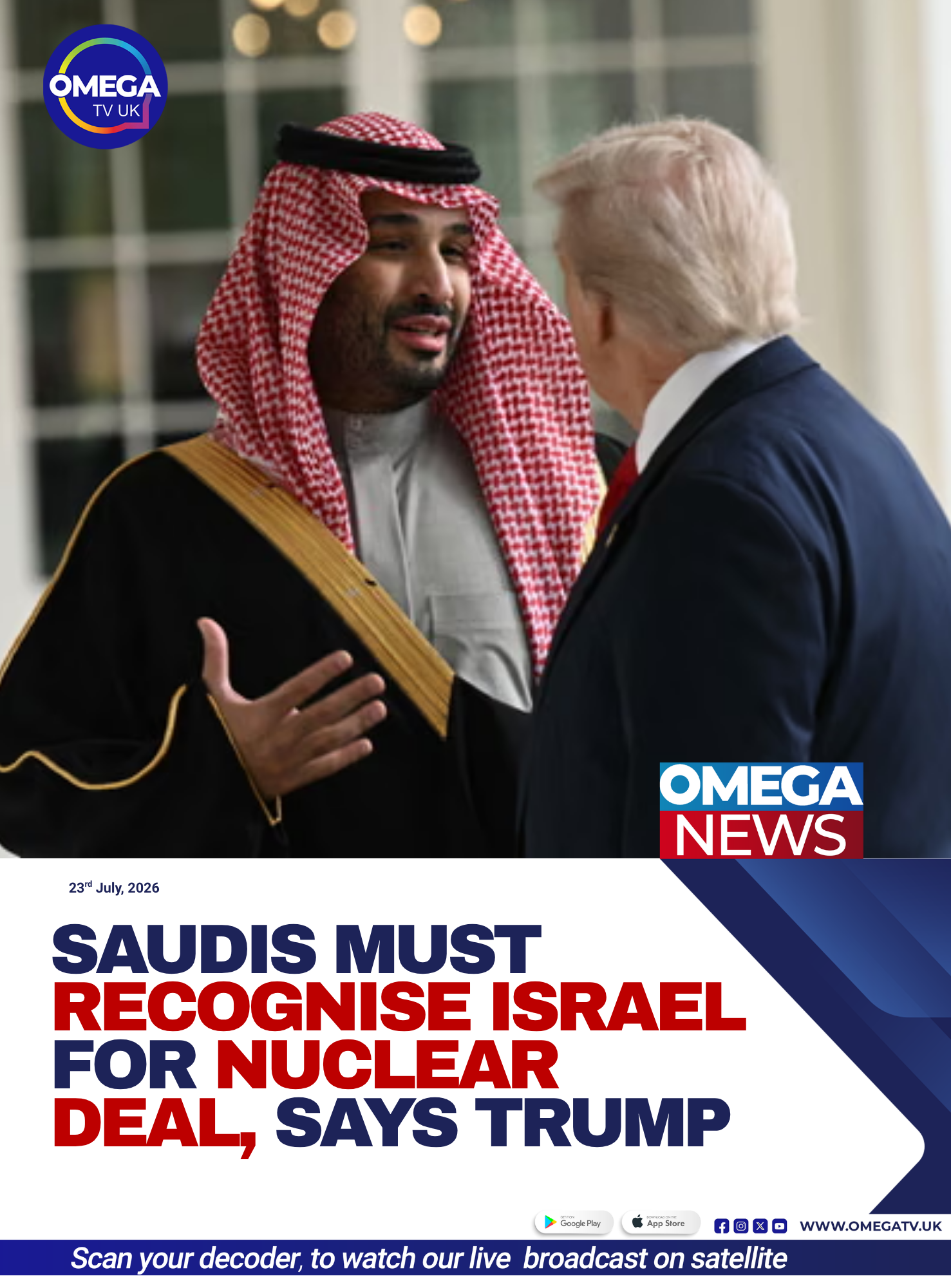
Riyadh Must Join Abraham Accords for Civil Nuclear Agreement to Proceed
US President Donald Trump has said Saudi Arabia’s planned nuclear energy deal with Washington will depend on the Gulf kingdom recognising Israel and joining the Abraham Accords.

Trump announced the condition in a post on Truth Social, saying the civil nuclear agreement would only move forward if Saudi Arabia became part of the US-brokered diplomatic agreements that normalised relations between Israel and several countries.
He stressed that the nuclear agreement would focus only on peaceful energy purposes and would not allow the enrichment of nuclear material.
Saudi Arabia Has Not Responded
Saudi Arabia has not yet publicly responded to Trump’s comments.
The kingdom has previously stated that it would not establish diplomatic relations with Israel unless there is progress toward creating a Palestinian state.
The condition places renewed pressure on Riyadh as the United States seeks to expand the Abraham Accords, which were launched during Trump’s first term.
The agreements saw the United Arab Emirates and Bahrain establish diplomatic ties with Israel in 2020, marking the first such moves by Arab nations in decades.
Morocco, Sudan and Kazakhstan later joined the agreements.
Israel Welcomes Potential Normalisation
Israel welcomed Trump’s statement, describing Saudi Arabia joining the Abraham Accords as a major step toward peace in the Middle East.
A statement from Israeli Prime Minister Benjamin Netanyahu’s office said Saudi participation would represent a historic development, although it did not directly mention the nuclear agreement.
Israeli officials have previously said they could accept Saudi Arabia developing nuclear energy for peaceful purposes.
Israel is widely believed to possess nuclear weapons, although it has never officially confirmed or denied having them.
Nuclear Concerns Surround Agreement
The US-Saudi nuclear agreement has attracted international attention due to concerns about nuclear proliferation in the Middle East.
The deal has been described by the US Department of Energy as a peaceful nuclear cooperation agreement aimed at expanding American involvement in Saudi Arabia’s nuclear energy programme.
However, experts have raised concerns about whether Saudi Arabia could eventually develop the ability to enrich uranium.
Uranium enrichment can be used for civilian energy production but can also potentially support the development of nuclear weapons.
Rosemary Kelanic, director of the Middle East programme at Defense Priorities, said allowing Saudi Arabia to enrich uranium domestically would be unusual because it could increase the risk of nuclear weapons development.
Deal Heads to US Congress
The agreement will now be reviewed by the US Congress, where some lawmakers from both parties are expected to raise concerns.
However, with Republicans controlling both chambers, opponents are unlikely to have enough votes to block the deal.
The nuclear agreement comes amid wider regional tensions, particularly following the long-running dispute between the United States and Iran over Tehran’s nuclear ambitions.
Saudi Crown Prince Mohammed bin Salman previously said in 2018 that if Iran developed a nuclear weapon, Saudi Arabia would seek to do the same.
The latest negotiations place Saudi Arabia’s nuclear ambitions, Middle East diplomacy, and relations with Israel at the centre of a major geopolitical debate.