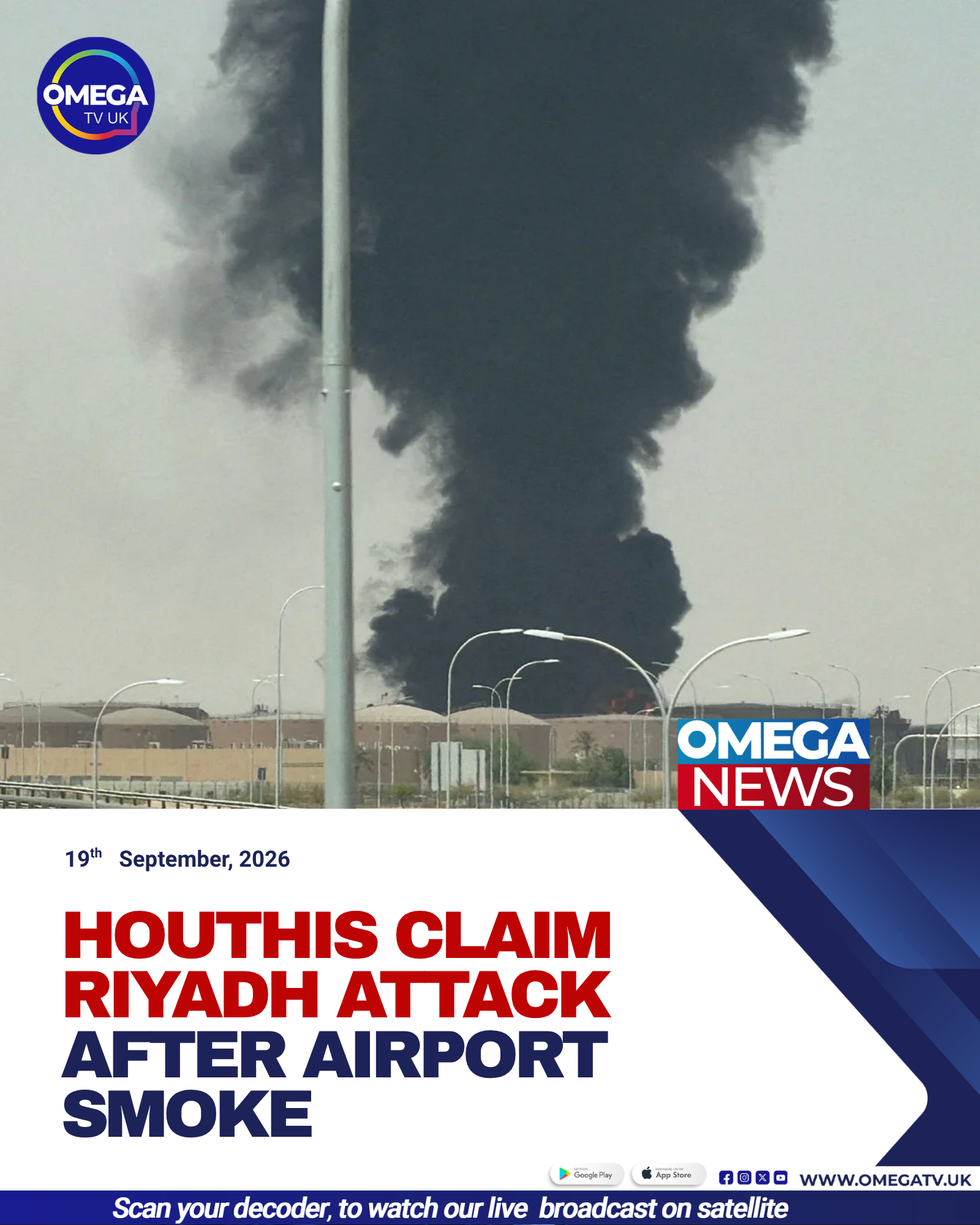
Houthis Claim Attack on Riyadh as Smoke Rises Near Saudi Airport
Iran-backed Houthi militants in Yemen have claimed responsibility for missile and drone attacks targeting Saudi Arabia, including the capital Riyadh and energy infrastructure along the Red Sea coast, after a large plume of black smoke was seen rising near King Khalid International Airport.

The smoke and flames were visible on Saturday after Saudi authorities issued emergency alerts warning residents in Riyadh and other areas of possible aerial attacks. It was the first such alert issued for the Saudi capital since fighting with the Houthis intensified in July.
Residents reported hearing several explosions across Riyadh, while firefighters were seen attempting to extinguish flames from what appeared to be a fuel storage tank belonging to Saudi oil giant Aramco near the airport.
Saudi authorities later issued an all-clear, but there was no immediate official explanation for the incident or confirmation of what caused the fire. Flight tracking data showed significant disruption at King Khalid International Airport, with delays and cancellations reported.
Houthi military spokesman Yahya al-Sarea said the group had launched a large number of ballistic and cruise missiles and drones against what he described as sensitive targets in Riyadh and Aramco facilities in Yanbu, a major industrial and oil hub on Saudi Arabia’s Red Sea coast.
The Houthis said the attacks were retaliation for Saudi military operations against their positions in Yemen. The group has accused Saudi Arabia of carrying out hundreds of strikes in Yemen in recent days.
Saudi Arabia has not publicly confirmed the Houthi claims about the attacks. However, the appearance of smoke and flames near the airport came shortly after the emergency warnings and explosions reported across the capital.
The latest incident comes amid a renewed escalation in Yemen’s long-running conflict. The Houthis control large parts of northern Yemen and are fighting the internationally recognised government, which has received support from Saudi Arabia.
The group has stepped up attacks against Saudi targets in recent months, while also claiming responsibility for attacks on shipping and strategic positions along the Red Sea. The United Nations Security Council has condemned continued Houthi attacks against Saudi Arabia, including strikes affecting civilian and energy infrastructure.
The fighting has also triggered a major humanitarian crisis. The International Organization for Migration initially reported that more than 104,000 people had been displaced by the renewed fighting since June. Updated figures covering September 1 to 17 put the number of people displaced during the latest escalation at 114,498, with the cumulative number recorded since June reaching 118,086.
Taiz has recorded the largest concentration of displaced people, followed by Lahj, while additional displacement has been reported in several other governorates. Thousands of Yemenis have also crossed the Red Sea to neighbouring Djibouti as violence along the country’s western coast has intensified.
The Houthis have also expanded their military activity around important Red Sea territory. Recent fighting has involved the strategic port of Mokha and islands near the Bab el-Mandeb Strait, a key maritime passage connecting the Red Sea with the Gulf of Aden.
The developments are particularly significant for global energy markets because Saudi Arabia is one of the world’s largest oil exporters and relies heavily on Red Sea routes for some shipments. The wider regional conflict has already disrupted major energy routes, including the Strait of Hormuz.
The latest attack therefore adds another layer of uncertainty for oil markets and international shipping, while the renewed fighting continues to drive displacement and humanitarian needs inside Yemen.