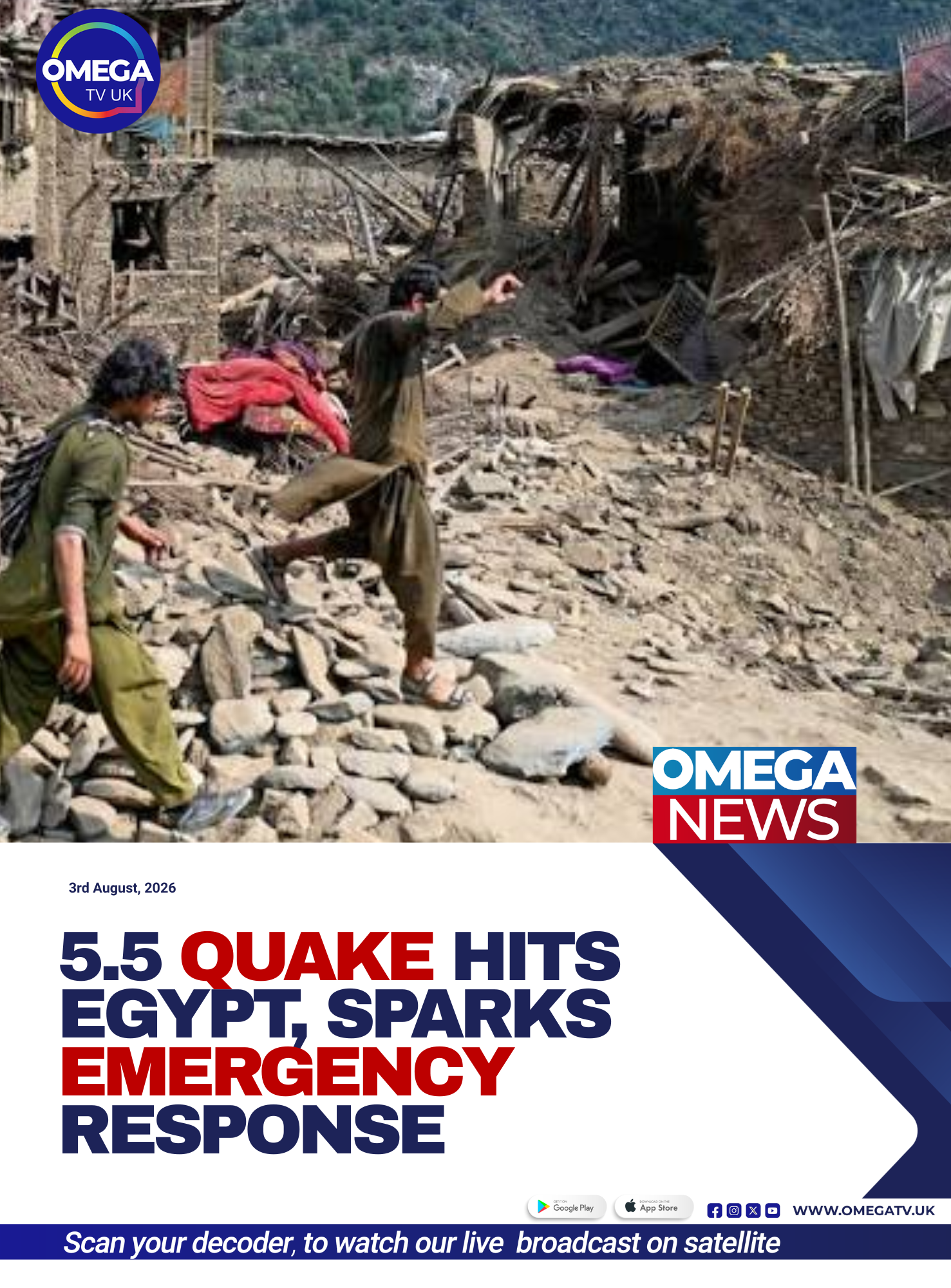
Magnitude 5.5 Earthquake Shakes Egypt, Triggers Nationwide Emergency Response

A magnitude 5.5 earthquake struck eastern Egypt early Monday, shaking buildings across several cities, including the capital Cairo, and prompting authorities to activate emergency response measures across the country.
According to Egypt’s National Research Institute of Astronomy and Geophysics, the earthquake occurred at around 3:00 a.m. local time (0000 GMT). The epicentre was located approximately 40 kilometres north of the city of Suez, with tremors felt across a wide area stretching to El-Arish near Egypt’s border with the Gaza Strip.
The U.S. Geological Survey later measured the earthquake at magnitude 5.0 after initially issuing a higher preliminary estimate.
Following the quake, Health Minister Khaled Abdel Ghaffar ordered the immediate activation of the country’s emergency response plans. Ambulance services and emergency medical teams were placed on the highest level of readiness to respond to any incidents.
Despite the widespread tremors, Egyptian authorities said there were no immediate reports of deaths, injuries or significant structural damage. The Ministry of Health and the Egyptian Red Crescent confirmed that emergency teams remained on standby while assessments continued.
As a precaution, the Egyptian Red Crescent advised residents to avoid entering old or structurally weakened buildings until safety inspections could be completed. The warning particularly applies to older neighbourhoods in Cairo, where ageing buildings remain vulnerable to seismic activity.
Officials urged the public to stay calm, monitor updates from official sources and follow safety instructions should aftershocks occur.
Although strong earthquakes are relatively rare in Egypt, the country has experienced destructive seismic events in the past. The most devastating in modern history occurred in October 1992, when a magnitude 5.8 earthquake struck near Cairo, killing more than 500 people, injuring thousands and causing widespread destruction.
Authorities continue to monitor seismic activity while emergency services remain on alert as a precaution against possible aftershocks.