Netanyahu Bloc Leads Israel Election Count but Falls Short of Majority
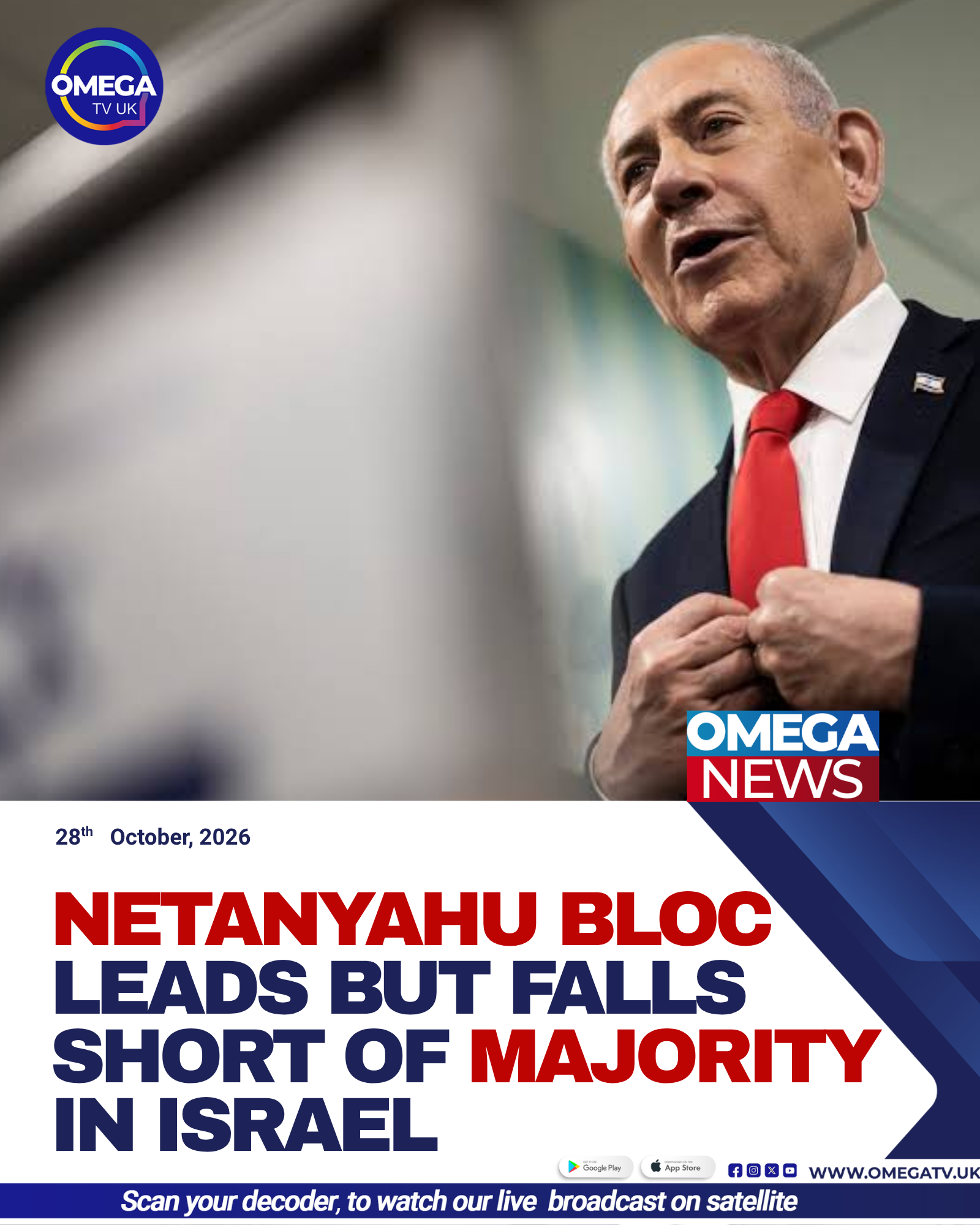
Israeli Prime Minister Benjamin Netanyahu’s political bloc is leading in the country’s general election but remains short of the seats needed to form a majority government, according to partial results published on Wednesday.

With more than 85% of ballots counted following Tuesday’s election, Netanyahu’s right-wing bloc was projected to win 53 of the Knesset’s 120 seats. The opposition bloc led by former military chief Gadi Eisenkot was expected to secure 48 seats, while Arab-led parties were projected to win a record 19 seats.
A minimum of 61 seats is required to secure a parliamentary majority, leaving neither of the main political camps with a clear route to forming a government. The figures remain provisional as additional votes are counted. <Cite refs={[“turn895697view0″,”turn901646news20”]}/>
Netanyahu, Israel’s longest-serving prime minister and leader of the Likud party, called for the formation of a strong right-wing government following the vote. His party was expected to emerge as the largest individual political party, despite the wider coalition falling short of a majority.
Eisenkot, meanwhile, argued that voters had chosen a change in leadership and said his camp would work to replace Netanyahu’s government.
The inconclusive result sets the stage for potentially lengthy negotiations as political leaders attempt to assemble a coalition capable of governing the country.
Arab-led parties gain record representation
One of the most significant developments in the election was the performance of parties representing Israel’s Arab minority, whose combined representation was projected to reach 19 seats.
The result could give Arab-led parties considerable influence in negotiations between the main political blocs, particularly if neither side can secure enough support from its existing allies.
Yousef Jabareen, head of the Arab-majority Joint List, said parties seeking an alternative to Netanyahu would need to engage with Arab political representatives.
However, cooperation remains uncertain. Eisenkot has been reluctant to form an alliance with Arab-led parties, while Netanyahu has campaigned against an opposition government that depends on their support.
Some figures within Eisenkot’s broader camp have called for closer cooperation, leaving the question of whether the Arab parties can translate their electoral gains into political influence unresolved.
The country’s president, Isaac Herzog, has urged political leaders to remain open to negotiations and avoid another election. Under Israel’s parliamentary system, the president plays a key role in selecting the candidate tasked with forming a government.
Netanyahu and Eisenkot claim different mandates
During the campaign, Netanyahu called on voters to support a strong right-wing administration, highlighting his government’s security policies and international relationships.
His Likud party’s position as the largest individual party gives him a significant role in the post-election negotiations, but the wider bloc’s seat count presents a challenge.
Eisenkot, a former chief of staff of the Israel Defense Forces, campaigned on changing the country’s political leadership. He has argued that the election result reflects a desire for a different direction.
The vote was the first national election since the Hamas-led attacks on Israel on 7 October 2023, which triggered Israel’s subsequent military campaign in Gaza and wider regional conflict.
Security, the handling of the war, national leadership and relations with international partners were among the major issues facing voters.
Coalition negotiations ahead
The partial results leave Israel facing uncertainty over the composition of its next government. Netanyahu’s bloc could seek additional partners, while Eisenkot’s camp may explore arrangements involving smaller parties and independent parliamentary support.
Arab-led parties could become influential in negotiations, although their participation in a governing coalition is far from certain.
If neither side can assemble a workable majority, negotiations could continue for weeks, and another election may become a possibility.
For now, the final allocation of seats and the decisions made by party leaders will determine the next stage of Israel’s political process.