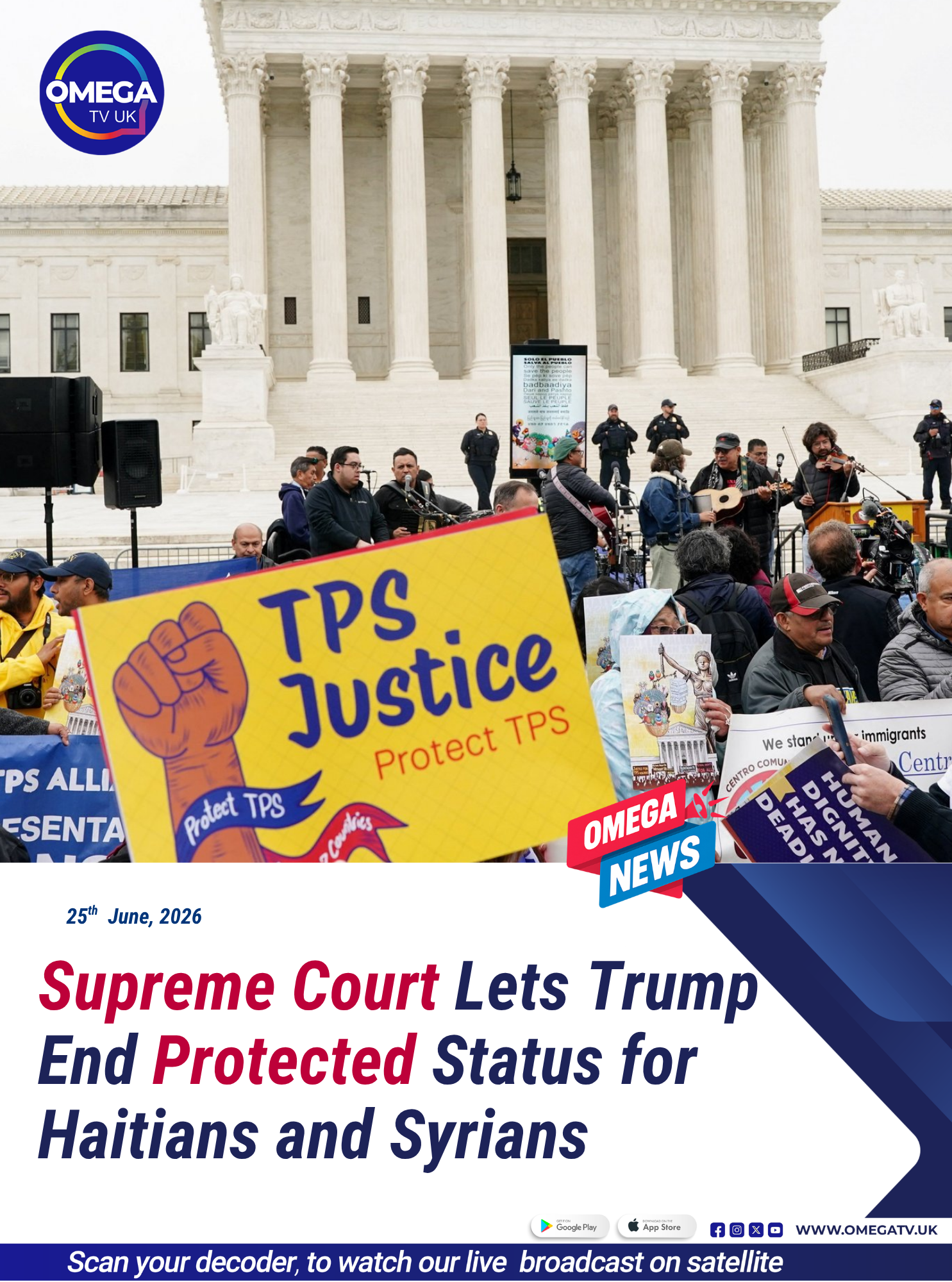
The US Supreme Court has ruled that the Trump administration can proceed with ending Temporary Protected Status (TPS) for hundreds of thousands of Haitian and Syrian migrants, marking a major victory for the government in a closely watched immigration case.

In a 6–3 decision, the court overturned lower court rulings that had blocked the termination of protections for approximately 350,000 Haitians and 6,100 Syrians who have been allowed to live and work in the United States for years due to instability in their home countries.
TPS is a humanitarian program that grants temporary legal status to people from countries affected by war, natural disasters or other extraordinary conditions that make safe return impossible. Under the program, recipients are protected from deportation and are permitted to work legally in the US while conditions in their home countries remain unsafe.
The United States first granted TPS to Haitian nationals following the devastating 2010 earthquake, while Syrians were added after the outbreak of civil war in 2012. The latest ruling now opens the door for the Trump administration to begin reversing these protections, potentially affecting some of the longest-standing TPS communities in the country.
The court’s majority opinion, written by Justice Samuel Alito, argued that the law governing TPS gives broad authority to the executive branch and limits judicial review of such immigration decisions. He also stated that claims alleging discriminatory intent were unlikely to succeed under constitutional equal protection standards.
The three liberal justices dissented strongly. Justice Elena Kagan argued that the decision appeared to be influenced by racial considerations, pointing to public statements made during Trump’s political campaign about Haitian migrants. She suggested that such rhetoric raised serious constitutional concerns about equal protection under the law.
Immigrant advocacy groups have warned that the ruling could have severe humanitarian consequences. Jill Habig, CEO of the Public Rights Project, said the decision places “hundreds of thousands of people at risk,” warning that families could be separated and communities destabilised if deportations proceed.
The ruling is expected to have broader implications for other TPS-designated nationalities, potentially reshaping how the United States handles long-term humanitarian migration protections in the future.
In a separate but related ruling, the Supreme Court also sided with the Trump administration on asylum policy at the US–Mexico border. In another 6–3 decision, the court held that migrants cannot apply for asylum unless they have physically entered US territory.
The majority opinion, again delivered by Justice Alito, stated that in “ordinary speech” a person cannot be said to have arrived in a country before physically entering it. The decision effectively supports the administration’s interpretation that migrants stopped at the border but not yet on US soil are ineligible to apply for asylum.
Justice Sonia Sotomayor issued a strong dissent, warning that the ruling could have deadly consequences. She argued that restricting asylum access in this way could force more migrants to attempt dangerous crossings, increasing the risk of loss of life.
The asylum ruling also revives elements of a 2016 policy that allowed border authorities to limit daily asylum claims when processing capacity was exceeded. That policy had been rolled back under the Biden administration but is now expected to return under the court’s decision.
Together, the two rulings represent a significant expansion of executive authority over immigration enforcement and asylum policy, while raising concerns among human rights advocates about the future of protections for vulnerable migrant communities.