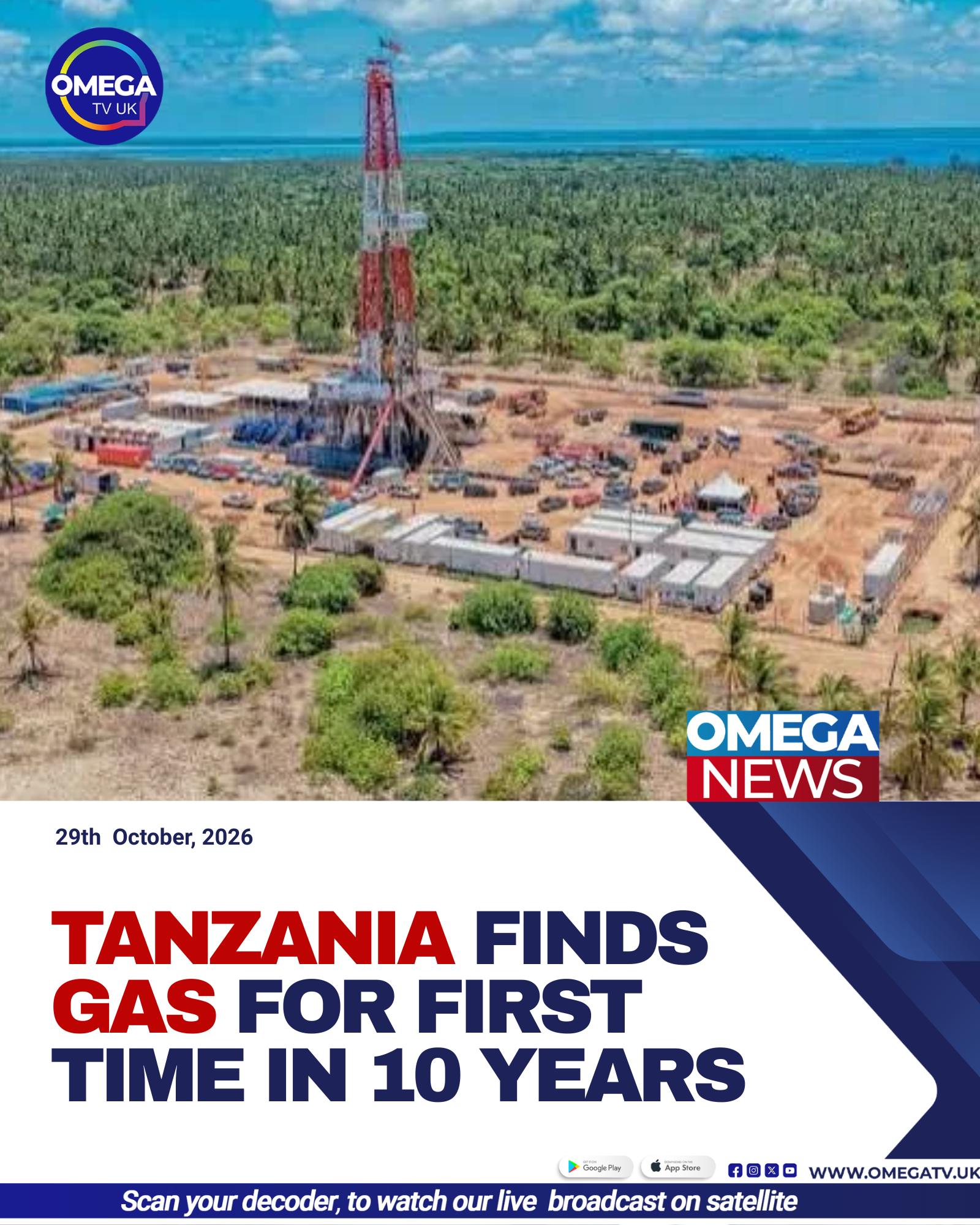
Tanzania Announces First Major Natural Gas Discovery in More Than a Decade
Tanzania has announced a significant natural gas discovery in the Mnazi Bay area in the south of the country, marking its first new find in more than 10 years and raising hopes of increased domestic energy supplies.

The discovery, estimated at 223 billion cubic feet (6.3 billion cubic metres), was announced during a ceremony at the Kasa-1X ST2 well attended by Energy Minister Juma Homera.
The well is jointly owned by Tanzania Petroleum Development Corporation (TPDC), the state-owned energy company, and French oil and gas firm Maurel & Prom.
Homera described the discovery as a major milestone for Tanzania’s energy industry, saying it could help the country meet growing demand for affordable and reliable energy as industrial activity and other economic sectors expand.
Production from the new well is expected to begin in early November, with the gas intended primarily to strengthen domestic supplies.
Boost for Tanzania’s energy sector
Tanzania already has estimated natural gas reserves of 57.54 trillion cubic feet, making the resource an important part of its energy mix.
According to government statistics for 2024, natural gas accounted for nearly 80% of the country’s electricity generation. The latest discovery could therefore help reinforce the role of gas in powering homes, businesses and industries.
Homera said the find would contribute to the government’s objective of providing reliable, clean and safe energy at affordable prices.
Growing industrial activity and rising energy demand have increased pressure on Tanzania to strengthen its generation capacity and maintain dependable supplies. The additional gas could provide further support for electricity production and other domestic energy needs.
However, the scale of its impact will depend on production levels, infrastructure capacity and how the resource is developed and supplied to consumers.
Natural gas use expands beyond electricity
Tanzania has also been encouraging the use of compressed natural gas (CNG) as an alternative fuel for vehicles.
Natural gas filling stations and processing facilities have been established mainly in Dar es Salaam, the country’s largest city, where some motorists have converted their vehicles to dual-fuel systems.
The use of locally available gas can offer motorists a potentially cheaper alternative to petrol, depending on conversion costs and fuel prices.
Expanding domestic gas production could support these initiatives while helping reduce reliance on more expensive imported fuels.
A history of gas exploration
Tanzania’s natural gas industry dates back to 1974, when the country made its first discovery on Songo Songo Island in the southeastern Lindi Region.
A second discovery followed in 1982 at Mnazi Bay, in the neighbouring Mtwara Region. Commercial development began in 2004, paving the way for further exploration onshore and offshore.
One of the country’s largest discoveries came in 2016, when a deposit estimated at 2.7 trillion cubic feet was identified.
The latest find adds to this established resource base and provides renewed momentum for exploration in the country’s southern energy-producing regions.
Prospects for economic growth
The discovery comes as Tanzania seeks to expand its energy capacity and support wider economic development. Increased domestic gas production could help strengthen electricity supplies, support industrial activity and create opportunities across the energy sector.
TPDC’s involvement also gives the state-owned corporation a direct role in developing the resource alongside its private-sector partner, Maurel & Prom.
The expected start of production in early November will be an important next step in determining how quickly the new discovery can contribute to the country’s energy needs.
For Tanzania, the find represents another opportunity to develop its natural resources, improve energy security and support growing demand from households and businesses.