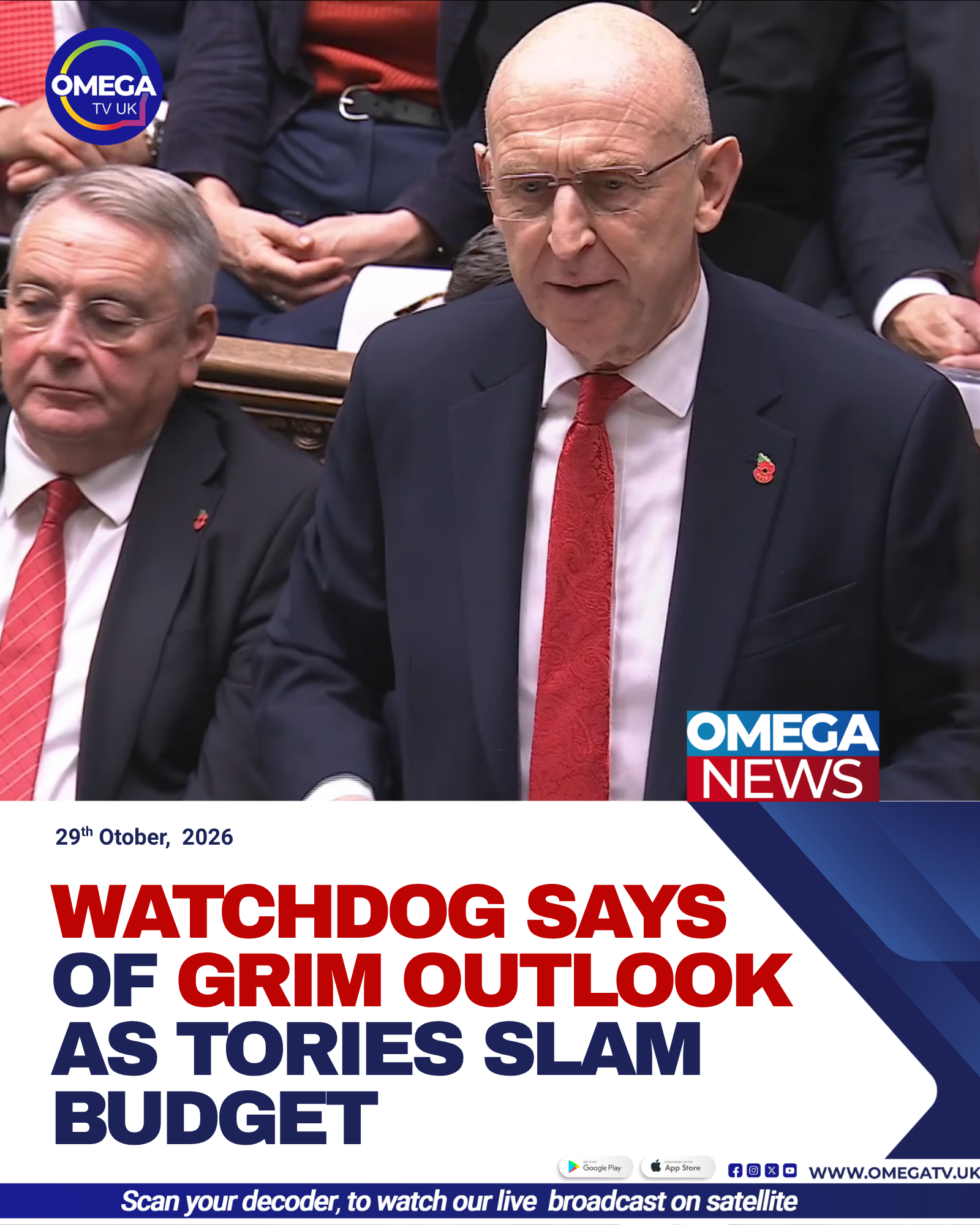
Tories Criticise ‘Disjointed’ Budget as Watchdog Warns of ‘Pretty Grim’ Economic Outlook
The UK Conservative Party has criticised Chancellor John Healey’s first Budget, describing it as “disjointed”, as the Office for Budget Responsibility (OBR) warns that the country faces a difficult economic outlook, with weak growth and pressure on household incomes.

Shadow chancellor Andrew Griffith told BBC Radio 4’s Today programme that the public finances were not in good shape and identified welfare spending as one of the biggest areas requiring government attention.
His criticism followed Wednesday’s Budget, which introduced measures to support households facing rising living costs while raising taxes on some savings and rental income.
The economic assessment from the OBR added to the political pressure on the government. The independent watchdog warned that the outlook for living standards was a “pretty grim picture”, citing the effects of higher energy prices, weaker growth and rising borrowing costs. <Cite refs={[“turn834806news28″,”turn834806news25”]}/>
Conservatives question government spending
Griffith argued that welfare spending had become an increasingly significant challenge for the public finances, accusing the government of failing to provide a convincing plan to control the benefits bill.
The Conservatives have also criticised Labour for prioritising welfare spending while households and businesses continue to face financial pressures.
Healey has defended the government’s approach, promising that the benefits bill will fall before the next general election. He said the government would pursue reforms that help people into employment rather than introduce what he described as crude cuts.
The chancellor has pointed to upcoming reviews of disability benefits and support for young people who are not in education, employment or training as important parts of the government’s longer-term plans.
However, critics say the lack of detailed proposals in the Budget leaves unanswered questions about how spending will be reduced and how vulnerable people will be supported.
OBR warns of weak growth and living standards
The OBR’s latest forecasts paint a challenging picture for the UK economy.
The watchdog expects economic growth to slow to 1% in 2027, down from its previous forecast of 1.5%. It also expects real household disposable income per person to fall in the near term as households face the effects of higher prices.
Professor David Miles of the OBR described the outlook for real household disposable income as “pretty grim”, noting that there had been virtually no growth per person since before the Covid pandemic.
Higher energy costs, linked partly to the conflict in the Middle East, have contributed to the deterioration in the outlook. The increase in borrowing costs has also placed additional pressure on public finances.
The forecasts suggest the government will have limited room to manoeuvre if economic conditions worsen further.
£100 energy payment offers some relief
Healey’s Budget includes a one-off £100 energy payment for around 20 million households in England living in council tax bands A to D. Wales and Scotland have also indicated plans to provide equivalent support.
The government says the payment will offer some breathing space for households during the winter, although critics question whether it will be sufficient to offset rising energy bills.
Other measures include plans to abolish gas standing charges during 2027, while shifting those costs into the price paid for each unit of energy consumed.
The Budget also raises taxes on certain savings and rental income, alongside increased taxes on banks to help fund the support package.
Healey has acknowledged that the government cannot completely remove the cost-of-living pressures facing households, particularly when energy prices remain affected by international events.
Pressure grows over future decisions
The Liberal Democrats have argued that welfare reform should focus on helping people into work while providing the care and support needed by those unable to do so.
The Institute for Fiscal Studies has also warned that the government still faces difficult decisions concerning disability benefits, young people’s support and future public spending.
With economic forecasts deteriorating and the government’s financial room for manoeuvre narrowing, the Budget has intensified debate over how Labour plans to balance household support with control of public spending.