
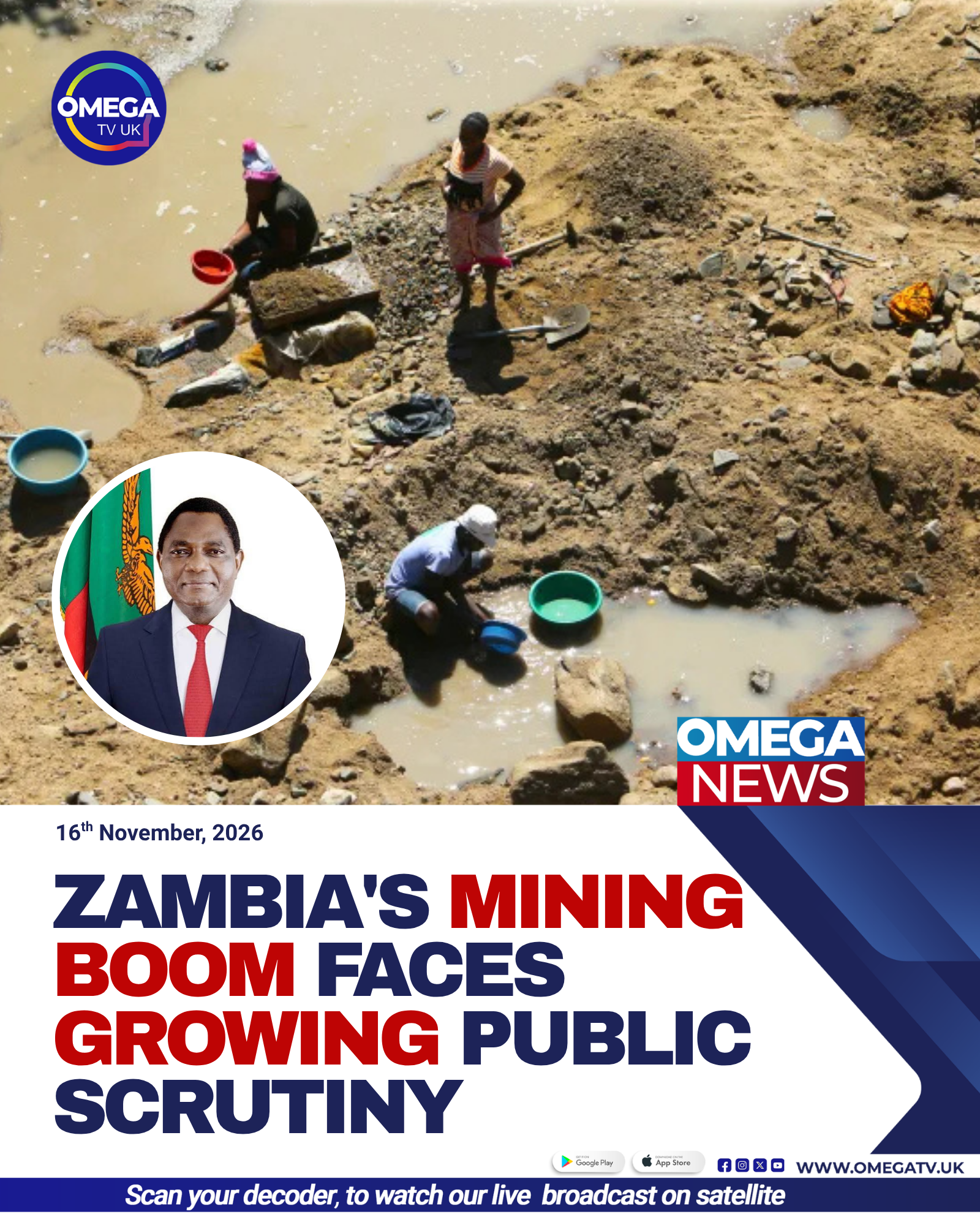
Zambia’s mining sector has attracted more than $12bn in investment since 2022, but concerns are growing over whether ordinary citizens are benefiting from the country’s expanding mineral wealth.

President Hakainde Hichilema says the investments reflect renewed confidence in the country’s mining industry as the government seeks to increase copper production and strengthen Zambia’s position in the global energy transition.
Major investors include Canada’s First Quantum Minerals and Barrick Mining Corporation, India’s Vedanta Resources and China’s China Nonferrous Metal Mining Group.
Abu Dhabi-based International Resources Holding has also committed $1.1bn to recapitalise Mopani Copper Mines, securing a 51 per cent stake. State-owned ZCCM Investments Holdings retains the remaining 49 per cent.
The government aims to increase annual copper production to three million tonnes by 2031, from less than one million tonnes in recent years.
It is also investing in geological exploration through a nationwide aerial geophysical survey, which the Ministry of Mines and Minerals Development says is approximately 98 per cent complete.
Beyond expanding production, Zambia wants to develop domestic mineral processing and manufacturing capacity to capture more value from its natural resources.
Hichilema says Zambia and the Democratic Republic of Congo are exploring cooperation with South Africa to develop an electric vehicle battery manufacturing industry.
The proposed partnership would enable the three countries to combine their respective mineral resources and industrial capabilities to support electric vehicle production.
However, the investment boom has raised questions about employment conditions, environmental protection and the distribution of mining revenues.
Stephen Mwaanga, secretary of the National Union of Miners and Allied Workers, says increased investment and higher copper prices have not translated into better conditions for mineworkers.
He told Al Jazeera that workers continue to experience difficult employment conditions despite the industry’s expansion.
Mining operations are also facing challenges from higher production costs and electricity shortages. Drought conditions have affected Zambia’s hydropower-dependent electricity supply, increasing pressure on the industry.
Environmental concerns have added to the challenges.
In February 2025, a tailings dam failure at Chinese-owned Sino-Metals Leach Zambia released acidic, metal-laden mining waste into the Chambishi Stream.
The pollution spread into the Mwambashi and Kafue river systems, raising concerns about water quality, aquatic life and communities dependent on the affected waterways.
Human rights defender Eugene Mulenga has warned that expanding mining activities could further threaten communities whose livelihoods depend on local water resources.
Meanwhile, the government has introduced local-content regulations requiring mining companies to allocate at least 20 per cent of their annual procurement budgets for core mining goods and services to local suppliers in 2026. The requirement is scheduled to increase to 25 per cent after one year.
The policy aims to strengthen domestic businesses and ensure more mining-related spending remains within Zambia.
As the country pursues its ambition to become a major supplier of critical minerals, the challenge will be ensuring that increased investment delivers better jobs, stronger local industries and environmental protection.


