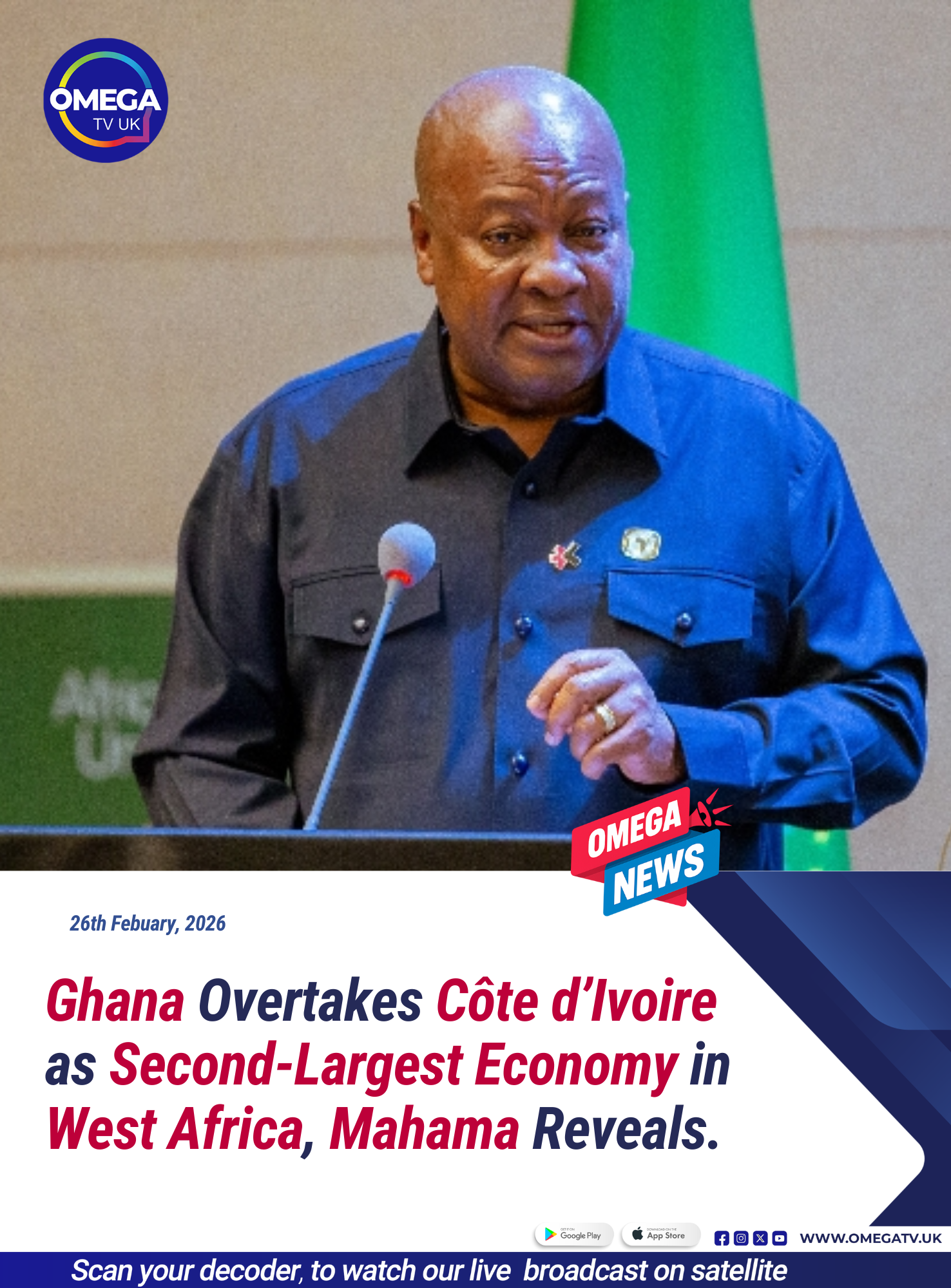
President John Dramani Mahama has revealed that Ghana has overtaken Côte d’Ivoire to become the second-largest economy in West Africa. Speaking at a recent economic forum, President Mahama highlighted this milestone as a reflection of sustained economic growth, sound policy measures, and investment in key sectors.

According to official data, Ghana’s Gross Domestic Product (GDP) has grown significantly over recent years, driven by expansion in manufacturing, services, agriculture and energy. The president attributed the achievement to initiatives aimed at industrialization, infrastructure development, and local value addition in sectors such as mining, cocoa processing, and manufacturing.
President Mahama also emphasized that strengthening domestic revenue mobilization, reducing dependency on imports, and creating employment opportunities have been central to the country’s economic transformation. By overtaking Côte d’Ivoire, Ghana now ranks just behind Nigeria in the West African economic hierarchy, signaling the country’s rising influence in the regional market.
Economic analysts noted that Ghana’s strategic focus on industrial projects, export diversification, and foreign investment has contributed significantly to this growth. Initiatives such as the recent launch of the $250 million float glass manufacturing plant in Shama, industrial parks, and incentives for local entrepreneurs have all bolstered production and increased economic output.
The government also credits its efforts in financial management, currency stabilization, and improving the business environment for attracting investors. By implementing reforms that encourage private-sector growth and enhance productivity, Ghana has strengthened its position as a regional hub for trade and industry.
While the announcement is a source of national pride, President Mahama highlighted the need to maintain momentum through continued policy discipline, investment in human capital, and strategies to mitigate global economic challenges. He underscored that the goal is not just to grow the economy but to ensure that growth is inclusive, sustainable, and translates into tangible improvements in citizens’ living standards.
Regional leaders and economic observers have welcomed Ghana’s advancement, noting that it reflects the dynamic nature of West Africa’s economies and the potential for African countries to achieve rapid economic transformation through strategic planning and investment.
Ghana’s rise as the second-largest economy in West Africa is expected to attract further international interest, expand trade partnerships, and increase the country’s influence in regional economic forums such as ECOWAS.