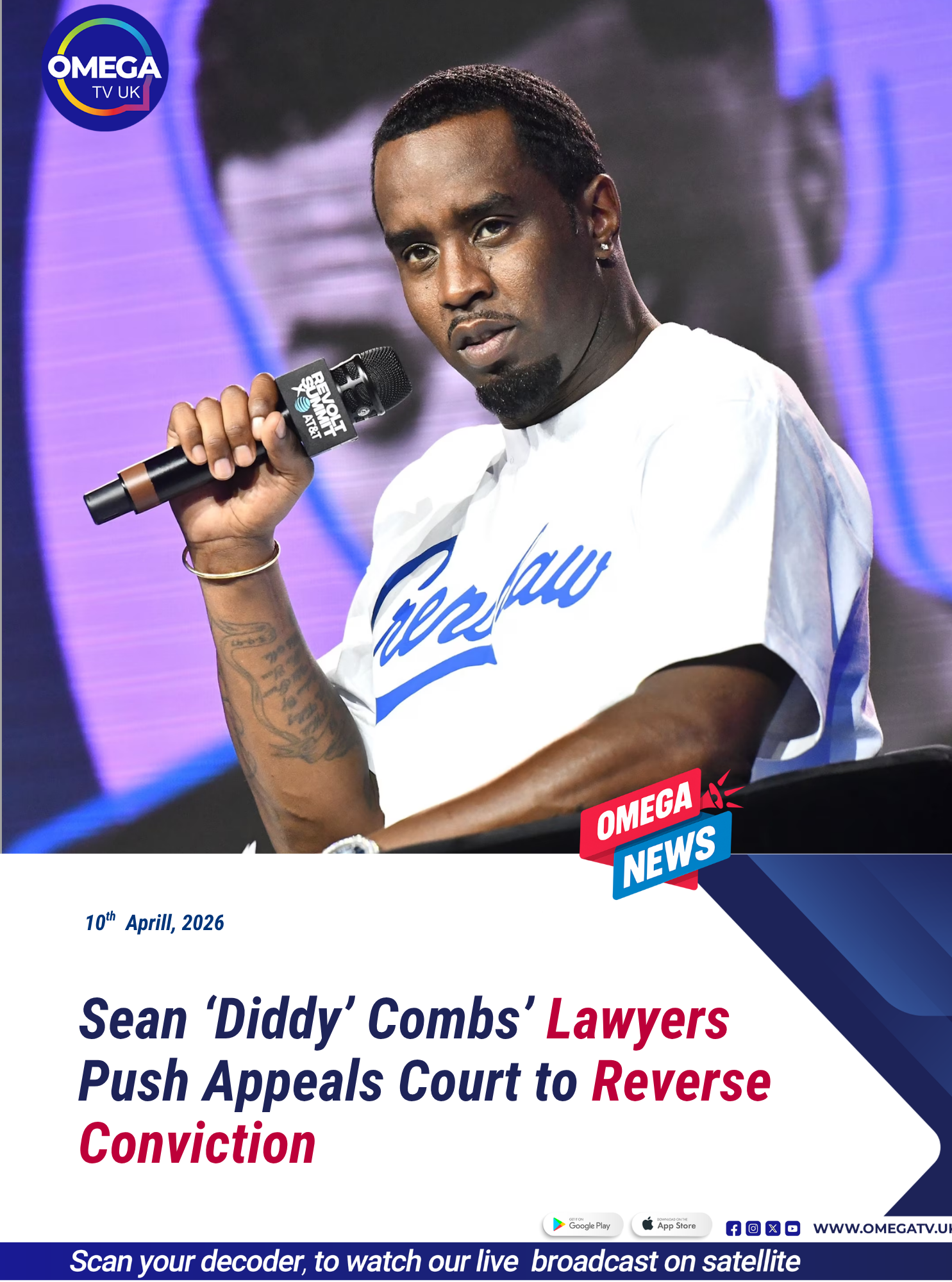
Diddy’s lawyers urge US court to overturn prison sentence

Lawyers for hip hop mogul Sean Combs have urged a federal appeals court in the United States to overturn his conviction and four-year prison sentence tied to prostitution-related charges.
The case was heard by a three-judge panel at the 2nd US Circuit Court of Appeals in Manhattan, where judges listened to nearly two hours of arguments but did not immediately issue a ruling.
During proceedings, Circuit Judge William J. Nardini described the case as “exceptionally difficult,” noting that it raises complex legal questions that could have wider implications for federal courts.
Combs’ lawyer, Alexandra Shapiro, argued that the sentencing judge improperly considered elements of charges for which Combs had been acquitted. She claimed the four-year sentence was unusually harsh compared to similar cases involving defendants with comparable criminal histories.
However, Assistant US Attorney Christy Slavik disputed that claim, telling the court the sentence was actually below federal sentencing guidelines and consistent with other rulings in the same jurisdiction.
Combs was convicted last July under the Mann Act, which prohibits transporting individuals across state lines for illegal sexual activity. He was acquitted of more serious charges, including sex trafficking and racketeering, which could have resulted in a life sentence.
At sentencing, Judge Arun Subramanian stated that while Combs was being punished only for the charges of conviction, the court was legally permitted to consider his broader conduct and personal history.
Combs, 56, has been in federal custody in New Jersey since his arrest in September 2024. According to authorities, he is currently scheduled for release in April 2028.
His legal team is seeking either a full reversal of the conviction or a reduced sentence through resentencing.
One argument raised in written filings—but not discussed extensively during Thursday’s hearing—relates to claims that some of the conduct in question should be protected under the First Amendment. His lawyers argued that certain recorded encounters amounted to consensual adult content.
Much of the courtroom discussion instead focused on whether the judge improperly relied on allegations involving fraud and coercion that the jury ultimately rejected.
The trial drew widespread attention, offering a detailed look into the private life of one of the most influential figures in the music industry. Testimony included allegations of violence, drug use, and orchestrated sexual encounters, described by witnesses as “freak-offs” or “hotel nights.”
Combs did not testify during the trial. His defense acknowledged aspects of his personal behavior but maintained that prosecutors overreached by attempting to criminalise private conduct.
The appeals court’s decision is now awaited, with the outcome likely to have significant implications not only for Combs but also for how similar cases are handled in the future.