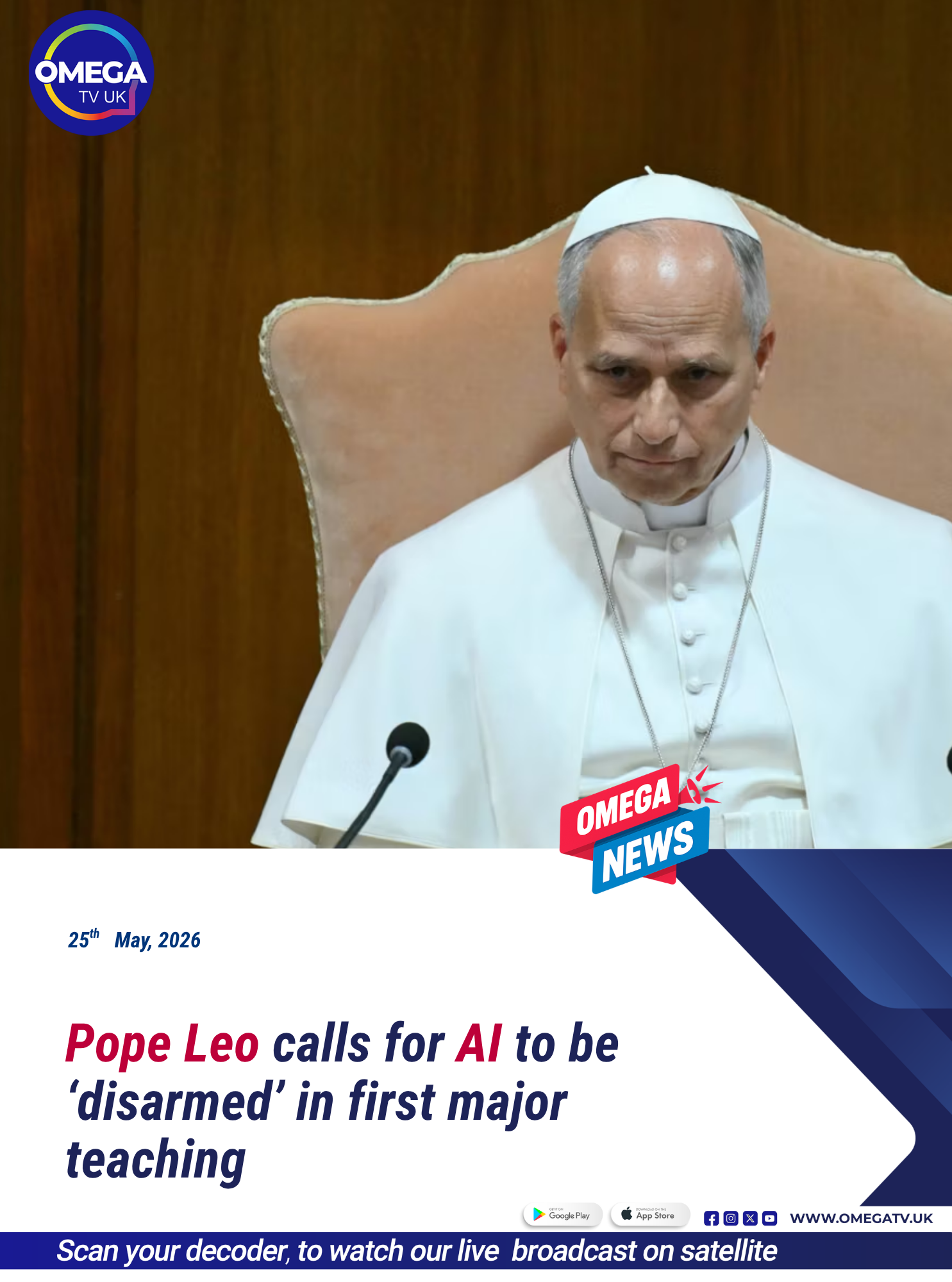
Pope Leo has released the first major teaching document of his papacy, warning that artificial intelligence must be “disarmed” before it poses deeper threats to humanity.

The encyclical, titled Magnifica Humanitas, addresses the ethical, political and social dangers linked to the rapid growth of AI technology. Speaking at the Vatican during the document’s presentation, the Pope acknowledged the strength of his language but defended it as necessary.
“The word is strong, I know, but deliberately chosen because this moment needs words capable of attracting attention,” he said.
Although the document focuses heavily on artificial intelligence, it also contains one of the Vatican’s most comprehensive apologies for the Catholic Church’s historical role in slavery. The Pope wrote that it was “impossible not to feel deep sorrow” over the suffering endured by enslaved people and said he “sincerely asked for pardon” on behalf of the Church.
Drawing parallels between slavery and modern technological exploitation, Pope Leo warned of the dangers of what he described as “new digital slaveries”. He suggested that unchecked AI systems risk normalising exploitation through both their development and practical applications.
The Pope also strongly criticised the use of AI in warfare, warning against an artificial intelligence arms race and condemning the increasing automation of military decisions.
“No algorithm can make war morally acceptable,” he wrote, arguing that AI-driven warfare risks lowering the threshold for violence and reducing human lives to data points.
Beyond warfare, the encyclical also raised concerns about AI’s influence on politics, misinformation and digital manipulation. Pope Leo warned that AI-generated images, videos and biased systems could distort public understanding and deepen social divisions.
The Vatican unusually chose to present the document alongside leading AI experts, including Christopher Olah, co-founder of Anthropic. Olah acknowledged that AI companies often face pressures that can conflict with ethical decision-making.
The Pope also issued a direct appeal to AI developers, stating that every technological design choice reflects a broader vision of humanity and carries ethical responsibility.
Pope Leo compared the current moment in AI development to the Industrial Revolution, arguing that society must act early to protect human dignity before harmful systems become deeply embedded.
The Vatican has since announced the creation of a commission to continue work on AI ethics and policy, though questions remain over how much influence the Church can exert as technology advances rapidly worldwide.