
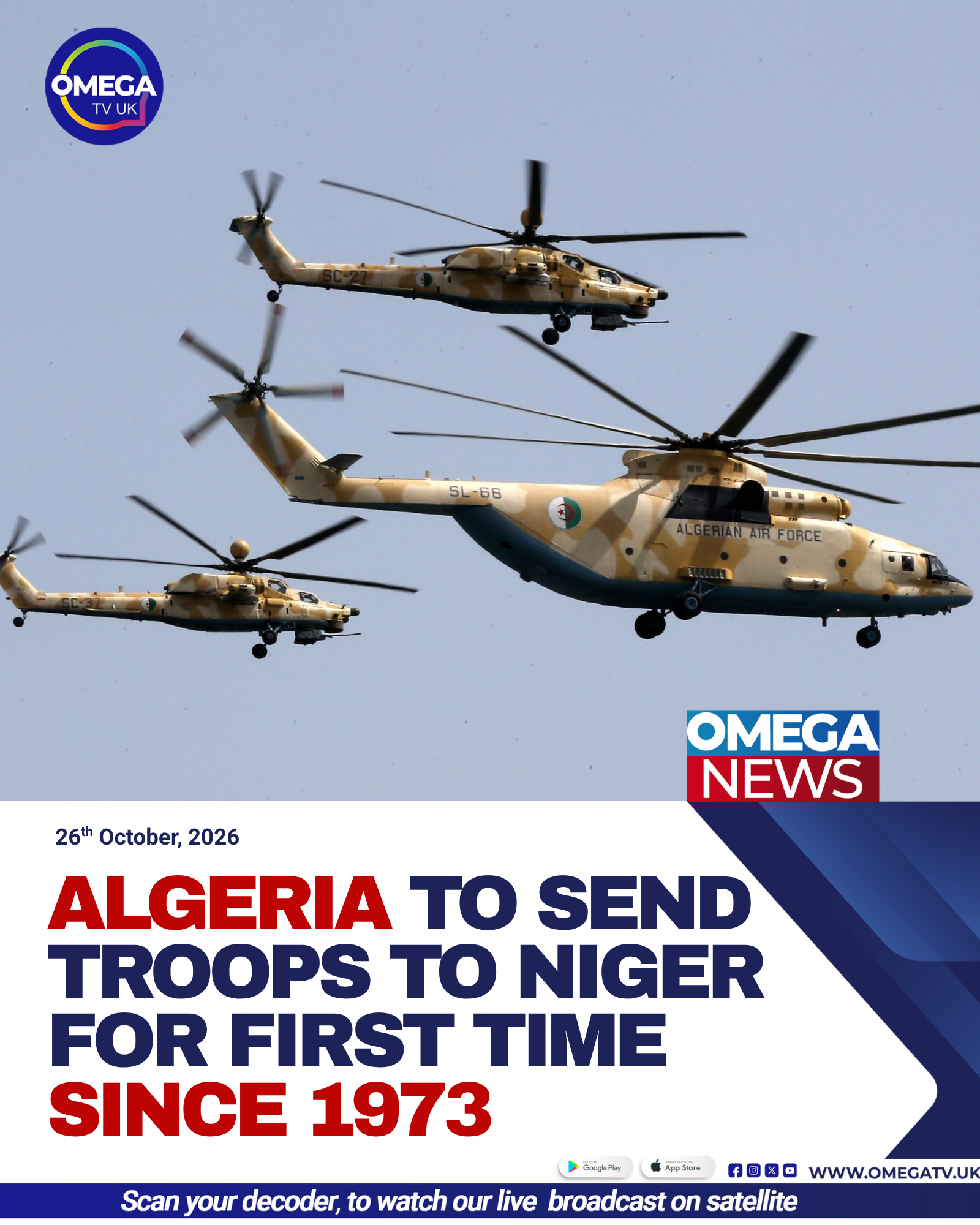
Algeria to Send Troops to Niger in First Foreign Deployment Since 1973
Algeria has approved the deployment of military troops to neighbouring Niger for the first time in more than five decades, marking a significant shift in its long-standing policy against overseas military operations.

The decision was approved by both chambers of Algeria’s parliament on Sunday, 25 October, following discussions on security cooperation between the two countries. President Abdelmadjid Tebboune ordered the deployment on Monday, with the troops expected to protect energy facilities and other strategic economic infrastructure in northern Niger.
The move would mark Algeria’s first foreign military deployment since it sent soldiers to support Egypt during the 1973 Arab-Israeli war.
The deployment follows a visit to Algiers by Niger’s Defence Minister Salifou Mody, who sought greater military support as his country continues to face attacks by armed groups, including organisations linked to al-Qaeda and the Islamic State group.
The troops are expected to operate around Madama, in northern Niger near the Libyan border. However, authorities have not announced the number of soldiers involved or when they will begin their mission.
Focus on protecting economic interests
Algeria’s decision is closely linked to its economic interests in Niger, particularly energy infrastructure and plans for a major trans-Saharan gas pipeline.
The proposed pipeline would transport natural gas from Nigeria through Niger to Algeria, creating a route for exports to international markets, particularly Europe.
Algeria’s state-owned energy company, Sonatrach, has also signed an agreement with Niger’s petroleum ministry to explore for oil in the Kafra region. Reports cited by Reuters estimate that two exploration wells could contain 168 million and 100 million barrels of oil respectively.
Algerian senator Belkacem Boulghiti said the deployment was intended to secure economic infrastructure rather than wage war in Niger.
“We are not sending our soldiers to wage war in Niger, but for a mission to secure economic infrastructure,” he said after the parliamentary vote.
The mission reflects growing concerns over the security of energy investments as armed groups continue to operate across parts of the Sahel region.
Relations improve after diplomatic tensions
Algeria and Niger have experienced strained relations in recent years, particularly following Niger’s 2023 military coup, which removed elected President Mohamed Bazoum and brought General Abdourahamane Tchiani to power.
Algeria condemned the coup, creating tensions with Niger’s military-led government.
Relations deteriorated further in 2025 after Algeria shot down a Malian drone near its border. Niger subsequently recalled its ambassador to Algiers in solidarity with Mali, a close regional ally.
However, diplomatic and military cooperation has improved during 2026. Tchiani visited Algeria in February, while Algerian authorities provided military support following what they described as an attempt to destabilise Niger’s government in August. Algeria also donated four military helicopters to Niger.
The latest deployment decision represents another step towards closer security cooperation between the neighbours.
A major shift in military policy
Algeria has traditionally opposed sending its armed forces on operations outside its borders. However, a constitutional amendment adopted in 2020 created a legal framework allowing overseas military deployments with parliamentary approval.
The latest decision marks a significant use of that provision and signals a change in how Algeria approaches regional security threats.
Niger, alongside neighbouring Mali and Burkina Faso, continues to face attacks by armed groups operating across the Sahel. These attacks have contributed to widespread insecurity, displacement and pressure on regional governments.
Algeria’s proposed deployment is intended to protect shared strategic interests while strengthening cooperation with Niger’s authorities. The scale and timing of the operation remain unclear as both countries prepare for the next stage of their security partnership.


