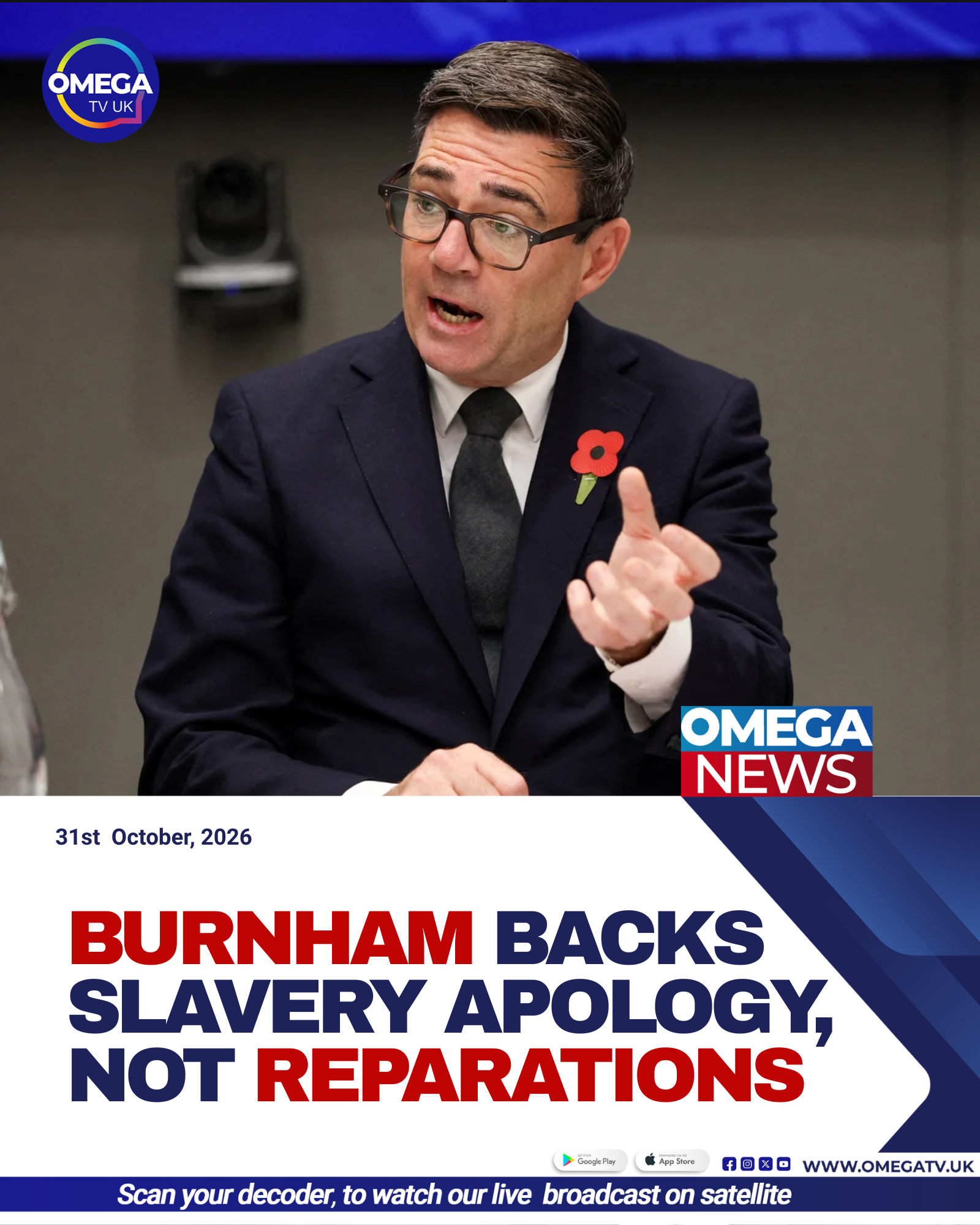
Burnham Open to Slavery Apology but Rules Out Reparations
British Prime Minister Andy Burnham has said he is open to calls for the United Kingdom to formally apologise for its role in the transatlantic slave trade, but has ruled out financial reparations.

Burnham said his government was prepared to begin structured discussions with communities and countries affected by the trade, adding that listening to calls for an official apology would form an important part of the process.
Describing the slave trade as a “brutal and barbaric violation”, he said Britain must confront its history and acknowledge the suffering inflicted on millions of Africans who were forcibly transported to the Americas.
However, the Prime Minister rejected demands for financial compensation, arguing that people living in Britain today should not be held responsible for historical wrongs in which they had no personal involvement.
His comments were welcomed by the All-Party Parliamentary Group for Afrikan Reparations. Its chair, Bell Ribeiro-Addy, told BBC Radio 4’s Today programme that the issue of reparatory justice was not solely about money.
Barbados Prime Minister Mia Mottley also welcomed Burnham’s willingness to consider an apology, while making clear that her country would continue to pursue reparatory justice.
However, Denis O’Brien, founder of The Repair Campaign, said the Prime Minister’s position was disappointing and did not go far enough.
He argued that the British government should issue a full and formal apology, describing it as an important symbolic step towards addressing the lasting consequences of slavery.
The debate comes ahead of next week’s Commonwealth leaders’ summit in the Caribbean, where Britain is expected to face renewed calls to acknowledge its historical role in the slave trade.
The calls have intensified during King Charles III’s Caribbean tour. During his visit to the Bahamas, the King referred to the suffering and injustices of the past. In Guyana, he also visited a site connected to the 1823 rebellion by enslaved people against British colonial authorities.
The transatlantic slave trade began centuries ago, with English authorities and the monarchy playing prominent roles from the 16th century. Millions of Africans were captured, transported and forced into slavery across the Americas.
Britain later became involved in efforts to abolish the trade, with Parliament passing legislatio