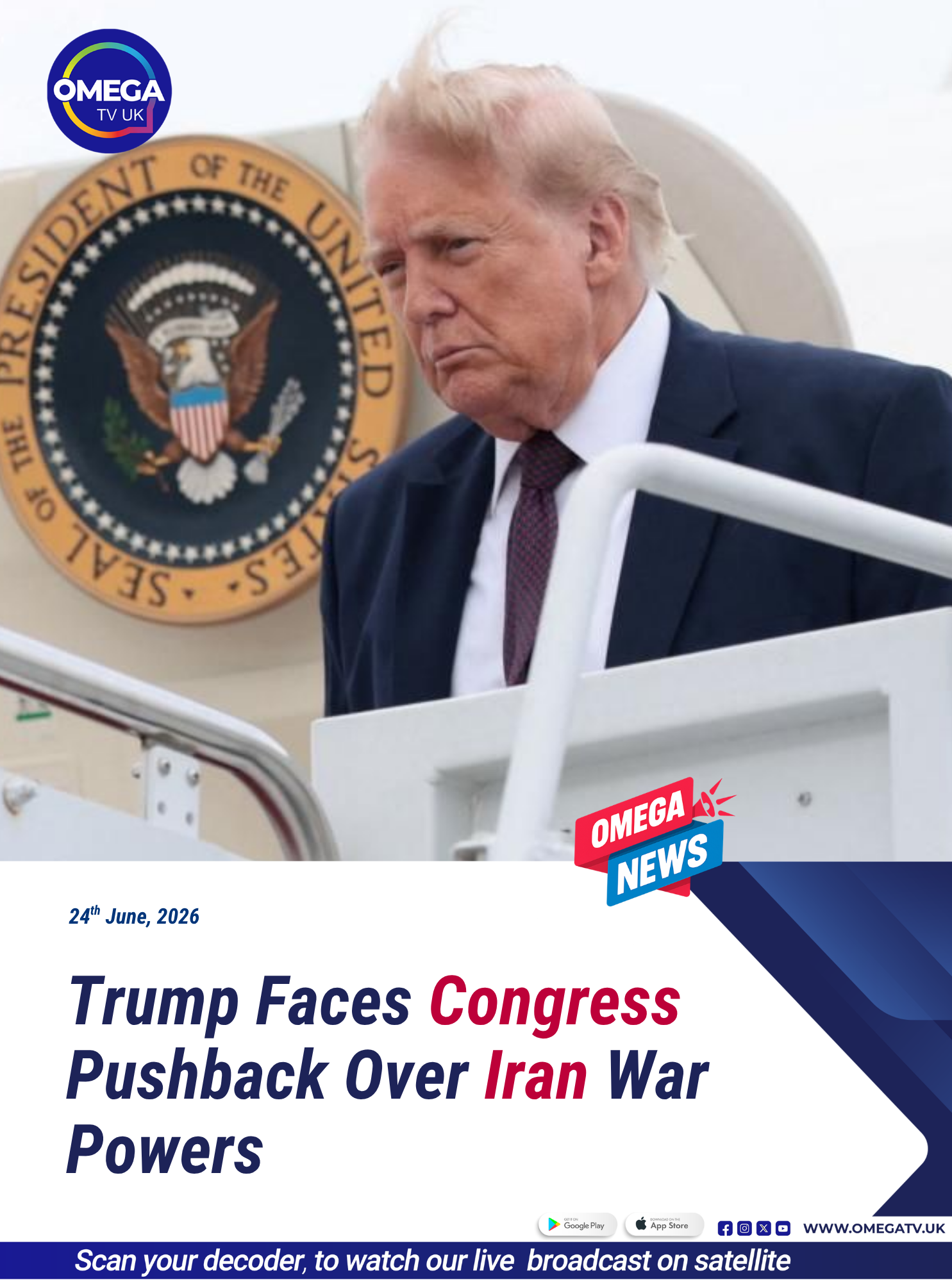
Trump Faces Rare Congressional Pushback as Senate Moves to Restrict Iran War Powers
The Republican-controlled US Senate has approved a war powers measure requiring President Donald Trump to halt military action in Iran or obtain congressional approval before continuing, marking a rare moment of resistance from lawmakers within his own party.

The resolution, passed in a narrow 50–48 vote, carries largely symbolic weight but signals growing unease in Congress over the direction of US involvement in the Iran conflict. A small group of Republicans joined Democrats in supporting the measure, which mirrors legislation already passed by the House of Representatives earlier this month.
The vote comes amid escalating political tension over a US-led military campaign in Iran that is now approaching its fifth month. While the measure does not have the force of law, it represents one of the most significant public challenges to presidential war authority in recent years.
President Trump strongly rejected the Senate’s decision, calling it “poorly timed and meaningless” in a post on his Truth Social platform. He argued that lawmakers were undermining his strategy at a critical moment, insisting that his administration was close to achieving its objectives in Iran.
The resolution demands that any continued military engagement in Iran must be explicitly authorised by Congress, reflecting the intent of the War Powers Resolution of 1973, which was designed to limit unilateral presidential military action. However, experts note that similar congressional efforts in the past have rarely forced a change in presidential policy.
Legal scholars describe the measure as politically significant but not legally binding. Middle East analyst Laura Blumenfeld characterised it as “more of a slap on the wrist than a handcuff,” noting that it reflects congressional sentiment more than enforceable authority.
Despite its symbolic nature, the vote highlights growing divisions within the Republican Party. Four Republican senators broke ranks to support the measure: Rand Paul, Lisa Murkowski, Susan Collins, and Bill Cassidy. Democratic Senator John Fetterman was the only Democrat to vote against it.
The House of Representatives passed the same resolution earlier in the month in a 215–208 vote, with a small group of Republicans joining Democrats in approval. However, White House officials dismissed the measure, arguing that it is irrelevant due to a ceasefire agreement reached earlier in April and the absence of active hostilities.
The administration also suggested that procedural absences among Republican senators influenced the final result, citing the non-participation of Mitch McConnell and Dave McCormick.
While Congress has occasionally challenged presidential war authority, experts say such coordinated opposition across both chambers is rare. This marks the first time since the War Powers Resolution was enacted that both the House and Senate have passed a concurrent resolution seeking to end or restrict a military operation.
Political analysts say the vote may have more impact on domestic politics than on foreign policy. Michael Glennon, a law professor at Tufts University, described the development as “far more significant politically,” noting that it signals unease within a party that has largely aligned itself with Trump since his return to office.
However, other experts caution against interpreting the vote as a major shift in congressional behaviour. Jonathan Entin of Case Western Reserve University said the move may reflect election-year positioning ahead of the November midterms rather than a sustained break with the president.
The conflict itself remains in a complex phase. A ceasefire agreement between the US and Iran, reached on 7 April, has paused active combat operations, although both sides are continuing negotiations under a broader memorandum of understanding aimed at addressing Iran’s nuclear programme.
Under the agreement, Washington and Tehran have 60 days to work toward a long-term settlement. Meanwhile, the Pentagon has requested approximately $80 billion in funding related to the ongoing military campaign, underscoring the scale of US involvement even as active fighting has slowed.
The war powers vote also comes amid broader Republican divisions on foreign policy, with some lawmakers recently opposing administration-backed funding proposals and supporting alternative aid packages, including assistance for Ukraine.
As the political debate intensifies, analysts say the Senate vote reflects a broader question: how far Congress is willing to assert its constitutional authority over war-making powers in an era of strong executive influence.
For now, the measure is unlikely to change military operations on the ground—but it has exposed growing cracks between the White House and Capitol Hill at a politically sensitive moment.