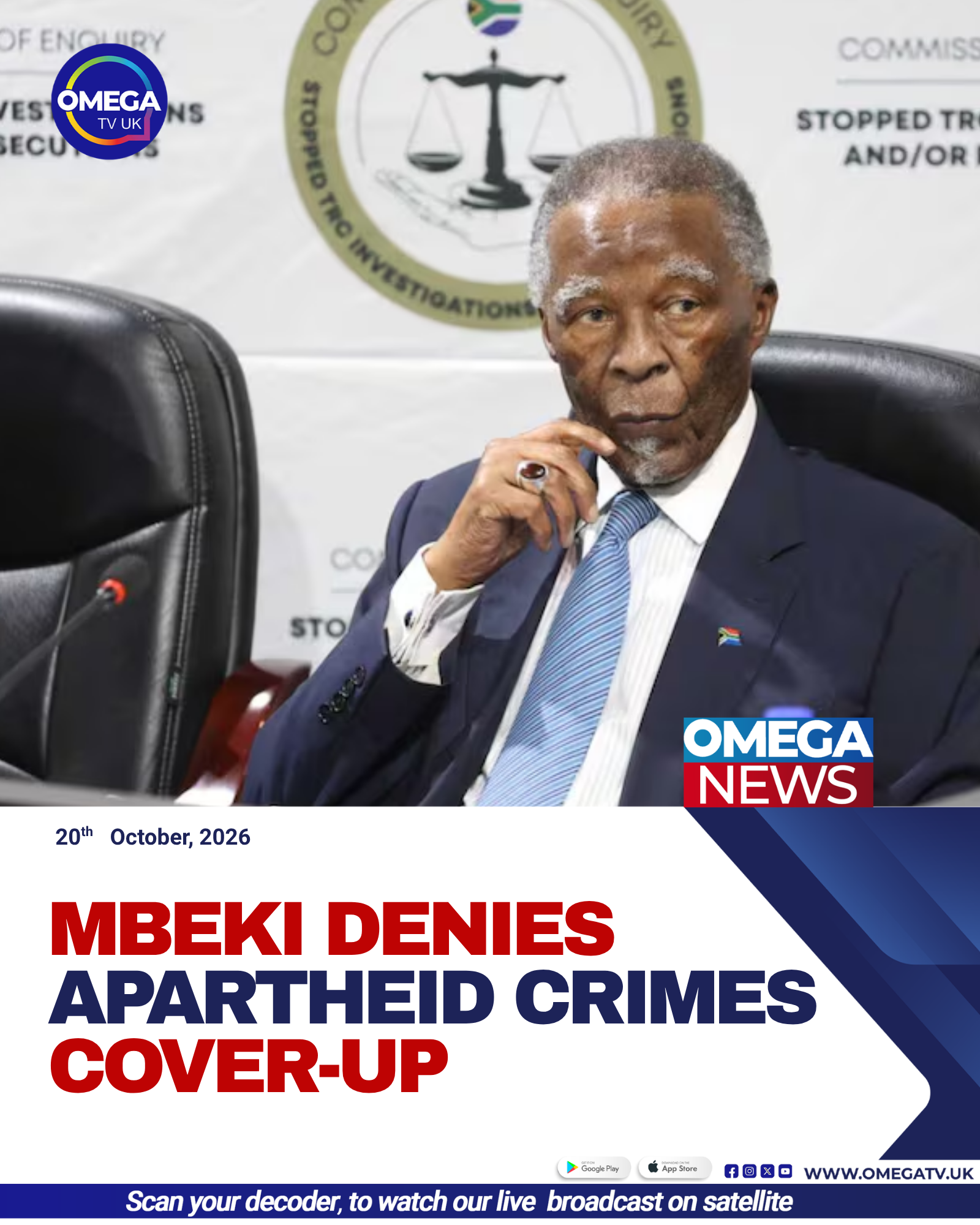
Mbeki Denies Apartheid Crimes Cover-Up
Former South African President Thabo Mbeki has denied ordering prosecutors to halt investigations into apartheid-era crimes or making secret agreements to protect former security officials from prosecution, as a judicial inquiry examines decades of alleged political interference.

Mbeki rejects allegations of interference
Mbeki made the denial on Monday while testifying before a judicial inquiry in Johannesburg investigating why many crimes committed during South Africa’s apartheid era were never prosecuted. He described allegations that he ordered a cover-up as “a complete fabrication” and insisted that no such agreement existed.
Mbeki, who succeeded Nelson Mandela as president in 1999 and served until 2008, said the National Prosecuting Authority must explain why it failed to pursue cases referred by the Truth and Reconciliation Commission.
His testimony comes amid renewed efforts to investigate unresolved killings, disappearances and other crimes committed under white minority rule. Victims’ families and human rights advocates have spent decades seeking answers about why cases were abandoned or never brought to court.
Ahead of Mbeki’s appearance, the Foundation for Human Rights and 25 families of victims and survivors called for an honest explanation and an apology.
Zaid Kimmie, the foundation’s executive director, said families wanted a candid account of why they had been denied justice after years of waiting and what he described as continued obfuscation.
Inquiry examines decades of unresolved crimes
The inquiry was ordered by President Cyril Ramaphosa in April 2025 after survivors and victims’ families took successive governments to court over their failure to investigate unresolved apartheid-era crimes.
The African National Congress played a central role in the struggle against apartheid and led South Africa into democracy in 1994. However, successive ANC-led governments have faced criticism from some victims’ families and campaigners who argue that national reconciliation was prioritised over criminal accountability.
The Truth and Reconciliation Commission, chaired by Archbishop Desmond Tutu from 1996, offered amnesty to perpetrators who fully disclosed politically motivated crimes. Those who were denied amnesty or did not apply remained liable to prosecution.
The commission received approximately 7,000 amnesty applications. An interim tally published by the Justice Department recorded around 850 approvals and approximately 5,400 refusals by November 2000. Other applications were partly granted, withdrawn or still being processed.
The commission referred about 300 cases for further investigation and possible prosecution, according to a review commissioned by the National Prosecuting Authority. Only a small number resulted in successful prosecutions.
Investigations have been complicated by missing evidence and the deaths of witnesses and suspects. Allegations that political interference contributed to delays and abandoned cases are a central focus of the inquiry.
Mbeki explains his 2003 parliamentary remarks
One of the allegations against Mbeki concerns claims that he held secret discussions with former military generals to secure an agreement preventing prosecutions of apartheid-era crimes.
In a parliamentary address in April 2003 responding to the Truth and Reconciliation Commission’s final report, Mbeki said prosecutors, working with intelligence agencies, could enter lawful arrangements with people prepared to disclose information about past crimes.
Critics argue that the government’s response created opportunities for political interference in decisions about prosecution.
Mbeki acknowledged meeting former military and police officers but denied agreeing to shield them from justice. He said the discussions were intended to encourage their participation in the truth commission process.
He also argued that his 2003 remarks concerned individuals who had not gone through the commission’s amnesty process, rather than cases already referred for prosecution. According to Mbeki, his statement rejected blanket amnesty and affirmed the prosecuting authority’s responsibility to determine which cases should proceed.
Addressing presidential pardons, Mbeki said the process applied to people who had already been convicted and did not prevent investigations or prosecutions.
Legal challenge over inquiry chair
Mbeki and former president Jacob Zuma unsuccessfully sought the recusal of the inquiry’s chairperson, retired Constitutional Court Justice Sisi Khampepe. They argued that her previous roles involving the Truth and Reconciliation Commission and the National Prosecuting Authority compromised her impartiality.
The Constitutional Court dismissed their challenge, allowing the inquiry to continue under Khampepe’s leadership.
Authorities have also reopened inquests into several prominent apartheid-era deaths, including the 1967 death of Nobel Peace Prize laureate Albert Luthuli, the 1981 killing of lawyer Griffiths Mxenge and the 1977 death of anti-apartheid activist Steve Biko in police custody.
Mbeki’s testimony is scheduled to continue on Tuesday, with three former Cabinet ministers expected to appear later in the week. Zuma’s appearance, initially scheduled for Thursday, has been postponed to a date yet to be confirmed.
The inquiry continues to examine how decisions by successive governments and prosecuting authorities affected the pursuit of justice for victims of apartheid-era crimes.