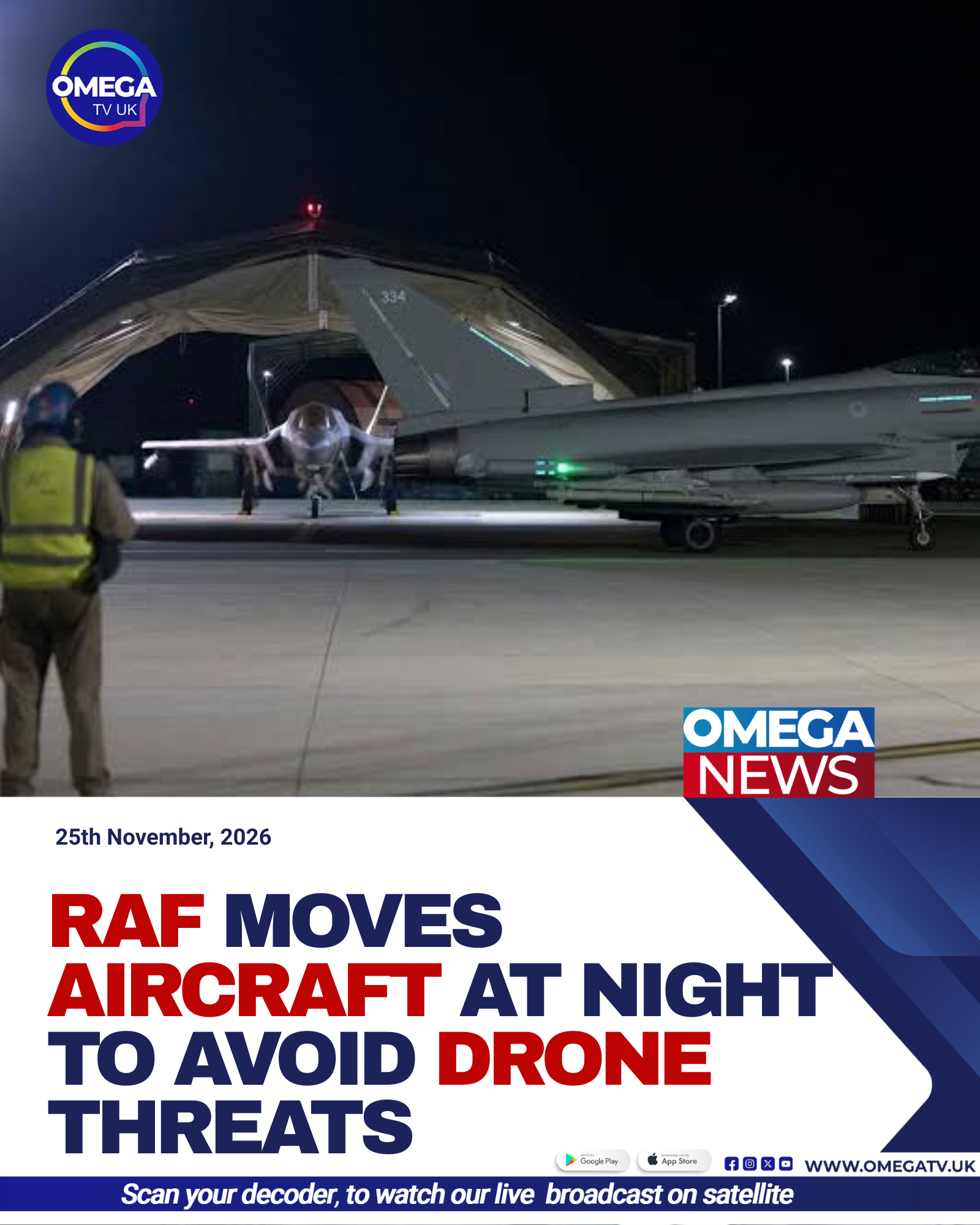
The Royal Air Force (RAF) is taking additional measures to protect its aircraft from potential drone attacks, including moving warplanes into hangars and reinforced shelters during the night.

The reported security measures are part of wider efforts to strengthen Britain’s military defences amid growing concerns about threats to military bases and equipment.
There are also plans to install anti-drone nets around aircraft that cannot be moved into protected facilities, particularly those parked near runways or at airbases with limited security infrastructure.
Similar protective netting has become increasingly common in Ukraine, where it is used to shield military equipment, important infrastructure and roads from Russian drone attacks.
The RAF’s reported preparations come as British security agencies warn of increased risks to companies involved in supplying military equipment to Ukraine.
MI5 and the Ministry of Defence recently alerted British businesses to the possibility of Russian sabotage targeting organisations connected to Ukraine’s military supply chain.
Concerns have also been raised over possible threats to RAF Fairford in Gloucestershire, which is used by the United States Air Force.
Suspected Iranian-linked threats prompted the Pentagon to move bomber aircraft away from the base. American military aircraft were also reportedly relocated from another UK airbase following separate security concerns.
The developments highlight the growing importance of protecting military aircraft while ensuring they can be moved quickly if a conflict threatens British territory.
Air Chief Marshal Sir Harv Smyth has stressed that the RAF must be prepared to operate from different locations rather than relying on a small number of permanent bases.
Speaking at an event organised by the Freeman Air and Space Institute on Tuesday evening, he said the military needed to prepare for a situation in which there was no completely safe location at home.
He explained that aircraft would need to be moved around the country while continuing to carry out military operations.
The RAF has already tested some of these capabilities during construction work at RAF Brize Norton, its main air transport base.
During the summer, a new runway was built at the base, requiring aircraft to be temporarily dispersed to other locations, including Prestwick in Scotland and Boscombe Down in Wiltshire.
Air Chief Marshal Smyth said the operation demonstrated that the RAF could relocate aircraft across the United Kingdom without interrupting its activities.
He described the exercise as a major test that had shown the service could successfully spread its aircraft across multiple locations when required.
He also emphasised the need for further training to ensure the RAF remains prepared for the demands of a potential conflict.
During the Cold War, Britain’s armed forces regularly practised moving aircraft and military equipment at short notice in preparation for a possible large-scale confrontation.
However, after the collapse of the Soviet Union, many of those readiness arrangements were gradually reduced.
The UK’s military infrastructure has also become smaller over the decades following defence cuts, leaving the RAF with fewer operational airbases available for dispersing aircraft than it had during the 1980s.
Despite this, the air force retains the ability to use other airfields, including civilian facilities, during a national emergency. Investment has also been made in facilities such as Boscombe Down to accommodate heavy transport aircraft and other military planes.
The RAF’s ability to defend the UK was tested earlier this year during a two-week exercise known as Agile Warrior.
The homeland defence training involved air and ground personnel at military bases across the country simulating threats including cyber-attacks and incoming missile strikes.
The RAF said the exercise was designed to test its ability to protect Britain in an increasingly unstable security environment and maintain its readiness to respond to threats.
The latest reported aircraft protection measures reflect a renewed focus on preparing Britain’s military for the possibility of conflict closer to home.