
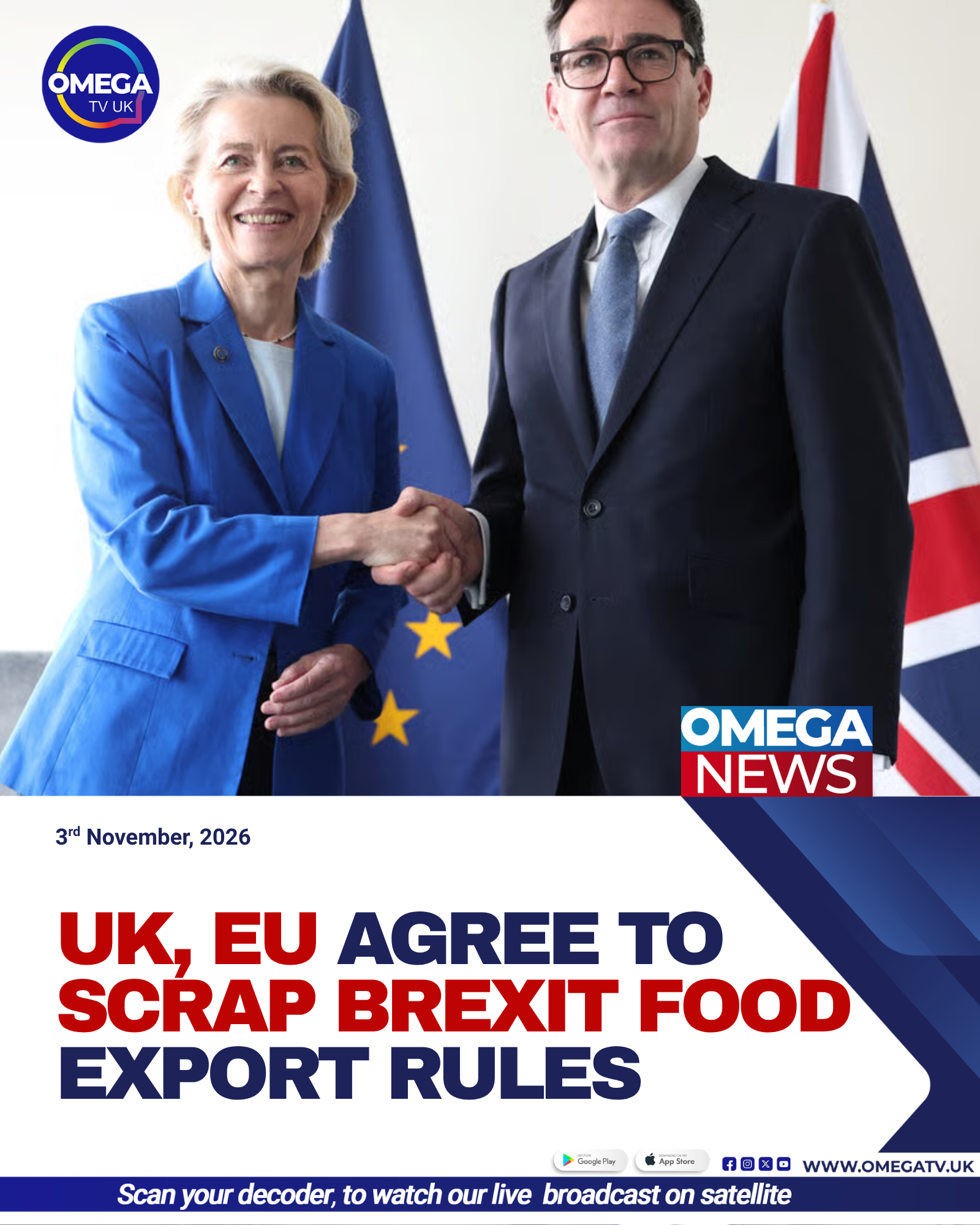
UK and EU Agree Draft Deal to Ease Food Export Checks
The United Kingdom and the European Union have agreed on a draft deal to remove post-Brexit checks and paperwork affecting food and agricultural trade between them.

The 200-page draft agreement, covering sanitary and phytosanitary (SPS) standards, has been circulated to EU member states in Brussels ahead of a meeting of EU ambassadors on Wednesday.
The deal is expected to be a major part of the UK’s efforts to reset its relationship with the EU and reduce trade barriers introduced after Brexit.
The government estimates that the agreement could eventually deliver £5.1 billion in annual economic benefits to the UK.
Under the proposed arrangement, exports of fresh sausages, burgers, shellfish caught in UK waters and seed potatoes to the EU could resume.
The agreement is also expected to remove the need for £200 Export Health Certificates and £25 phytosanitary certificates, which confirm that food and plant products meet health and safety requirements.
Other costs, including inspection fees, organic certificates and some port charges, could also be removed.
British pet owners would also be able to use pet passports when travelling with their animals to EU countries.
In return, the UK is expected to commit to following existing and future EU rules covering plant, animal and food standards. This process, known as dynamic alignment, would require Britain to adapt its regulations as EU rules change.
Changes to UK-EU relations
The food agreement forms part of a wider package of proposed deals covering emissions trading, youth travel and work opportunities, and other areas of cooperation.
The draft agreements will be discussed by EU ambassadors at a meeting known as Coreper on Wednesday.
The UK is also seeking closer cooperation with the EU on defence programmes and access to law enforcement databases. Discussions include linking the UK and EU emissions trading schemes, which could help British exporters avoid the EU’s new carbon border tax.
The government’s proposed European Partnerships Bill would provide the legal framework for applying relevant EU rules in the UK.
Under Andy Burnham, Britain’s approach to post-Brexit relations with the EU has shifted. Burnham has expressed a desire to see the UK return to the bloc during his lifetime, while saying he would not move ahead of public opinion.
In an interview with ITV, he said public attitudes had changed since the 2016 Brexit referendum but insisted that the public should determine the country’s future relationship with the EU.
He also said he had not proposed restoring freedom of movement between the UK and EU.
Impact on Northern Ireland
The proposed food deal is expected to have significant implications for Northern Ireland by reducing checks and paperwork on goods arriving from other parts of the UK.
Under Northern Ireland’s existing Brexit arrangements, the region remains aligned with the EU single market for goods. As a result, some food products arriving from Great Britain require documentation and physical inspections at Northern Irish ports.
The new agreement is expected to remove these requirements.
Business groups welcome proposal
Supermarkets and farming representatives have backed the proposed changes, while some pro-Brexit campaigners have criticised the prospect of Britain adopting EU regulations.
The British Chambers of Commerce’s head of trade policy, William Bain, said businesses considered the benefits of following common rules worth the compromise.
He said companies could benefit from lower costs, fewer delays and improved access to European markets.
Bain explained that Export Health Certificates could add thousands of pounds to the cost of each truck carrying goods, alongside delays at ports and borders.
The British Chambers of Commerce has also published an analysis of its members’ views, arguing that the current trading relationship is failing to deliver for businesses.
The organisation said companies were still struggling with Brexit-related paperwork and trade barriers nearly six years after the UK’s departure from the European Union.


