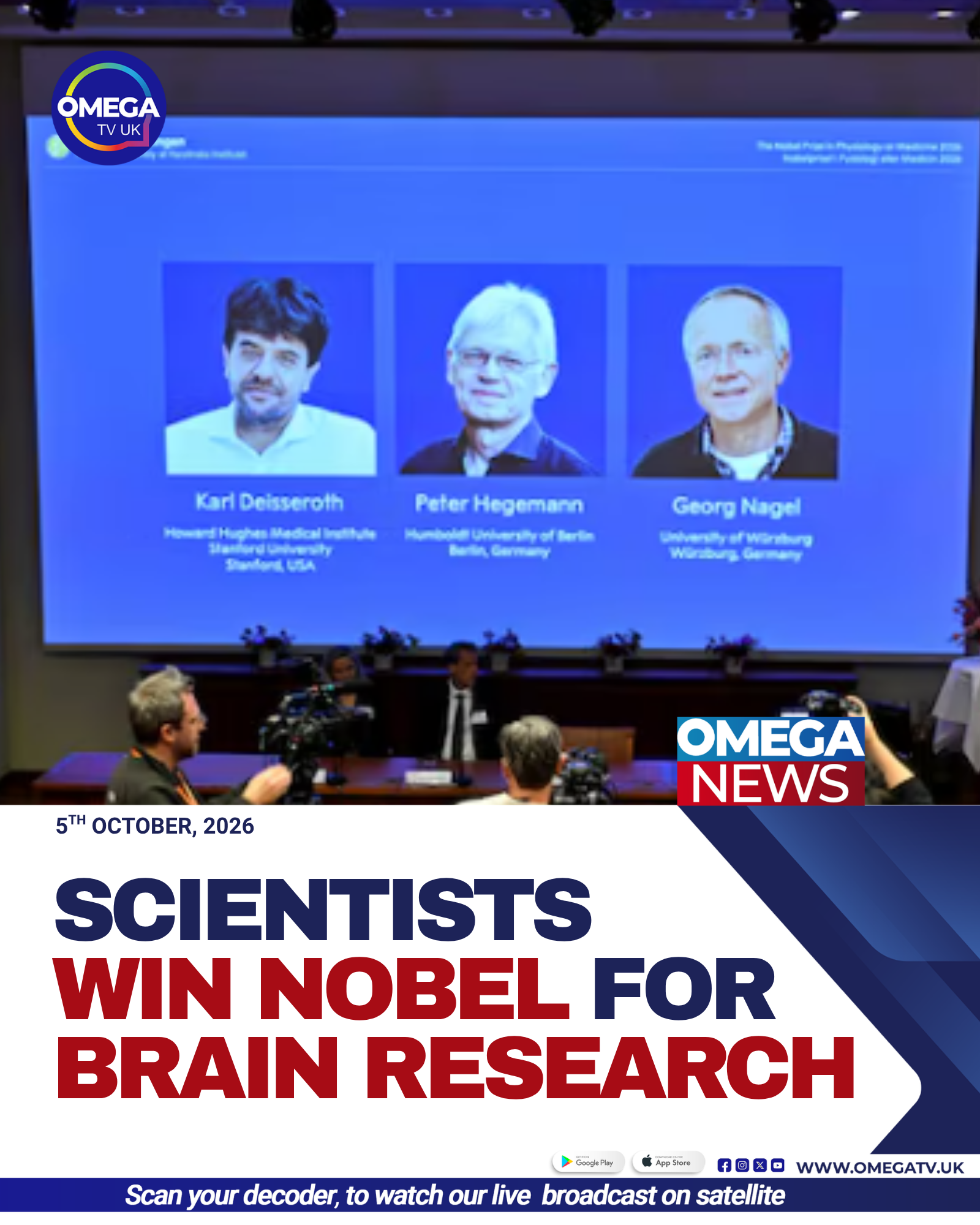
American scientist Karl Deisseroth and German researchers Peter Hegemann and Georg Nagel have been awarded the 2026 Nobel Prize in Physiology or Medicine. The Nobel Assembly at Sweden’s Karolinska Institutet awarded the prize to the scientists for their discoveries concerning light-gated ion channels and optogenetics.

Deisseroth, 54, Hegemann, 71, and Nagel, 73, were recognized for their research that has contributed to a better understanding of how the brain works. The new technique of optogenetics allows scientists to control the activity of individual nerve cells using light.
Thomas Perlmann, Secretary-General of the Nobel Assembly, said the method can switch individual nerve cells on or off in a living brain. He said the technique is now being used in laboratories around the world to study the brain.
The discoveries have also opened up new avenues for medical research. Researchers are already testing the technique to help blind people regain their sight. The approach involves using a light-sensitive protein in the retina to restore vision in patients with retinitis pigmentosa.
Researchers are also trying to find out if the method can be used to improve cochlear implants. They believe it could allow more precise stimulation of the auditory nerve than current electrical devices. The research that led to the prize-winning work started in the 1990s.
Hegemann was studying how the single-celled alga Chlamydomonas reacts to light and theorized that a particular protein probably acts as a light-sensitive ion channel. Nagel later tested the hypothesis and found that the gene that codes the protein could be placed into frog eggs. The experiment led to the discovery of channelrhodopsin-2, an ion channel that opens up when it is exposed to light.
In 2003, Hegemann and Nagel announced that they had found a way to insert the protein into human and hamster cells. The scientists also demonstrated that light could be used to create electrical impulses in the cells.
In 2005, Deisseroth demonstrated the technique on rat nerve cells at Stanford University. The method was named optogenetics the following year. Perlmann said he spoke to all three laureates after the announcement.
He said they were surprised and delighted to be awarded the prize together. The three scientists will share prize money of 12 million Swedish kronor, about $1.2 million. The Physiology or Medicine prize usually marks the start of the annual Nobel Prize announcements.
Awards in physics, chemistry, literature, peace and economics will follow in the coming days.