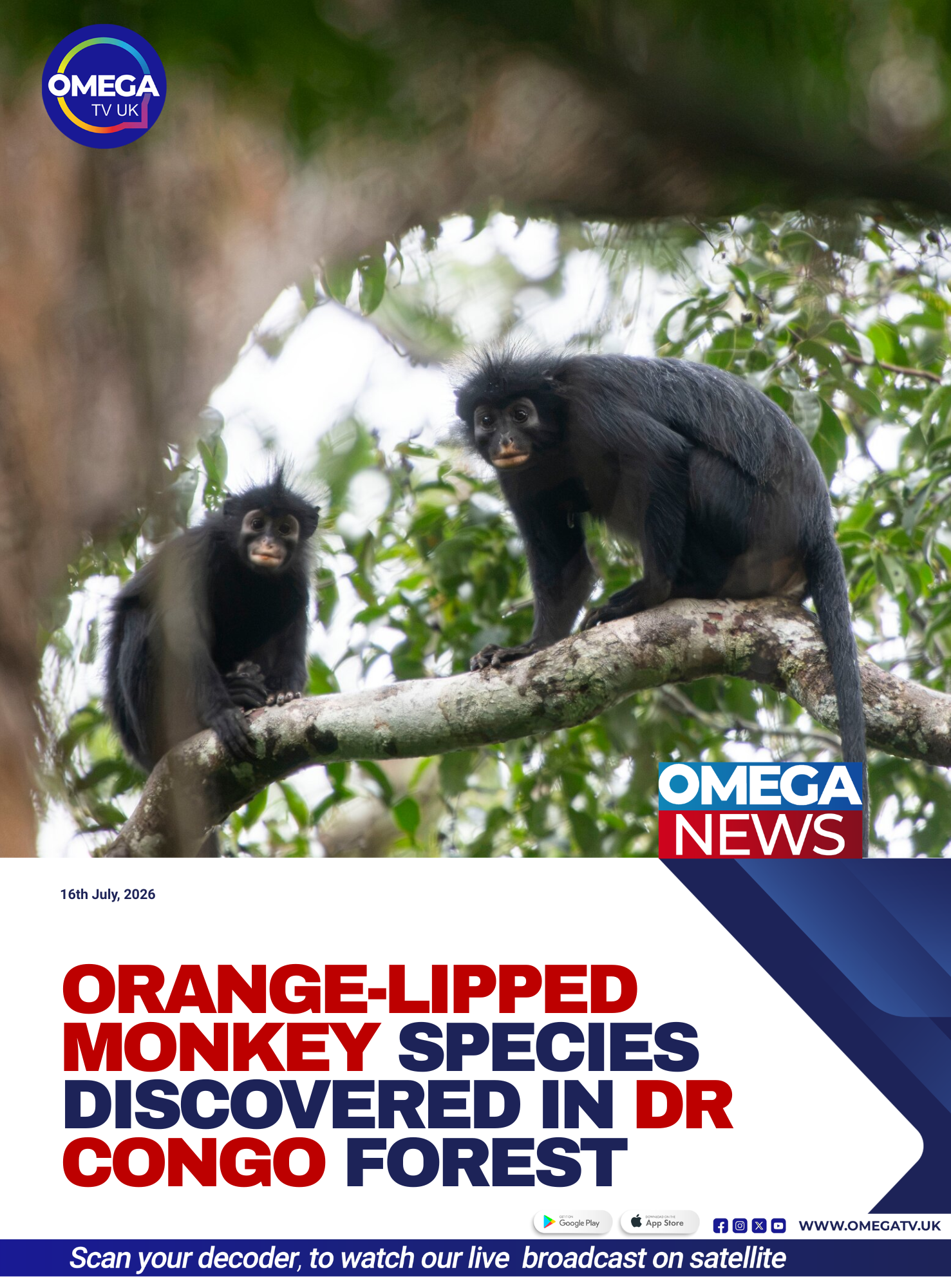
New Monkey Species With Bright Orange Lips Discovered in DR Congo Forest
Rare primate hidden in treetops officially confirmed as a new species
Scientists have officially identified a new species of monkey living deep within the forests of the Democratic Republic of Congo (DRC), ending years of mystery surrounding the unusual primate with striking pinkish-orange lips and a black face.

The monkey, now named Colobus congoensis, was found in the dense tropical forests of Lomami National Park in central-eastern DRC. Although local communities have long known about the animal and call it Likweli, researchers have only recently confirmed that it is genetically distinct from other monkey species.
Conservationists first spotted the rare primate in 2008 but managed to capture only a blurry photograph. A second sighting a decade later prompted an international team of scientists from the DRC, the United States and Germany to launch an extensive search.
Their investigation included photography, sound recordings and genetic analysis, ultimately proving that the monkey is a completely new species. The findings have been published in the scientific journal PLOS One.
The discovery is particularly significant because it is only the fifth new species of African monkey to be identified in the last 75 years.
Junior Amboko, a PhD student at Florida Atlantic University who helped lead the research, described the experience as extraordinary.
“It was an amazing feeling to look into the face of an animal that so few people knew existed,” he said.
According to the researchers, the monkeys are extremely shy and spend most of their time high in the forest canopy, making them difficult to study.
As part of their investigation, the team interviewed residents in 52 villages near the monkey’s habitat. Surprisingly, people from only eight villages said they had ever seen the elusive animal.
The scientific name, Colobus congoensis, was chosen to honour the rich biodiversity of the Democratic Republic of Congo.
The newly identified species belongs to the colobus monkey family, a group of African primates known for lacking thumbs. Experts say these monkeys play a crucial role in maintaining healthy forest ecosystems.
Professor Kate Detwiler of Florida Atlantic University explained that the animals are important seed dispersers and contribute to forest regeneration by helping plants reproduce.
Researchers are also fascinated by the monkey’s unusual appearance. They believe its bright orange facial markings may help individuals recognise one another or even attract potential mates.
Another distinctive feature is its loud, roaring call, which often reveals its presence long before it can be seen.
Scientists believe the species has a limited range and depends on specific forest conditions and food sources to survive. However, the monkeys face growing threats from hunting, as they are sometimes killed for bushmeat.
The research team hopes that officially classifying the animal as a separate species will help secure legal protections and strengthen conservation efforts in the region.
Despite the breakthrough, many questions remain unanswered. Researchers plan to conduct further studies to estimate the monkey’s population size, better understand its behaviour and determine what measures are needed to ensure its long-term survival.
The discovery serves as a reminder that even today, some of the world’s most remarkable species remain hidden in remote corners of the planet.