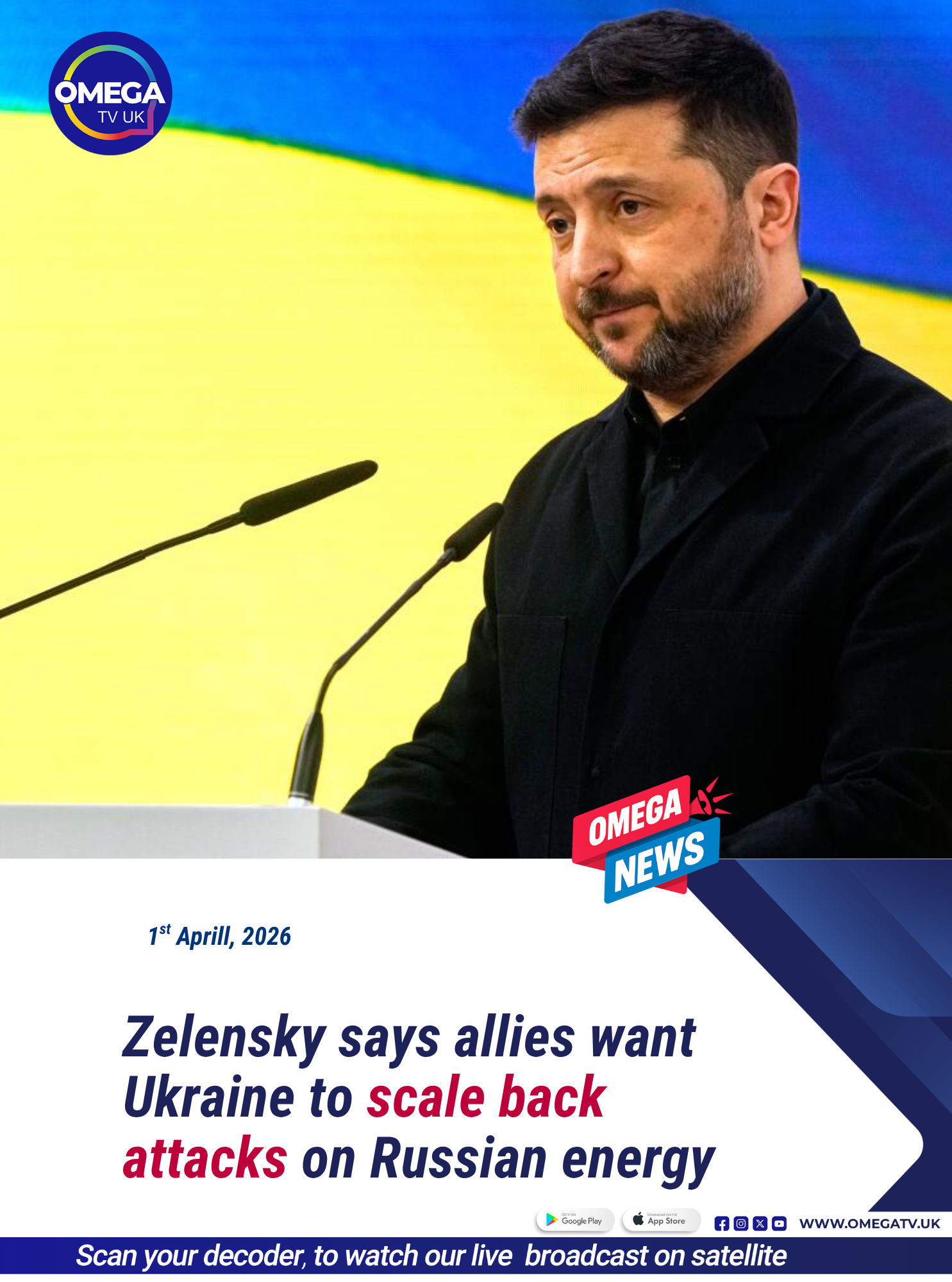
Ukrainian President Volodymyr Zelenskyy has said that some of Ukraine’s allies have asked Kyiv to reduce its attacks on Russian energy infrastructure, amid growing concerns about global fuel supplies and rising energy prices linked to the wider conflict.

Speaking in a voice message to journalists, Zelensky said Ukraine would only scale back such strikes if Russia also stopped targeting Ukraine’s energy systems. He emphasised that Ukraine’s actions are a response to ongoing attacks, suggesting a reciprocal approach to the escalating conflict.
While he did not name specific countries, the comments come at a time when major global players are closely tied to energy markets affected by the war. Countries such as China and India remain heavily dependent on Russian oil, while the European Union continues to rely significantly on Russian gas and liquefied natural gas.
The issue has become even more sensitive as the war continues to disrupt global supply routes. Rising tensions in the Middle East, including disruptions to the Strait of Hormuz, have further contributed to volatility in global oil markets. These developments have placed additional pressure on governments seeking to stabilise fuel prices and maintain energy security.
Zelensky’s remarks follow a series of long-range Ukrainian strikes targeting key Russian energy facilities. Among the most significant is the oil export terminal at Ust-Luga, near St Petersburg, which has reportedly been hit multiple times. According to Zelensky, recent attacks on the terminal disrupted a large portion of its operations, significantly affecting its capacity.
Russian and Ukrainian officials have both confirmed further strikes on the facility, with reports of damage and injuries, including among civilians. The exact extent of the damage remains unclear, as details of such operations are often closely guarded by both sides.
At the same time, Ukraine’s own energy infrastructure has suffered extensive damage due to repeated Russian strikes. These attacks have left large parts of the country struggling with power shortages, particularly during winter months when demand for heating is highest. In some instances, more than a million people have been left without electricity or heating.
Ukraine has increasingly relied on fuel imports to compensate for the damage to its domestic energy production. Supplies are often routed through neighbouring countries such as Poland, Greece, Lithuania, and Turkey, highlighting the importance of international support in sustaining Ukraine’s energy needs.
Zelensky has also pointed to shifting global energy dynamics, noting that recent conflicts have led to changes in oil trade patterns. The United States has eased some sanctions on Russian oil in response to global price pressures, while countries like China and India continue to be among the largest buyers of Russian crude.
In addition, the European Union remains one of the biggest consumers of Russian gas, reflecting the continued interconnectedness of global energy markets despite political tensions. These dependencies have complicated international responses to the war, particularly when it comes to balancing sanctions with energy security.
The Ukrainian president recently travelled to several Gulf countries, including Saudi Arabia, the United Arab Emirates, Qatar, and Jordan, as part of efforts to strengthen international partnerships. During his visit, he offered Ukraine’s expertise in drone technology while also seeking support for defending against Russian missile attacks.
His tour comes at a time when several of those countries have themselves experienced regional tensions and aerial attacks, further highlighting the global nature of security concerns linked to the conflict.
Zelensky also addressed Ukraine’s fuel situation, stating that the country currently has enough fuel for its military operations. However, he acknowledged the importance of securing additional supplies, particularly as the war continues and demand remains high.
He also drew parallels between Ukraine’s efforts to keep its trade routes open and broader global challenges. Ukraine previously succeeded in reopening grain export routes through the Black Sea despite Russian efforts to block them, and Zelensky suggested that similar approaches could help address disruptions in other key maritime routes.
As the conflict continues, the issue of energy infrastructure remains a central point of tension. Both sides have targeted each other’s energy systems, with significant consequences not only for the countries involved but also for global energy markets.
The situation underscores the growing complexity of the war, where military actions are increasingly tied to economic pressures, international diplomacy, and global energy stability. For Ukraine, balancing its defensive strategy with the expectations of its allies remains a delicate and ongoing challenge.