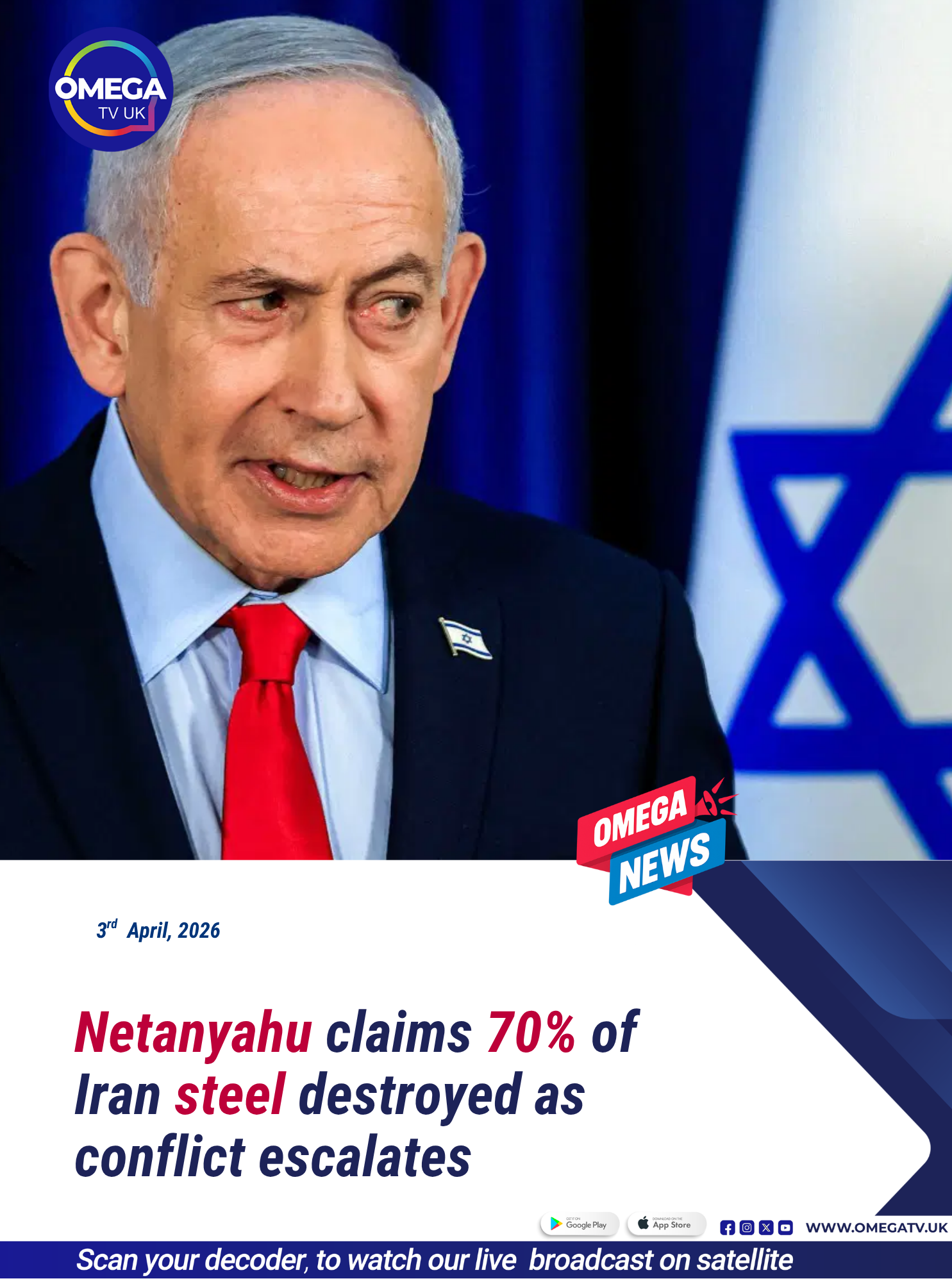
Benjamin Netanyahu has claimed that Israeli air strikes have destroyed up to 70% of Iran’s steel production capacity, as the conflict between Iran and the US-Israel alliance intensifies with fresh attacks across the region.

According to Netanyahu, the strikes targeted key industrial facilities critical to Iran’s economy and military capabilities. Steel production plays a major role in manufacturing weapons, including missiles and military equipment, making it a strategic target in the ongoing الحرب. He described the damage as a “tremendous achievement” that weakens Iran’s ability to sustain its military operations.
The claim comes amid a broader escalation in hostilities, with both sides exchanging attacks that increasingly target infrastructure rather than solely military positions. Israeli and US forces have carried out coordinated strikes on Iranian facilities, including factories, bridges, and other critical assets.
In one of the most recent incidents, local Iranian officials reported that at least eight people were killed following a US strike on a bridge connecting the city of Karaj to the capital, Tehran. The attack also left dozens injured, highlighting the growing human cost of the conflict.
At the same time, Iran has intensified its retaliation, launching new strikes against Israeli territory as well as targets in Gulf countries. Authorities in Kuwait reported that a water desalination plant had been hit, raising alarm about the vulnerability of critical civilian infrastructure in the region.
Desalination plants are essential for providing fresh water in many Gulf nations, where natural freshwater resources are limited. Any disruption to these facilities can have serious humanitarian consequences, affecting millions of people who depend on them for daily water supply.
The widening scope of attacks signals a dangerous expansion of the conflict beyond traditional battle zones. Analysts warn that targeting economic and civilian infrastructure could further destabilise the region and increase the risk of a prolonged war with global consequences.
Meanwhile, Iranian media has claimed that a US military jet was shot down over Iranian territory and that American forces are searching for a missing pilot. However, there has been no official confirmation from US Central Command, and the reports remain unverified.
The الحرب has also brought renewed focus to the Strait of Hormuz, a critical global shipping route through which a significant portion of the world’s oil supply passes. Iran has previously threatened to disrupt traffic through the strait, raising fears of a global energy crisis.
US President Donald Trump said Washington could “easily” reopen the Strait of Hormuz with more time, signalling the possibility of further military operations aimed at securing the vital waterway.
The ongoing conflict, which began with large-scale US and Israeli strikes on Iran, has quickly evolved into a broader regional confrontation. Iran has responded with missile and drone attacks not only against Israel but also against neighbouring countries, expanding the theatre of war across the Middle East.
Experts say the destruction of Iran’s steel industry, if confirmed, could have both military and economic consequences. The sector is a major source of revenue and a key component of the country’s industrial base. Damaging it could limit Iran’s ability to produce weapons while also impacting its broader economy.
However, analysts caution that such claims are difficult to independently verify during an active conflict, and both sides have engaged in information campaigns aimed at shaping public perception.
As the situation continues to evolve, fears are growing that the conflict could escalate further, drawing in more countries and disrupting global markets. With energy infrastructure under threat and tensions rising, the international community is increasingly calling for restraint and a return to diplomatic solutions.
For now, the region remains on edge, with both sides showing no signs of backing down.