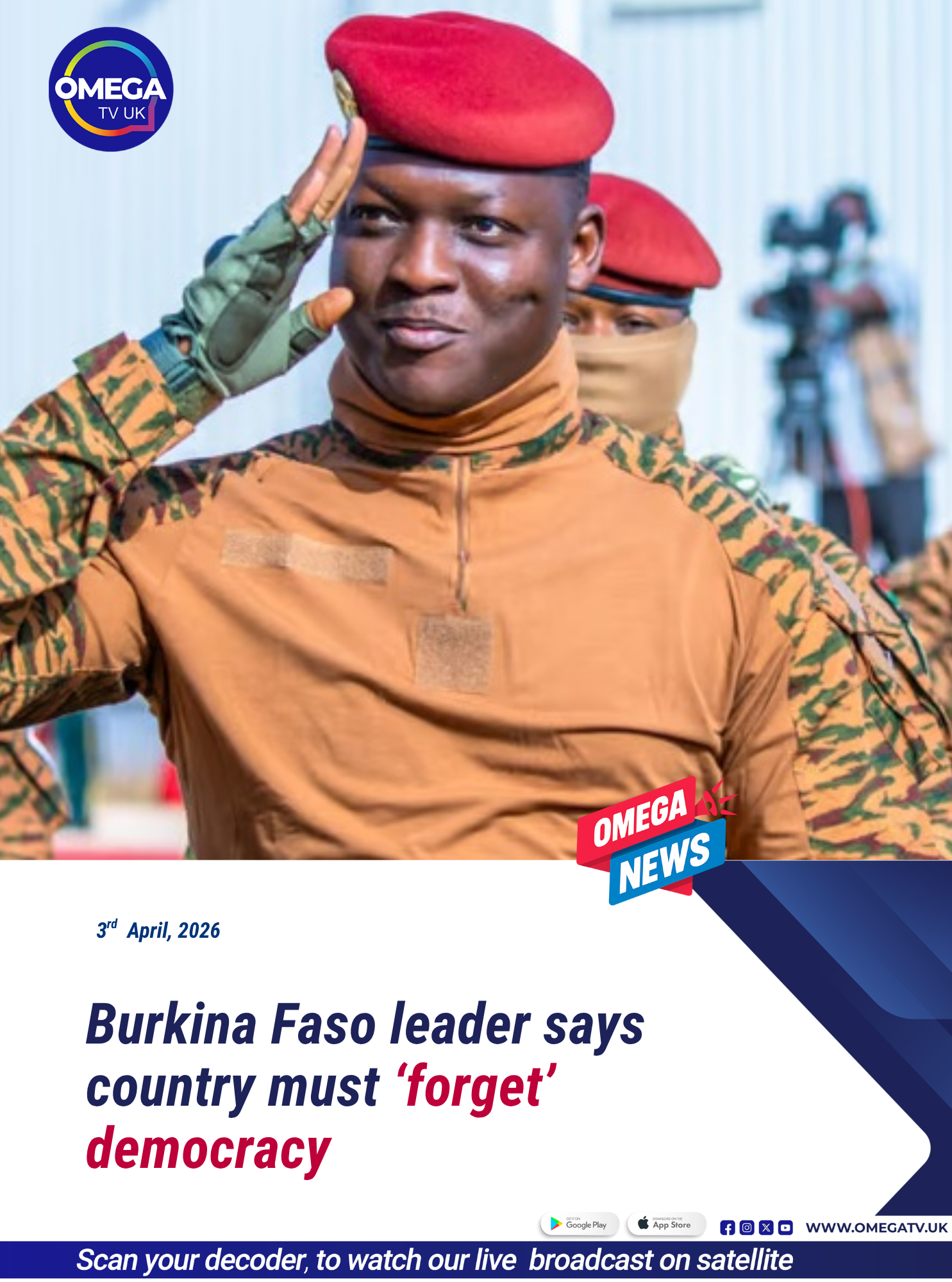
Burkina Faso’s military leader, Captain Ibrahim Traoré, has sparked controversy after declaring that democracy is not suitable for his country and urging citizens to abandon it altogether. His remarks, delivered during an interview on state television, highlight a growing shift in political direction under military rule.

Traoré, who came to power in a coup three years ago, argued that democracy has brought instability and violence rather than progress. “People need to forget about the issue of democracy. Democracy is not for us,” he said, suggesting that the system has failed to meet the needs of Burkina Faso and other African nations.
The 38-year-old leader positioned himself as a revolutionary figure, often critical of Western influence on African governance. Without offering detailed alternatives, he insisted that Burkina Faso is pursuing its own political model—one that departs from Western-style democratic systems.
Traoré initially promised to restore civilian rule by July 2024. However, just months before that deadline, his government announced an extension of military rule for an additional five years. The decision drew criticism both domestically and internationally, raising concerns about the country’s democratic future.
Earlier this year, authorities went further by banning all political parties, describing the move as necessary to “rebuild the state.” Critics argue that such actions undermine political freedoms and limit citizens’ ability to participate in governance.
In defending his stance, Traoré pointed to Libya as an example of democracy’s failures. He referenced the period following the fall of Muammar Gaddafi, when the country descended into prolonged instability and conflict. Gaddafi had ruled Libya for over four decades before being overthrown and killed during a rebellion supported by Western intervention.
Since then, Libya has struggled to establish a unified government, with rival administrations and armed groups competing for control. Traoré argued that such outcomes demonstrate the risks of imposing democratic systems without considering local contexts.
“Wherever Western powers try to establish democracy, it is always accompanied by bloodshed,” he said, reinforcing his criticism of foreign involvement in African political systems.
Despite Traoré’s claims, many African countries continue to hold regular elections, even though some have faced criticism over transparency and fairness. In recent years, however, the region has seen a rise in military takeovers, reflecting growing dissatisfaction with existing political systems.
Burkina Faso itself has faced significant challenges, including ongoing violence from extremist groups linked to al-Qaeda. The military government has justified its continued rule by arguing that strong leadership is necessary to restore security and stability.
Supporters of Traoré view him as a bold leader willing to challenge external influence and prioritise national sovereignty. However, opponents warn that rejecting democracy entirely could isolate the country and weaken institutions meant to protect citizens’ rights.
As Burkina Faso continues under extended military rule, the debate over its political future remains unresolved. Whether the country’s alternative approach will bring stability or deepen existing challenges is a question that both its citizens and the international community are watching closely.