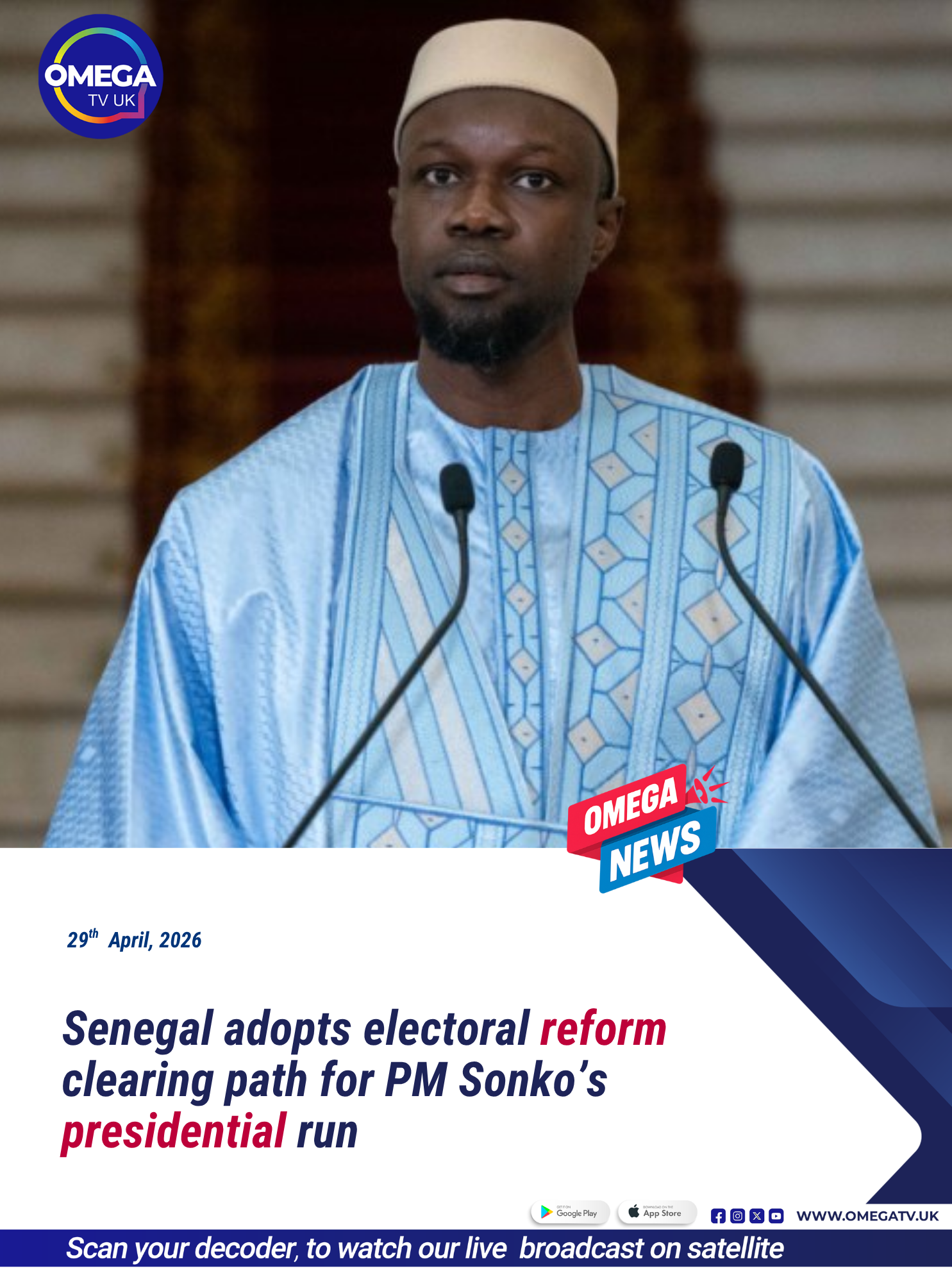
Senegal clears path for Ousmane Sonko’s presidential run after electoral code overhaul

Senegal’s political landscape has shifted sharply after the National Assembly voted to amend the country’s electoral code, a move that could allow Prime Minister Ousmane Sonko to contest the 2027 presidential election.
The reform, introduced by Sonko’s own Pastef party, was passed on Tuesday with a decisive majority: 128 votes in favour, 11 against, and two abstentions. The changes have immediately triggered heated debate across the country, with supporters hailing it as democratic correction and critics calling it a tailored political manoeuvre.
The amendment revises provisions that previously disqualified Sonko from standing for public office following a defamation conviction in 2024. That ruling had blocked his earlier presidential ambitions, forcing him to step aside and endorse his ally Bassirou Diomaye Faye, who went on to win the presidency.
Faye, now head of state, subsequently appointed Sonko as prime minister — a decision that already signalled his continued central role in Senegal’s political future.
The newly adopted bill removes the legal barriers that had prevented Sonko from running, effectively reopening the door for his candidacy in the next presidential race.
Sonko and his supporters argue that the previous electoral code was politically weaponised. Pastef officials stated that the system had been used to “eliminate candidates according to political interest,” claiming that the reforms are necessary to restore fairness and democratic balance.
The party has long framed Sonko’s legal troubles as politically motivated, portraying him as the target of judicial actions aimed at weakening opposition forces during a period of intense political rivalry.
However, the move has been sharply criticised by opposition groups, who accuse the ruling party of manipulating electoral laws for personal and political advantage. Several opposition figures described the reform as “personal legislation” designed specifically to clear the way for one individual.
They argue that the retroactive nature of the amendment undermines institutional integrity and sets a dangerous precedent for future elections. Some opposition voices have also raised concerns that the rapid passage of the bill reflects growing political consolidation around Sonko and his allies.
Despite the controversy, the bill has now been forwarded to President Bassirou Diomaye Faye for final approval. As head of state, Faye holds the constitutional authority to sign the amendment into law or return it for further review.
The political relationship between Faye and Sonko remains central to Senegal’s current governance structure. The two men, once aligned in opposition politics, now occupy the highest offices in the country — with Faye as president and Sonko as prime minister — a dynamic that continues to shape national decision-making.
Sonko’s political journey has been marked by both rapid rise and intense controversy. A former tax inspector turned opposition leader, he built a strong support base among Senegal’s youth by positioning himself as an anti-establishment figure challenging entrenched political elites.
His 2024 defamation conviction, which barred him from running for office, came amid broader tensions that at times sparked unrest and public demonstrations across the country. Despite his legal setbacks, Sonko remained one of Senegal’s most influential political figures, ultimately returning to government in a senior executive role.
The latest electoral reform has therefore reignited debates about fairness, political accountability, and the independence of Senegal’s judicial and electoral systems.
Supporters of the amendment argue that democratic systems must allow for political rehabilitation and voter choice, insisting that Sonko’s exclusion was excessive and politically driven.
Critics, however, warn that rewriting electoral rules in this manner could weaken institutional checks and balances, especially in a country widely regarded as one of West Africa’s most stable democracies.
With the presidential election approaching next year, attention now turns to President Faye’s decision. His approval would cement one of the most significant political comebacks in recent Senegalese history, while rejection could deepen divisions within the ruling establishment.
For now, Senegal stands at a political crossroads, with the future candidacy of Ousmane Sonko likely to shape the tone and direction of the country’s next electoral cycle.