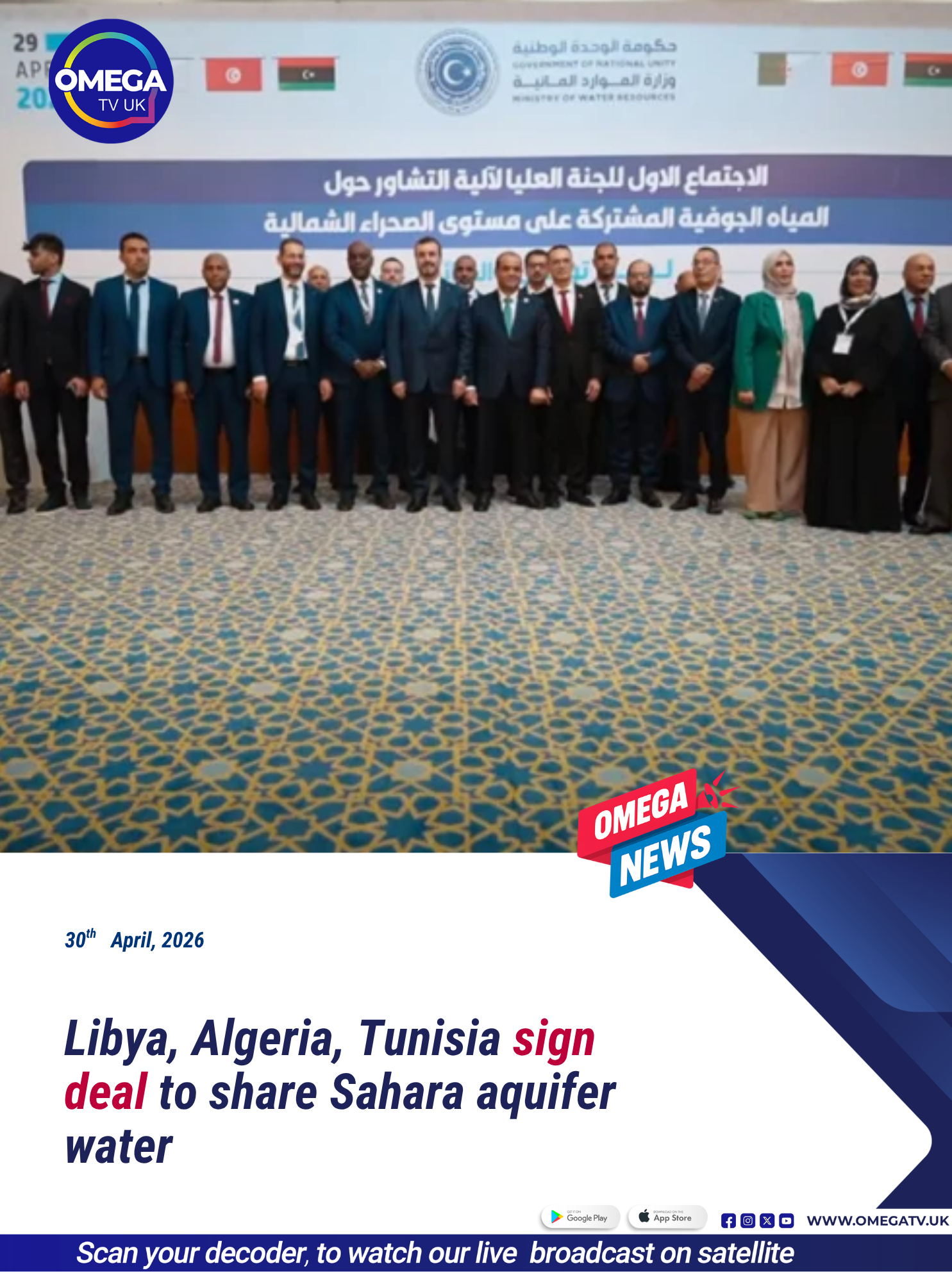
Libya, Algeria and Tunisia have signed a new agreement aimed at ensuring the fair and sustainable use of one of the world’s largest underground water reserves, a critical move as North Africa faces growing water shortages and climate pressures.

The agreement, known as the Tripoli Declaration, was signed on Wednesday and focuses on the management of the North-Western Sahara Aquifer System, a vast underground water source shared by the three countries.
Officials described the deal as a framework for the “rational and equitable” use of the aquifer, which stretches beneath all three nations and contains an estimated 40 trillion cubic metres of fossil water.
The aquifer has supported communities in the Sahara region for centuries through natural springs and shallow wells. However, growing populations, agricultural expansion and increased drilling activity have accelerated water extraction rates in recent decades.
Modern boreholes, some reaching depths of up to 1,000 metres underground, are allowing countries to access deeper reserves at a much faster rate than before, raising concerns about overexploitation of the non-renewable resource.
Under the new agreement, Libya, Algeria and Tunisia will work together to monitor extraction levels, prevent pollution and coordinate long-term use of the shared water system.
Libya’s Minister of Water Resources, Hosni Aouidat, said the agreement was necessary given mounting environmental and demographic challenges facing the region.
He noted that climate change, population growth and rising water demand are putting significant pressure on already limited water resources.
“The challenges facing our water resources, whether related to climate change or rising demand, require us to strengthen coordination and integration among ourselves,” he said.
The declaration also introduces a system of joint monitoring and data sharing between the three governments.
According to Libyan officials, mathematical models will be used to determine fair water quotas for each country.
Authorities will track groundwater levels, extraction volumes and environmental risks, including contamination and ecosystem degradation.
Hussein al-Talou, head of research at Libya’s Ministry of Water Resources, said the agreement is designed to ensure long-term sustainability.
He explained that each country will receive an allocated quota while monitoring systems will help identify risks such as pollution or excessive pumping.
Algeria holds the largest share of the aquifer, with nearly two-thirds of the underground reserve located beneath its territory.
A little under one-third lies beneath Libya, while Tunisia controls approximately eight percent.
Despite these uneven proportions, all three nations depend heavily on the aquifer for agriculture, drinking water and economic activity in desert and semi-arid regions.
Libya, in particular, remains one of the driest countries in the world and relies heavily on underground water.
Its massive Great Man-Made River project, launched during the rule of former leader Muammar Gaddafi, transports fossil water from southern aquifers to major coastal cities through an extensive pipeline network.
The project has long been described as one of the largest engineering systems of its kind globally.
Experts have repeatedly warned that fossil water reserves are finite and cannot naturally replenish at a meaningful rate.
As a result, mismanagement or overuse could create serious long-term water security risks across North Africa.
The new agreement is being viewed as an important step toward regional cooperation on environmental issues.
With drought conditions intensifying and climate change expected to worsen water scarcity, collaborative resource management is becoming increasingly urgent.
The Tripoli Declaration signals a shared recognition among Libya, Algeria and Tunisia that water security is now a strategic issue requiring coordinated action.
Analysts say successful implementation of the agreement could serve as a model for other water-stressed regions managing shared natural resources.