Mali holds televised state funeral for slain former defence minister General Sadio Camara
Mali held a televised state funeral on Thursday for former defence minister General Sadio Camara, a senior military figure widely seen as one of the architects of the country’s security alliance with Russia.

The ceremony followed two days of national mourning after Camara was killed during coordinated attacks carried out last weekend by jihadist militants and allied Tuareg separatist fighters on military positions across Mali.
The large-scale attacks were described as the most significant assault on Malian military targets in more than a decade, dealing a major blow to the country’s armed forces and its Russian security partners.
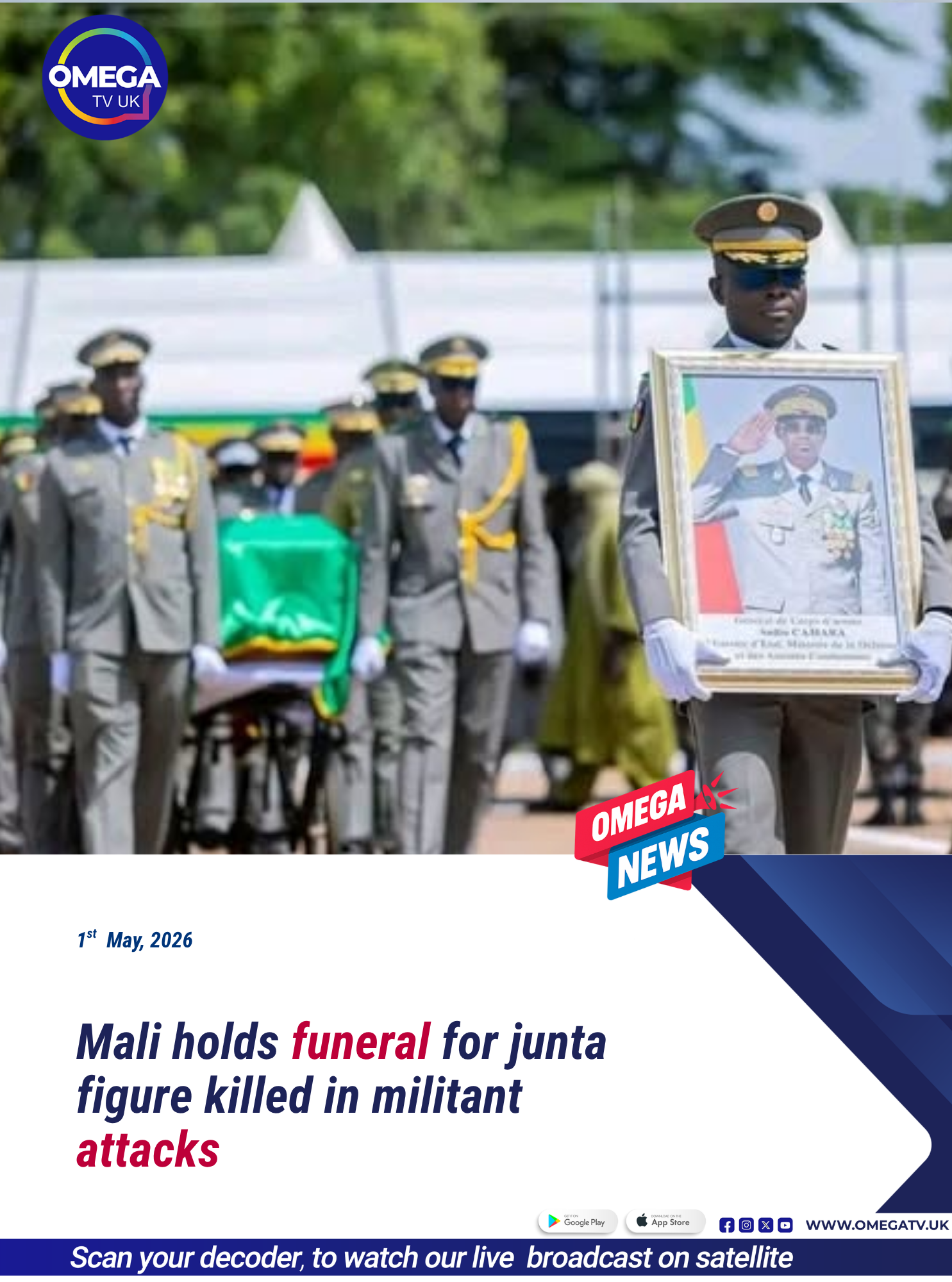
A funeral service broadcast live on state television was attended by Mali’s transitional president and junta leader, Assimi Goita, alongside senior military officials, government representatives, and mourners.
Camara’s coffin was wrapped in the Malian national flag, featuring the country’s green, yellow, and red colours, while large portraits of the late general were displayed during the ceremony.
The former defence minister was regarded as one of the most influential figures within Mali’s military-led government and played a central role in reshaping the country’s foreign and security policy following the coups that brought the military to power.
Analysts say Camara was instrumental in positioning Russia as Mali’s primary security partner after relations with France deteriorated.
Under the military government, Mali expelled French troops and later pushed out United Nations peacekeepers, instead strengthening military ties with Moscow and Russian-linked mercenary forces.
Observers believe Camara’s death could have serious political and security consequences for Mali’s ruling junta.
His killing, along with the military setbacks suffered during the recent attacks, may trigger internal tensions within the government and force officials to reassess aspects of their partnership with Russia.
Camara was born in 1979 in Kati, a major military town near the capital Bamako.
Ironically, Kati was also where he was killed after a car bomb exploded outside his home on Saturday.
Before rising to national prominence, Camara served as a field officer in northern Mali during the late 2000s, a period marked by growing insurgencies and armed rebellions, including groups linked to Al-Qaeda.
Following graduation from military academy, he completed several international training assignments, including military studies in Russia, which later aligned with his strategic foreign policy orientation.
Camara first became known to many Malians in August 2020, when he appeared on national television as one of five military officers announcing the overthrow of then-President Ibrahim Boubacar Keita.
The coup leaders accused Keita’s administration of failing to contain worsening militant violence and being overly dependent on France.
They promised to restore national security and stability.
Following the coup, Mali’s leadership increasingly distanced itself from Western allies and deepened cooperation with Russia.
Camara became a central figure in that transition and was widely viewed as the architect of Mali’s renewed relationship with Moscow.
He served as defence minister under both of Mali’s successive military governments.
He was first appointed following the August 2020 coup and later reappointed after a second military takeover in May 2021, which formally brought Assimi Goita to power.
His death marks a major loss for Mali’s military leadership at a time when the country continues to battle insurgent violence and political instability.
As Mali mourns one of its most prominent military figures, attention is now turning to how the junta will manage both the political fallout and growing security threats facing the nation.
Watch: