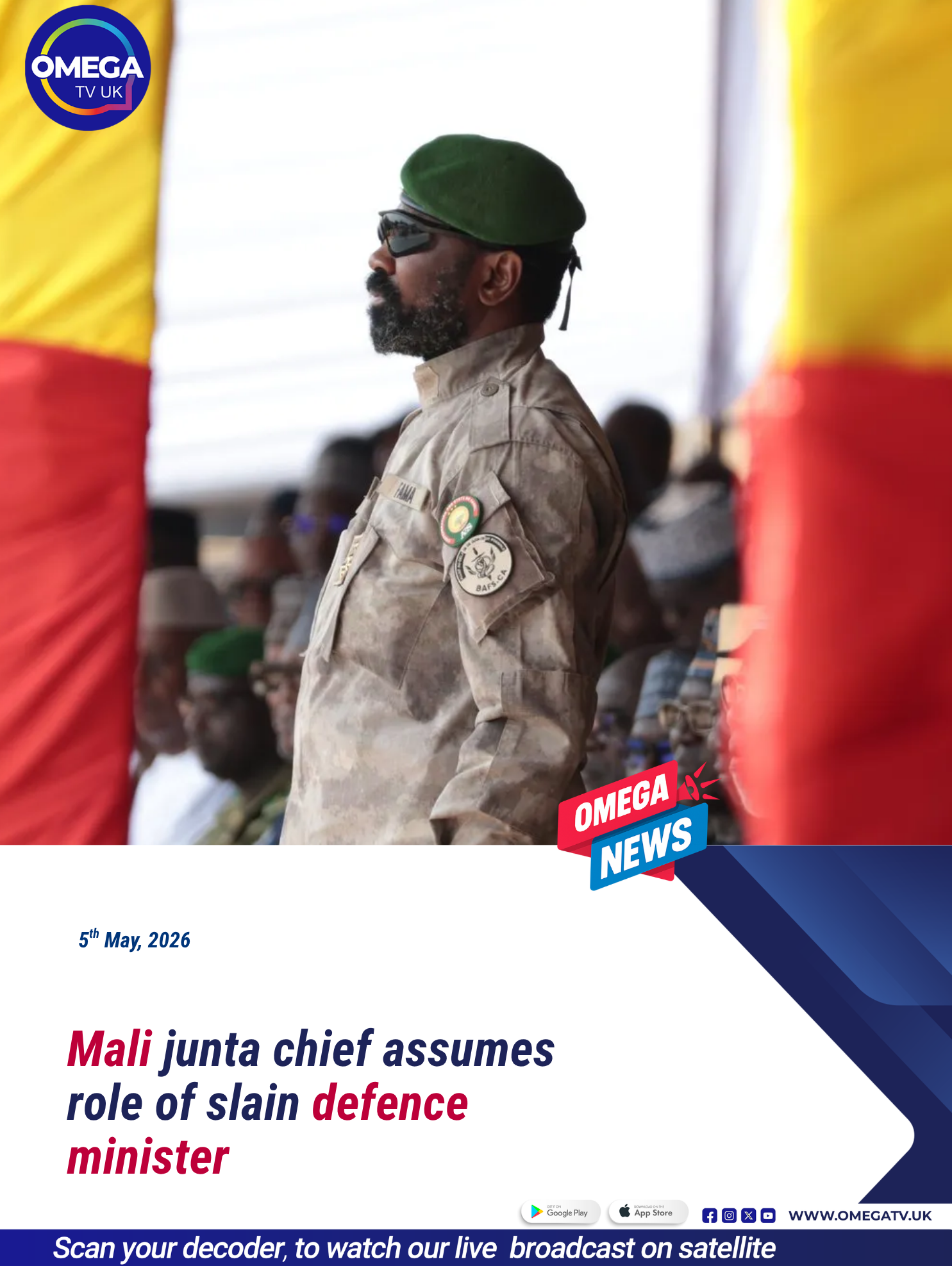
Mali junta chief to take over killed defence minister’s role
Mali’s military leader Assimi Goïta will now also serve as defence minister, according to a decree announced on Monday, following the death of the previous minister during recent large-scale attacks.

The decision comes after a major security crisis in which Defence Minister Sadio Camara was killed in a car bomb attack at his residence amid coordinated strikes by Tuareg separatists and al-Qaeda-linked militants.
The violence, described as one of the most significant in nearly 15 years, saw armed groups briefly seize the strategic northern town of Kidal and target several junta positions across the country.
At least 23 people were killed, with UNICEF reporting that civilians, including children, were among the victims.
The attacks were carried out by militants linked to al-Qaeda’s Sahel branch, the Group for the Support of Islam and Muslims (JNIM), working alongside the Azawad Liberation Front (FLA), a Tuareg separatist group. Both groups have increasingly coordinated against the ruling junta and its Russian-backed forces.
Under the new decree, Goïta will be assisted by General Oumar Diarra, who has been appointed minister delegate to the defence ministry. The announcements were read on state broadcaster ORTM.
Following the attacks, militant groups also claimed to impose a blockade on Bamako, though reports suggest its impact has been limited and inconsistent.
Security sources say militants are carrying out sporadic harassment rather than maintaining full control of key routes, although fear and uncertainty remain high among civilians.
Some transport companies have suspended travel to the capital, while passengers described tense journeys with detours and heightened anxiety.
Despite this, officials insist that security forces remain in control, even as concerns grow over the junta’s ability to stabilise the country.
The situation highlights the deepening instability in Mali, where jihadist groups and separatist forces continue to exploit political and security gaps, despite ongoing military operations and foreign support.