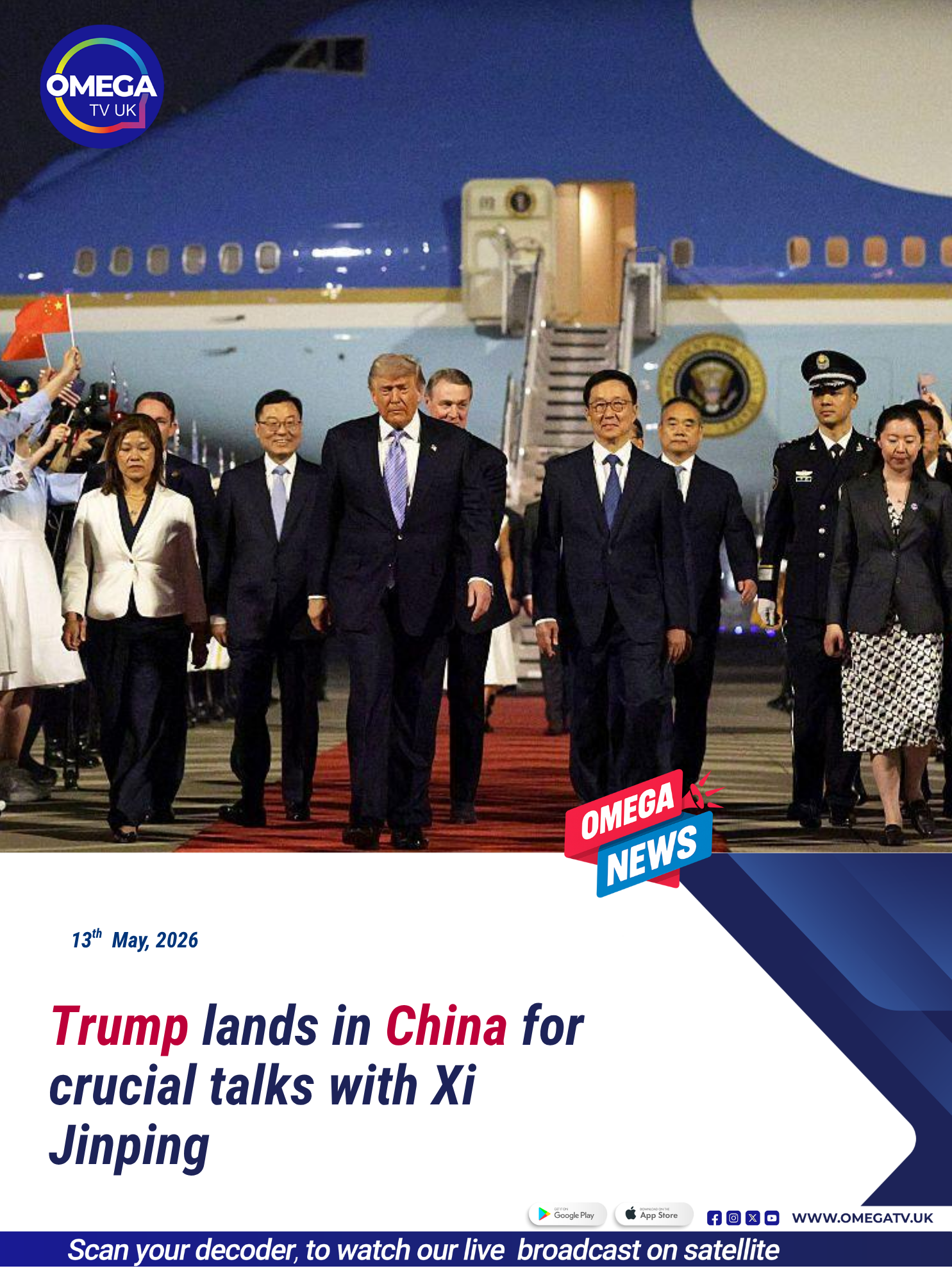
Trump arrives in China for crucial talks with Xi Jinping
United States President Donald Trump arrived in Beijing on Wednesday evening for a highly anticipated meeting with Chinese President Xi Jinping, marking his first visit to China since returning to office. Trump was welcomed with an elaborate reception as he stepped off Air Force One, signaling the importance Beijing is placing on the visit and the discussions ahead.

The two leaders are expected to hold intensive talks over the next two days on some of the world’s most pressing issues, including trade tariffs, technological rivalry, the ongoing conflict involving Iran, and the sensitive matter of Taiwan. The meeting comes at a time when relations between the world’s two largest economies remain tense, with both countries seeking to protect their economic and geopolitical interests.
Trump’s visit had originally been scheduled for March but was postponed due to escalating tensions in the Middle East following the war involving the United States, Israel, and Iran. The conflict has disrupted global markets and created fresh uncertainty around oil supply chains, making foreign policy discussions with China even more urgent.
Upon landing in Beijing, Trump was greeted by Chinese Vice-President Han Zheng, one of the country’s highest-ranking officials. Analysts view this as a deliberate gesture of respect from Beijing, especially considering that Trump’s previous visit in 2017 was received by a lower-ranking official.
A red carpet ceremony welcomed the US president, with several high-profile figures also in attendance. Among them were Trump’s son, Eric Trump, along with major US technology leaders such as Tesla CEO Elon Musk and Nvidia CEO Jensen Huang. Their presence highlights the growing significance of US-China competition and cooperation in the technology sector.
Ahead of his arrival, Trump posted on social media expressing optimism about his meeting with Xi. He described the Chinese leader as someone of “extraordinary distinction” and said he would ask China to further open its economy to American innovation and investment.
Trump stated that his first major request to Xi would be for China to allow greater opportunities for American technology companies and entrepreneurs to operate within its market. The US has long pushed for expanded business access in China, where foreign firms often face regulatory hurdles and restrictions.
One of the central issues expected to dominate the talks is the war involving Iran. China has long maintained close economic ties with Tehran and relies heavily on Iranian oil exports. However, shipping disruptions in the Strait of Hormuz have severely affected these exports, placing additional strain on China’s energy security.
Washington is expected to pressure Beijing to use its economic influence over Iran in efforts to reduce regional instability. China remains Iran’s largest trading partner, and its longstanding relationship with Tehran gives it a unique position in diplomatic discussions surrounding the conflict.
Taiwan is another likely flashpoint during the meeting. The Trump administration has sent mixed signals regarding its commitment to Taiwan, recently approving a major arms package while appearing less direct about military intervention in the event of Chinese aggression.
Beijing considers Taiwan a breakaway province and has consistently opposed US military and political support for the island. Any shift in Washington’s position is closely monitored by Chinese officials and could significantly influence bilateral relations.
Trade tensions are also expected to feature prominently. Trump is likely to push China to increase purchases of American agricultural goods, which would benefit US farmers and reduce trade imbalances. In contrast, Beijing is expected to pressure Washington to ease tariffs placed on Chinese imports.
Both leaders enter the talks with significant strategic interests at stake. For Trump, the visit offers an opportunity to demonstrate leadership on the global stage while addressing domestic concerns over trade and foreign policy. For Xi, it presents a chance to stabilize ties with Washington while protecting China’s economic priorities.
The meeting comes as China adopts a more confident global posture compared to Trump’s last visit nearly a decade ago. Beijing has expanded its international influence, strengthened military capabilities, and positioned itself as a major power in global diplomacy.
With tensions running high across multiple fronts, the outcome of this meeting could shape the direction of US-China relations for months to come. Investors, diplomats, and global markets will be closely watching for any signs of progress or further friction between the two superpowers.