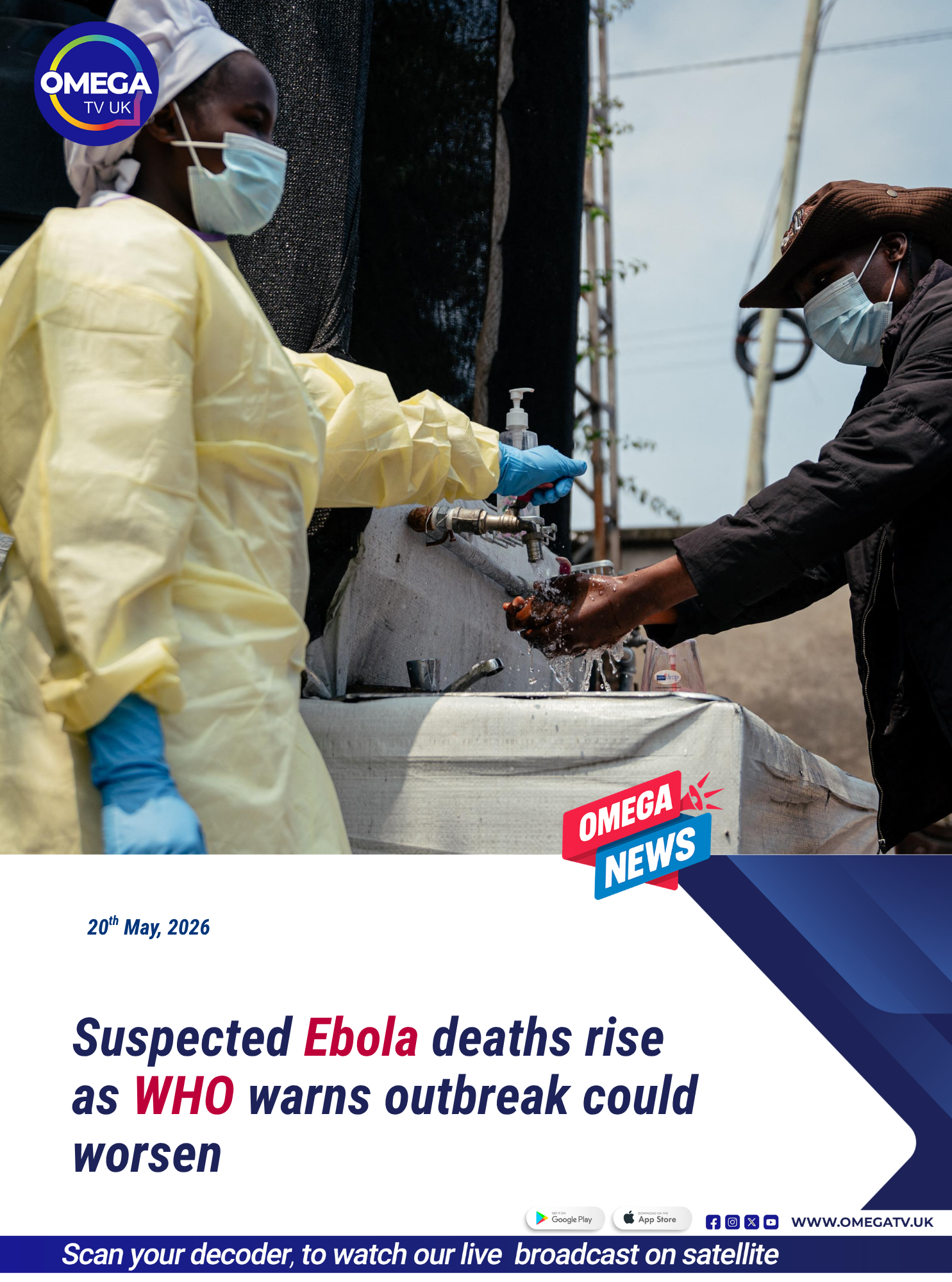
WHO warns Ebola cases and deaths could rise further in DR Congo outbreak
The World Health Organization has warned that Ebola infections and deaths are expected to increase further as health officials struggle to contain a growing outbreak in the Democratic Republic of Congo and neighboring Uganda.

According to WHO Director-General Tedros Adhanom Ghebreyesus, there are now approximately 600 suspected Ebola cases and 139 suspected deaths linked to the outbreak.
So far, authorities have confirmed 51 Ebola cases in the Democratic Republic of Congo and two additional cases in Uganda. The outbreak involves the Bundibugyo strain of Ebola, a rare species of the virus that has not been recorded in more than a decade.
Speaking to reporters in Geneva on Wednesday, Tedros said the outbreak likely began “a couple of months ago,” suggesting the virus circulated undetected before health officials identified the first known cases.
The WHO declared the outbreak a Public Health Emergency of International Concern on Sunday, signaling the seriousness of the situation and the need for international coordination. However, the organization clarified that the outbreak has not yet reached pandemic status.
Following a meeting of the WHO emergency committee, Tedros explained that the global health agency currently assesses the risk as high at national and regional levels, but low globally.
“We know the scale of the epidemic in DRC is much larger,” he said.
The outbreak’s epicenter is located in eastern Democratic Republic of Congo, particularly in Ituri province and North Kivu province, areas already heavily affected by years of armed conflict and humanitarian instability.
The first identified patient was reportedly a nurse in the provincial capital of Bunia who developed symptoms and died on 24 April. Her body was later transferred to Mongwalu, a gold-mining town where many additional infections have since been reported.
Health officials say four areas in Ituri province have been significantly affected: Mongwalu, Bunia, Rwampara, and Nyakunde.
Cases have also been detected in Goma and Butembo in North Kivu province. Goma is eastern Congo’s largest city and a major regional hub, raising concerns about further transmission due to population movement and trade activity.
Uganda’s two confirmed cases were identified in the capital, Kampala, and both patients had recently traveled from DR Congo.
The Bundibugyo strain presents additional challenges because it is less studied than the more common Zaire strain of Ebola, which has caused previous outbreaks in the region.
Bundibugyo has only been responsible for two known outbreaks in history and has historically carried a fatality rate of roughly one-third among infected patients.
Currently, there is no approved vaccine specifically targeting the Bundibugyo species. Researchers are working on experimental vaccines, while health experts are also investigating whether existing Ebola vaccines developed for the Zaire strain may provide partial protection.
Treatment options are also limited. Unlike the Zaire strain, there are currently no approved antiviral drugs specifically designed for Bundibugyo Ebola, making containment and supportive care even more critical.
Health officials fear that the combination of delayed detection, weak healthcare infrastructure, and insecurity in eastern Congo could complicate efforts to control the outbreak.
Eastern DR Congo has experienced prolonged violence involving armed groups, displacement, and attacks on medical infrastructure, factors that have repeatedly hindered responses to previous Ebola outbreaks.
The Democratic Republic of Congo has faced multiple Ebola outbreaks over the years and is currently battling its 17th recorded outbreak overall.
The WHO and regional authorities are continuing surveillance, contact tracing, and emergency response efforts while appealing for additional international support and resources.
Public health experts warn that rapid intervention will be essential to prevent further regional spread as concerns grow over the outbreak’s trajectory.