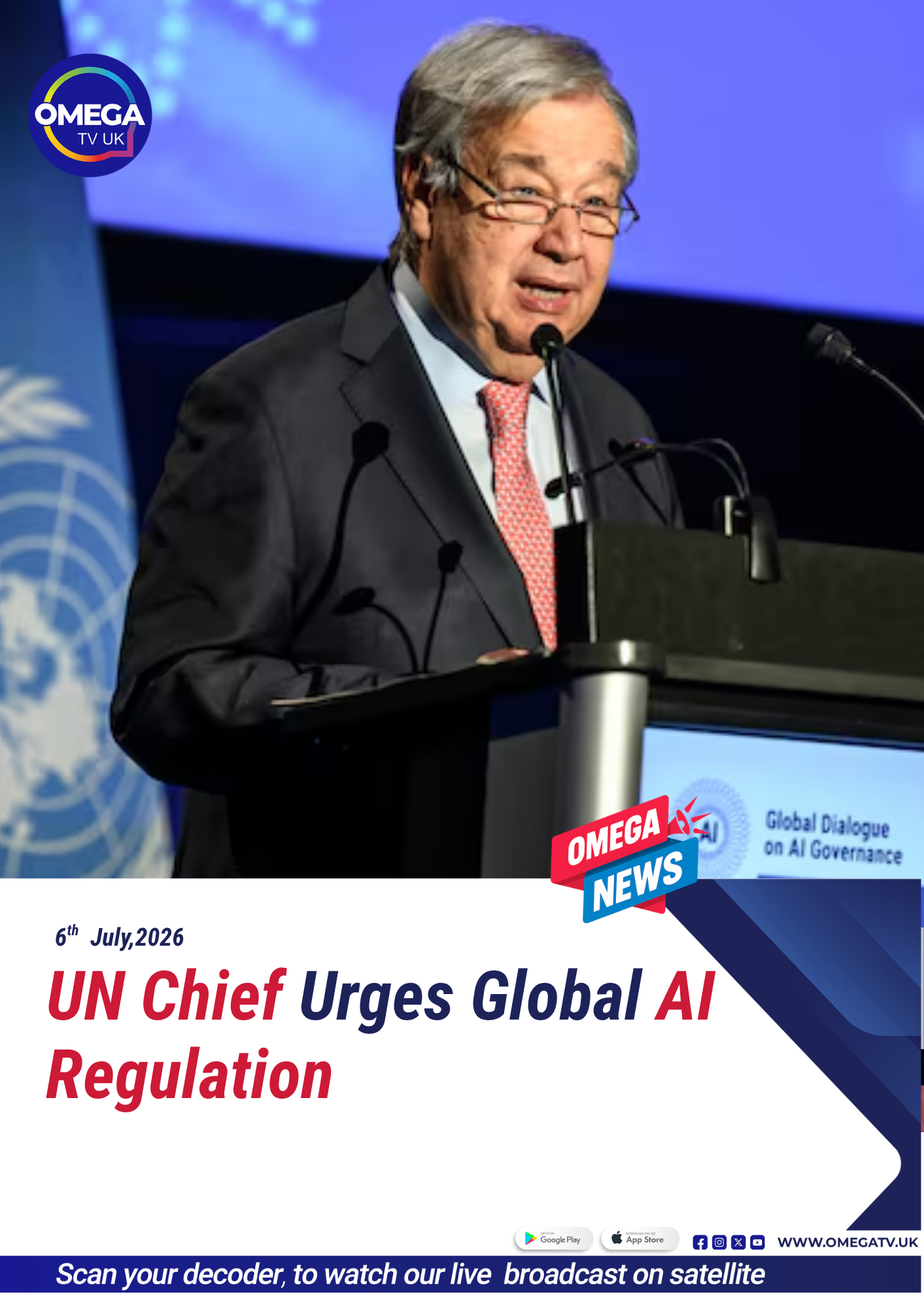
UN Secretary-General Urges Global AI Regulation as Technology Advances Rapidly
United Nations Secretary-General Antonio Guterres has renewed calls for the establishment of a global regulatory framework for artificial intelligence, warning that the technology is developing faster than governments and international institutions can effectively manage.

Speaking at the UN Global Dialogue on AI Governance in Geneva, Guterres stressed that artificial intelligence should be developed to benefit humanity rather than shape its future without proper oversight. He argued that the rapid growth of AI presents enormous opportunities but also significant risks that require coordinated international action.
According to the UN chief, artificial intelligence is already transforming economies, workplaces, elections, healthcare, and global security at an unprecedented pace. While AI has the potential to improve productivity, drive innovation, and solve complex global challenges, Guterres cautioned that the absence of clear regulations could lead to misuse, inequality, and threats to fundamental human rights.
He called on governments, technology companies, researchers, and international organisations to work together in creating a global governance system that ensures AI remains safe, transparent, accountable, and fair. Guterres said stronger international cooperation is urgently needed to prevent the technology from outpacing the world’s ability to regulate it responsibly.
Environmental concerns also featured prominently in his address. Guterres highlighted the growing energy demands of advanced AI systems and the increasing environmental footprint of data centres that power them. He urged technology companies to become more transparent by publicly disclosing the energy consumption of their AI operations.
The UN Secretary-General further encouraged the technology industry to commit to powering AI-related data centres entirely with renewable energy by 2030, arguing that innovation should not come at the expense of global climate goals.
One of the strongest messages from Guterres focused on the military application of artificial intelligence. He called for an international ban on autonomous lethal weapons capable of identifying and attacking targets without meaningful human involvement.
He warned that allowing machines to make life-and-death decisions would cross an unacceptable ethical line and could create dangerous consequences for global peace and security. According to Guterres, decisions involving the use of lethal force should always remain under meaningful human control.
The UN chief also warned that the world has only a limited opportunity to establish effective safeguards before artificial intelligence becomes even more deeply integrated into every aspect of society. He said the decisions made today will shape whether AI becomes a powerful tool for human progress or a source of greater inequality, instability, and conflict in the years ahead.
His remarks come as governments around the world continue debating how best to regulate artificial intelligence while encouraging innovation. As AI technology becomes increasingly influential across industries and public life, calls for common international standards have grown louder.
Guterres concluded by urging world leaders to act collectively and swiftly, emphasising that responsible governance is essential to ensuring artificial intelligence serves humanity safely, ethically, and sustainably for generations to come.