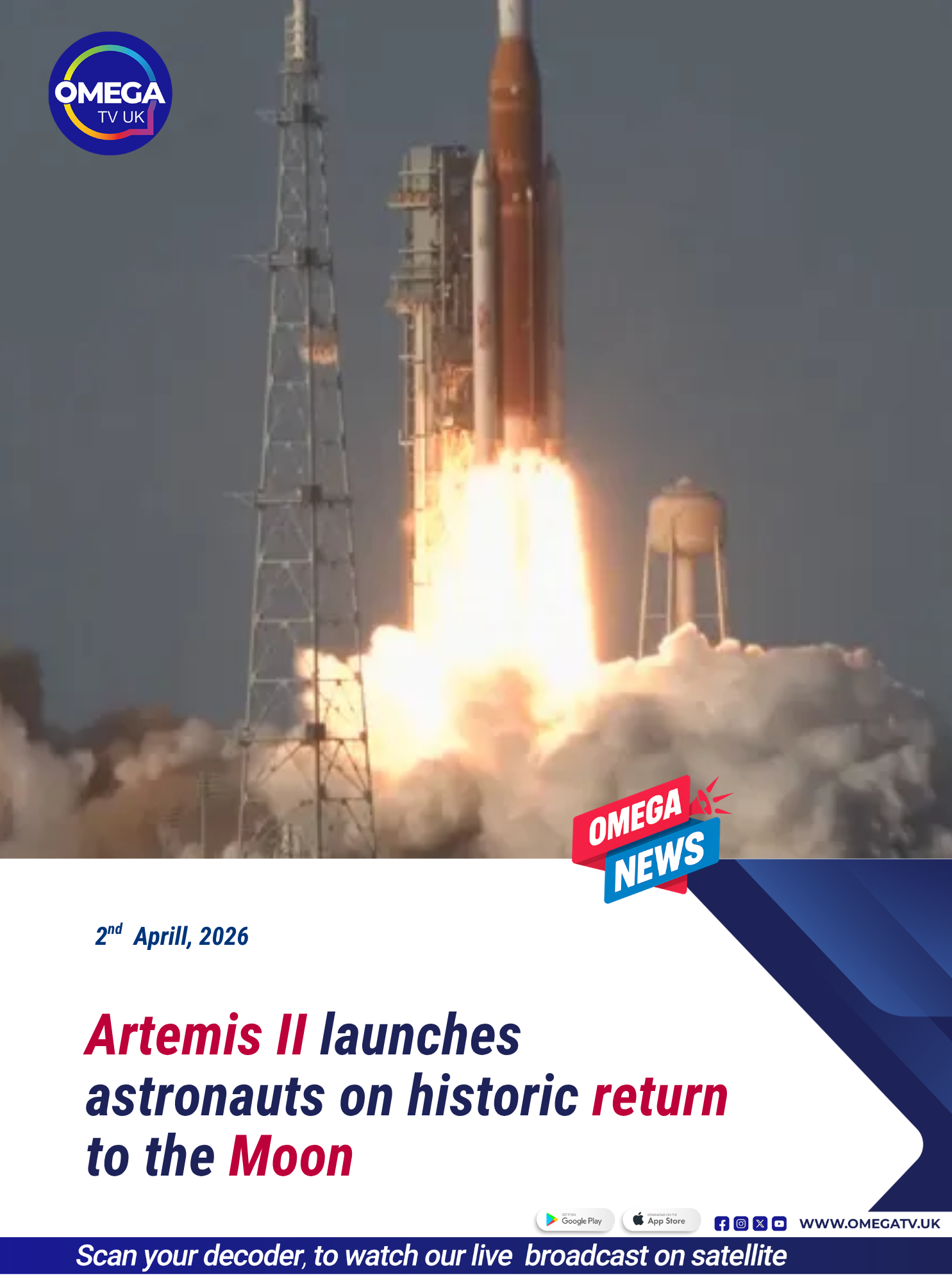
A new chapter in human space exploration has begun as Artemis II successfully launched, sending four astronauts on a historic journey around the Moon for the first time in more than five decades. The mission marks humanity’s return to deep space exploration since the final Apollo-era lunar flight in 1972.
The spacecraft lifted off from Kennedy Space Center on Wednesday evening, carrying a multinational crew on a carefully planned 10-day mission to orbit the Moon and return safely to Earth. The launch represents a major milestone for NASA and its international partners, as they work toward establishing a sustained human presence beyond Earth.
On board the spacecraft are four astronauts: Reid Wiseman, Victor Glover, and Christina Koch, alongside Jeremy Hansen of the Canadian Space Agency. Together, they represent a diverse and experienced team chosen to lead one of the most significant missions of the modern space era.
Shortly after launch, the crew completed initial operations and began settling into their journey. Mission planners scheduled a structured rest cycle to help the astronauts adapt to the demands of space travel. After an initial period of activity, the crew entered a four-hour sleep phase, followed by an orbit adjustment maneuver before another rest period. This careful pacing is designed to ensure peak performance during critical stages of the mission.
Artemis II is not a landing mission but rather a crucial test flight that will orbit the Moon and return. Its primary goal is to evaluate the spacecraft’s systems, life-support capabilities, and crew performance in deep space conditions. The data gathered will play a vital role in preparing for future missions that aim to land astronauts on the lunar surface once again.
The significance of this mission extends beyond its technical objectives. It represents the first time humans have traveled to the vicinity of the Moon since the end of the Apollo program, which famously put astronauts on the lunar surface between 1969 and 1972. For many, Artemis II symbolizes a renewed commitment to exploration and a stepping stone toward more ambitious goals, including missions to Mars.
One of the mission’s most remarkable aspects is its potential to push the boundaries of human spaceflight. The spacecraft is expected to travel farther from Earth than any human mission in history, surpassing the distance records set during the Apollo era. This extended range will test both the technology and the resilience of the crew in ways not seen for generations.
The mission also reflects growing international collaboration in space exploration. The inclusion of a Canadian astronaut highlights the global nature of modern space efforts, as agencies around the world contribute expertise, technology, and personnel to shared goals. This cooperative approach is expected to become even more important as missions grow in complexity and ambition.
Beyond its scientific and technical achievements, Artemis II carries symbolic weight. It represents a bridge between the pioneering achievements of the past and the possibilities of the future. For a new generation, it offers a glimpse of what lies beyond Earth and inspires renewed interest in space exploration.
As the spacecraft continues its journey, all eyes remain on the crew and mission control teams working around the clock to ensure its success. Each phase of the mission will be closely monitored, with lessons learned feeding directly into future Artemis missions, including those that aim to return humans to the Moon’s surface.
If successful, Artemis II will not only validate critical systems but also reaffirm humanity’s ability to venture beyond low Earth orbit. It sets the stage for a new era of exploration, where the Moon once again becomes a destination—and a gateway to even more distant worlds.