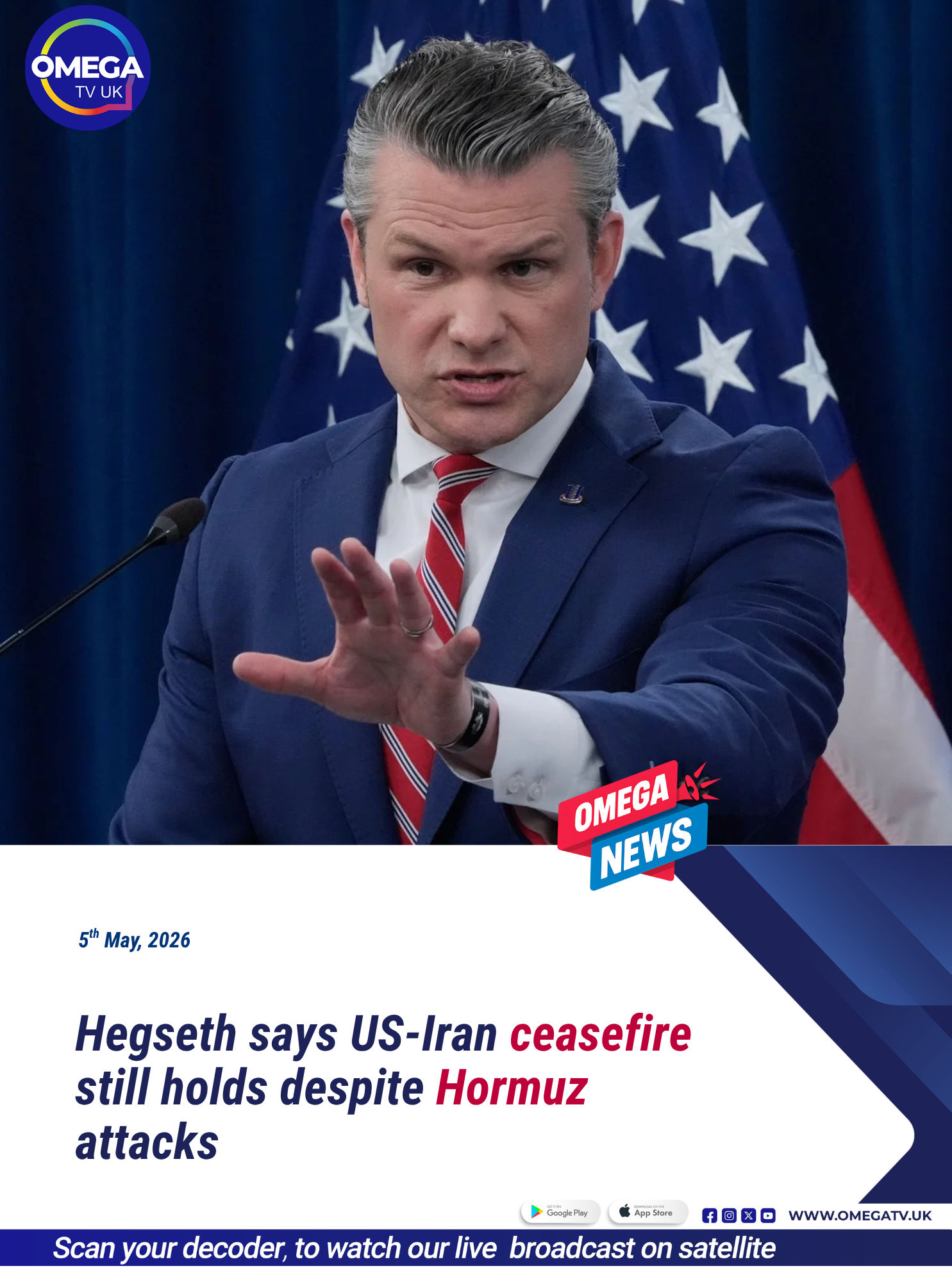
US Defence Secretary Pete Hegseth has insisted that the fragile ceasefire between the United States and Iran remains in place despite renewed attacks in the Strait of Hormuz.

Speaking after Monday’s escalation, Hegseth said the US-Iran ceasefire is “not over”, even as tensions continue to rise across the strategic waterway.
He claimed there is now a strong US military presence protecting maritime movement in the area, describing it as a “red, white and blue dome” over the Strait of Hormuz.
According to Hegseth, the successful transit of two US commercial ships on Monday showed the route remains operational despite recent threats.
The comments come after Iran’s top negotiator warned Washington that “we are just getting started”, following military exchanges and attacks targeting ships in the region.
US President Donald Trump’s “Project Freedom” is aimed at using American military assets to escort stranded commercial vessels through the Strait of Hormuz, a key global oil shipping route.
However, Iran has rejected US claims of control over the waterway, insisting it remains under Tehran’s influence.
The US accused Iran of firing missiles and drones at both military and commercial vessels in the strait on Monday, further threatening the already fragile truce.
Meanwhile, the United Arab Emirates reported intercepting 15 Iranian missiles and four drones, raising concerns that the conflict could spill further across the Gulf region.
Analysts warn that while both Washington and Tehran continue to publicly support the ceasefire, the situation remains extremely volatile.
Without significant diplomatic concessions from either side, experts say the risk of renewed large-scale hostilities remains dangerously high, with just one incident potentially triggering a wider conflict.
The Strait of Hormuz remains one of the world’s most strategically important waterways, handling a major share of global oil exports, making continued instability a serious concern for international markets and regional security.