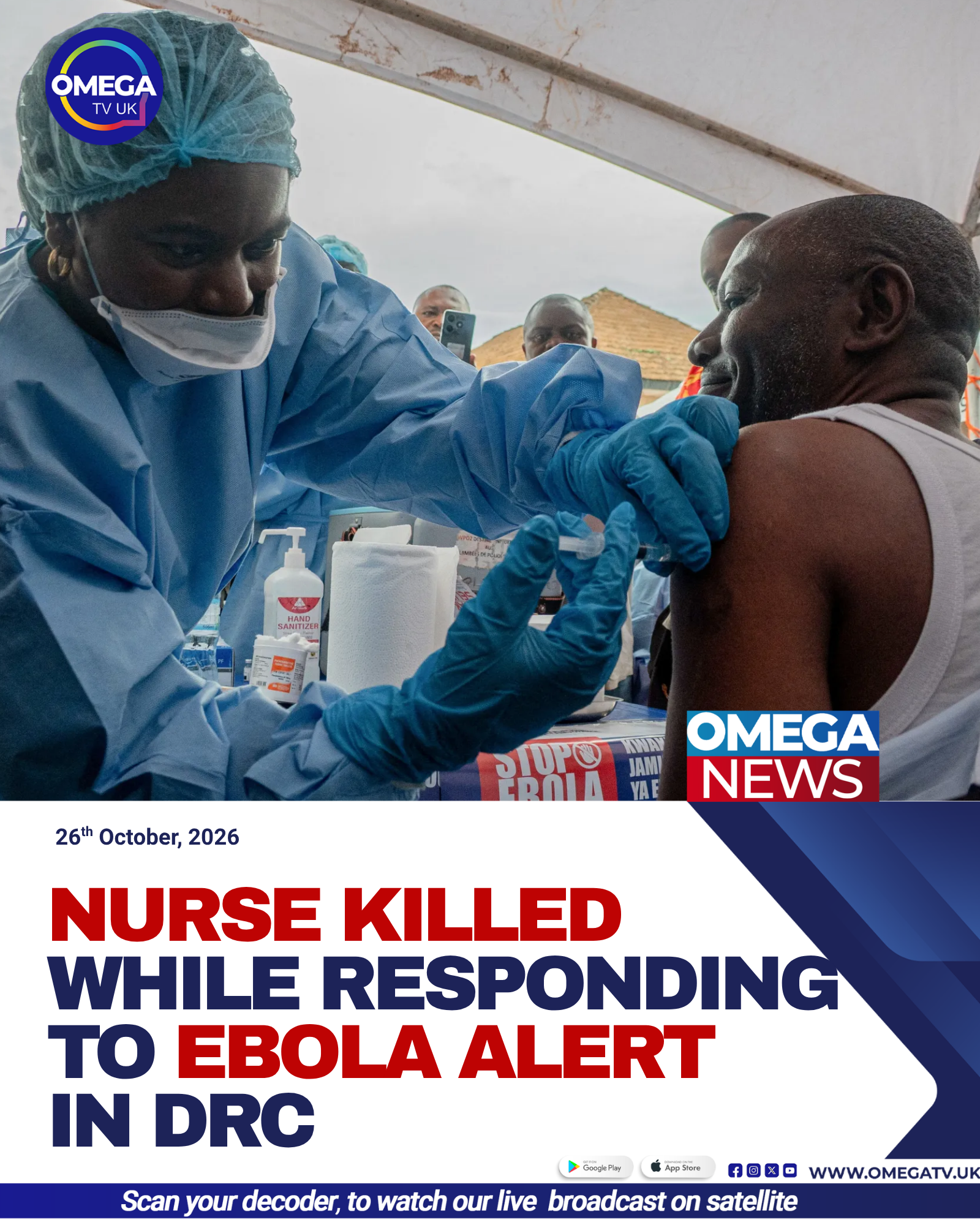
Nurse Killed in Attack While Responding to Ebola Alert in DR Congo
A nurse has been killed and another health worker seriously injured after they were attacked while responding to an Ebola alert in the Democratic Republic of Congo (DR Congo), amid growing hostility towards medical personnel fighting the deadly outbreak.

The attack occurred on Saturday, 24 October, in Bafwasende, in the eastern province of Tshopo. According to local reports, the victims were targeted by youths who accused them of spreading Ebola by contaminating local water sources.
The allegations have been rejected by health and administrative authorities, who have warned that rumours and misinformation are undermining efforts to contain the disease.
The World Health Organization (WHO) condemned the attack, expressing condolences to the family and colleagues of the nurse who died and wishing the injured worker a full recovery.
WHO Director-General Tedros Adhanom Ghebreyesus stressed that health workers must be able to carry out their duties safely and with dignity, emphasising that healthcare personnel must be protected while serving affected communities.
The killing comes as DR Congo battles its deadliest Ebola outbreak on record. Nearly 10,000 confirmed cases have been reported since the outbreak began in May, with the latest national figures indicating that more than 4,800 people have died. The outbreak is caused by the Bundibugyo strain of the virus, which continues to spread across several provinces. <Cite refs={[“turn895000view0″,”turn895000view2”]}/>
Growing hostility towards health workers
The latest attack highlights the dangers faced by medical teams working to control the outbreak, particularly in communities where fear and misinformation have fuelled distrust of health authorities.
According to local reports, the nurse and the injured worker were accused of being responsible for spreading the virus. Authorities have urged residents to rely on verified health information and cooperate with medical personnel involved in Ebola prevention and treatment.
Other attacks have also been reported during the outbreak. Last month, a politician was beaten to death after publicly supporting measures to prevent Ebola transmission. In previous incidents, Red Cross volunteers were injured and an ambulance was set on fire.
Such violence threatens efforts to identify infections, trace contacts and provide treatment, particularly in remote communities where access to healthcare is already limited.
The United Nations’ senior Ebola response coordinator, Julien Harneis, also condemned the killing, describing it as a serious loss for the outbreak response and for patients who depend on healthcare workers. He called for a thorough investigation and urged communities to allow medical teams to work safely.
Uganda tightens border measures
Neighbouring Uganda has strengthened its Ebola prevention measures because of continued transmission in DR Congo and the detection of imported cases elsewhere in the region.
The Ugandan government has restricted movement across its border with DR Congo to essential travellers, including humanitarian workers and truck drivers, subject to health screening. Ugandans returning from DR Congo with a history of travel there must undergo 21 days of quarantine at their own expense.
Authorities have also strengthened screening and contact-tracing arrangements as regional health officials work to prevent further cross-border transmission.
The measures follow reports of Ebola cases in Kenya and Nigeria linked to the wider regional outbreak. Investigations are continuing to establish the patients’ exposure histories and possible routes of infection.
Regional concern grows
Ebola spreads through direct contact with the bodily fluids of an infected person or contaminated materials. The current Bundibugyo outbreak has no approved specific vaccine or treatment, making early detection, appropriate medical care and infection-prevention measures particularly important.
Health officials continue to face the challenge of containing the disease while addressing fears and false claims within affected communities.
The killing of the nurse has renewed calls for stronger protection for frontline health workers and increased public education. Authorities are urging residents to cooperate with disease-control teams, warning that attacks on medical personnel could further obstruct efforts to contain the outbreak and save lives.