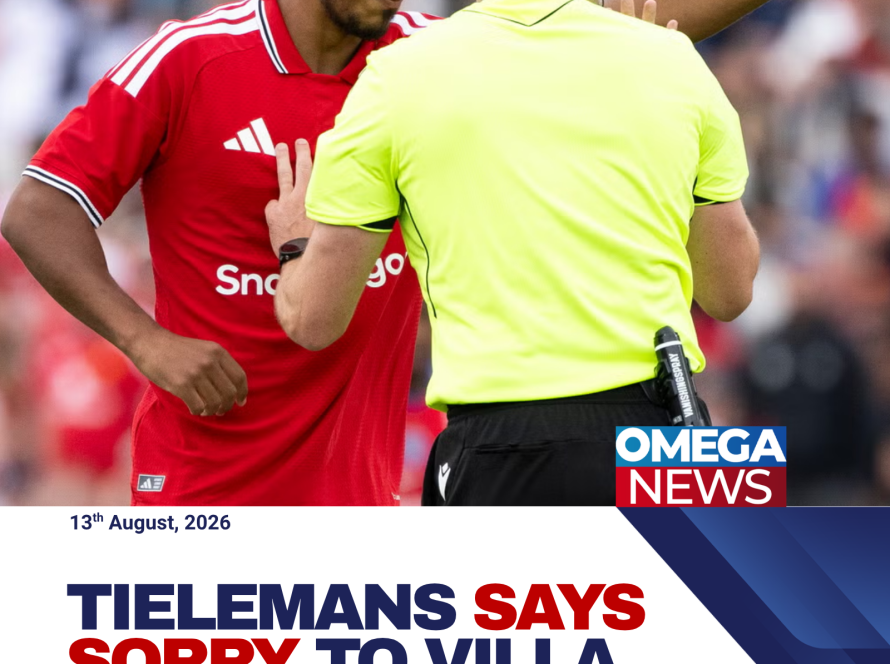
The Premier League refereeing body Pro Ref has admitted an “error of judgement” in the decision to award Erling Haaland’s controversial winning goal in Manchester City’s 1-0 victory over Manchester United at Old Trafford.

Haaland scored in the 60th minute, converting Josko Gvardiol’s cross at the back post after City had been reduced to 10 men. The goal was initially ruled out for offside, with the striker appearing to have moved beyond United’s defensive line.
However, a VAR review overturned the decision after the technology showed Haaland was played onside by Patrick Dorgu’s boot.
The decision immediately sparked controversy because United midfielder Enzo Fernandez was also in an offside position and appeared to be attempting to play the ball. Although Fernandez did not make contact with it, questions were raised about whether his movement interfered with United defender Lisandro Martinez and goalkeeper Senne Lammens.
Pro Ref later acknowledged that the VAR should have recommended an on-field review because Fernandez’s position and movement could have affected the play.
“It was established that Enzo Fernandez did not play the ball and therefore that makes any offside offence subjective,” Pro Ref said.
“However, on this occasion, the VAR did not recognise the likely impact of his position and should have recommended an on-field review.”
The refereeing body confirmed it had contacted Manchester United to acknowledge what it described as an “error of judgement” and said the incident would be reviewed.
United defender Martinez described the decision as an “injustice”, while manager Michael Carrick said he was “confused” by the explanation behind the ruling.
Why Haaland’s Goal Became Controversial
The controversy centred on two separate offside decisions.
Haaland was originally flagged offside, but VAR correctly determined that Dorgu’s boot had kept the Manchester City striker onside. Gvardiol’s cross had also taken a slight deflection from Dorgu before reaching Haaland at the far post.
However, Fernandez was positioned ahead of Dorgu and was clearly attempting to reach the ball with a diving header in the middle of the six-yard box. Although he failed to make contact, the question was whether his attempt affected an opponent.
Under the offside law, a player in an offside position can be penalised if they are clearly attempting to play a nearby ball and that action impacts an opponent.
Fernandez’s movement brought him directly into the area where Martinez was also trying to deal with the cross. The argument, therefore, was that Martinez may have reacted differently had Fernandez not attempted to play the ball.
The Premier League Match Centre said VAR had checked the original offside decision and determined that Haaland was onside. It also concluded that Fernandez, despite being in an offside position, had not played the ball.
However, BBC Sport football issues correspondent Dale Johnson argued that this interpretation failed to properly consider Fernandez’s involvement.
Johnson explained that the original decision to disallow Haaland’s goal was incorrect because the striker was onside. But once that decision was overturned, VAR should have considered whether Fernandez had committed a separate, subjective offside offence.
He argued that Fernandez’s attempted header could have influenced Martinez’s decision-making because the ball passed close to both players.
Johnson also suggested that Fernandez’s movement may have affected goalkeeper Lammens’ positioning.
In his view, VAR should therefore have sent referee Michael Oliver to the pitchside monitor so he could make a subjective decision on Fernandez’s involvement.
That would have produced an unusual outcome in which VAR overturned the original reason for disallowing a goal but still recommended that the goal remain disallowed for a different offside offence.
Johnson described the incident as a clear VAR mistake and questioned whether officials had focused too heavily on whether Fernandez had touched the ball while overlooking his offside position and attempted involvement.
He also pointed to a similar incident involving Arsenal and Brentford in February 2023, when an offside Christian Norgaard was involved in a goal that was allowed to stand.
Manchester United Furious Over Decision
With Haaland’s goal ultimately deciding the derby, Manchester United were understandably angry about the decision.
Martinez said he believed Fernandez was offside and questioned how officials had interpreted the rules.
“I think it was offside,” Martinez said, adding that it was difficult to accept losing a derby at home because of what he considered a refereeing mistake.
He criticised the situation in the Premier League, saying referees regularly visit clubs to explain the laws of the game but that significant mistakes continue to occur.
Carrick was also concerned about the interpretation of what constitutes interfering with play.
“We put things in place in the game now, we have people in offices with all the screens for this decision,” he said.
He questioned whether the decision represented the current interpretation of interference, describing the explanation as worrying and staggering.
Carrick acknowledged that the decision would not determine Manchester United’s entire season but said it had a major effect on the derby itself.
Former United striker Wayne Rooney was equally critical of the decision while working on BBC’s Match of the Day.
“Surely it’s offside,” Rooney said, arguing that Martinez was affected by Fernandez’s movement. He also expressed frustration with VAR and said players who had played football would recognise the situation as offside.
Former Tottenham midfielder Danny Murphy also believed Fernandez’s movement affected Martinez and Lammens.
Murphy argued that if Fernandez had not made his run, Martinez would have remained focused on Haaland, making the impact of the offside player more obvious.
Former Manchester United defender Gary Neville predicted that the refereeing body would eventually issue an apology, saying Fernandez was clearly attempting to play the ball and distract Martinez.
Micah Richards also criticised the officiating, saying referees had made mistakes both with the Fernandez incident and Foden’s first-half dismissal.
However, Richards stressed that the controversy should not take away from Manchester City’s overall performance.
City manager Enzo Maresca was far less concerned about the controversy, simply saying he believed the goal was clearly onside.
Controversial Red Card for Phil Foden
Haaland’s decisive goal came after another major refereeing controversy in the first half.
Manchester City midfielder Phil Foden was sent off in the 23rd minute after kicking out at Manchester United captain Bruno Fernandes.
Foden had collected the ball on the right side of City’s half when Fernandes closed him down and appeared to trip him. While Foden was on the ground, he reacted by kicking towards Fernandes’ body.
Referee Michael Oliver immediately showed Foden a straight red card, leaving City to play with 10 men for more than an hour.
VAR reviewed the incident but upheld the referee’s decision.
However, replays showed that Fernandes had kicked Foden in the back before Foden reacted, creating further debate over whether the City midfielder deserved to be dismissed.
Former United forward Rooney believed the incident did not warrant a red card, describing Foden’s action as more of a flick or gesture than an intentional kick.
Neville said he was surprised that Fernandes was not booked for his involvement in the confrontation.
Former United midfielder Roy Keane also argued that Fernandes was responsible for starting the incident.
“Foden gets up and reacts obviously, so he’s sent off,” Keane said. “Fernandes catches him and gives him a little kick. I guess it’s classed as violent. But Fernandes is the one who is violent here, I don’t think Foden should have a red card.”
Dale Johnson explained that officials would have needed to determine whether Fernandes’ action amounted to violent conduct rather than simply petulant behaviour.
He noted that refereeing guidance had changed in recent years, meaning similar incidents are now assessed differently.
Johnson compared the situation with David Beckham’s famous kick on Diego Simeone during the 1998 World Cup, which would not necessarily result in a red card under today’s interpretation.
He said Fernandes appeared to make little or no contact with Foden and, if contact occurred, it appeared limited in force and was not followed through.
As a result, Johnson believed Fernandes’ initial action would more likely have been considered worthy of a yellow card, which VAR could not intervene on because it was not a clear red-card offence.
The combination of the disputed red card and the controversial winning goal left Manchester United frustrated, while Manchester City secured a remarkable derby victory despite playing most of the match with 10 men.