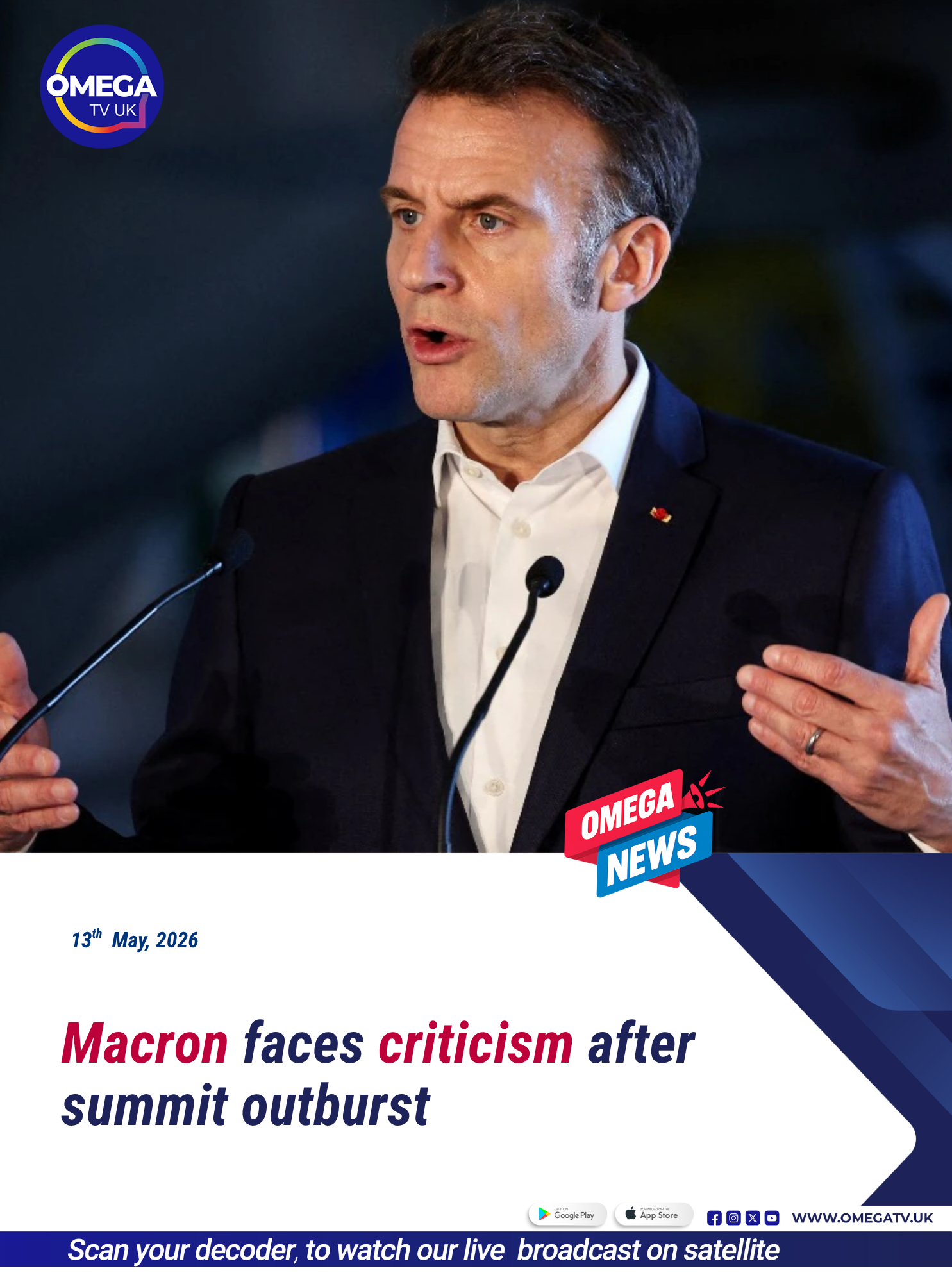
Macron Faces Backlash After Heated Outburst at Africa Summit in Kenya
French President Emmanuel Macron is facing criticism after a tense moment at the Africa Forward Summit in Kenya, where he interrupted a panel discussion to reprimand audience members over disruptions during a presentation.

The incident occurred during a session featuring artists and young entrepreneurs at the summit, an event designed to promote France’s renewed engagement strategy with Africa. Videos circulating on social media show Macron visibly frustrated before walking onto the stage, taking the microphone, and demanding silence from the audience.
Calling the noise in the room disrespectful, Macron criticized attendees for speaking over presenters and disrupting the session.
“This is a total lack of respect,” he reportedly told the audience in English as he attempted to restore order.
The unexpected intervention quickly became a talking point online, drawing mixed reactions ranging from praise to strong criticism.
Some attendees applauded Macron’s move, viewing it as an effort to protect speakers and maintain decorum. Others, however, argued that his tone and manner reinforced longstanding concerns about France’s posture toward Africa.
Critics accused the French leader of behaving in a patronizing manner, particularly given the continent’s colonial history with France.
“Just imagine what would happen if an African leader did the same thing in America or Europe,” said Thierno Mbaye, a university student in Dakar, Senegal. He described Macron’s behavior as resembling “a schoolteacher scolding children.”
Backlash also came from within France. Danièle Obono, a lawmaker from the left-wing France Unbowed party, criticized Macron on social media, accusing him of displaying colonial-era attitudes.
“As soon as he sets foot on the African continent, he can’t help but behave like a colonizer,” she wrote.
The controversy comes at a sensitive time for France, which is actively trying to rebuild strained relationships with African nations after years of diplomatic and military setbacks, especially in West Africa.
The Africa Forward Summit was intended to showcase what Paris describes as a new partnership model with Africa—one based on equality rather than the historically criticized “Françafrique” system, through which France maintained strong political, economic, and military influence in former colonies.
During the summit, Macron announced a $27 billion investment package targeting sectors including energy, artificial intelligence, and agriculture across Africa.
However, the summit has been overshadowed by controversy following Macron’s earlier comments describing himself and France as “the true Pan-Africanists” during a joint press conference with Kenyan President William Ruto.
The remark sparked immediate backlash across social media and political circles.
Pan-Africanism is a political ideology centered on African unity, self-determination, and resistance to colonialism. Given France’s long colonial history on the continent, critics viewed Macron’s use of the term as inappropriate or tone-deaf.
Farida Nabourema, a Togolese human rights activist, publicly challenged Macron’s statement in an open letter.
“Pan-Africanism is not a brand, Mr. Macron,” she wrote. “It is a political philosophy that said no to everything France spent centuries saying yes to: slavery, colonialism and neocolonialism.”
Political analysts say Macron’s recent Africa strategy reflects France’s attempt to shift its focus after being forced to withdraw troops from several West African nations, including Mali, Burkina Faso, Niger, and Senegal, where anti-French sentiment has grown significantly.
According to analysts, Macron is now placing greater emphasis on East Africa and English-speaking countries, where France hopes to find stronger diplomatic goodwill.
Beverly Ochieng, a geopolitical analyst at Control Risks, said Macron is attempting to distance France from its recent setbacks while rebranding its Africa policy.
Still, she noted that Macron’s remarks and actions continue to raise questions about whether France’s new approach represents a genuine equal partnership or simply a repackaging of old dynamics.
Macron later reiterated that France respects the sovereignty and independence of African nations, stating that Africa’s success is tied to Europe’s future.
“Your success is our success,” he said, emphasizing shared autonomy and partnership.
Despite the backlash, Macron continues to push his message of renewed France-Africa cooperation but the summit has highlighted how deeply historical tensions still shape perceptions of French diplomacy on the continent.