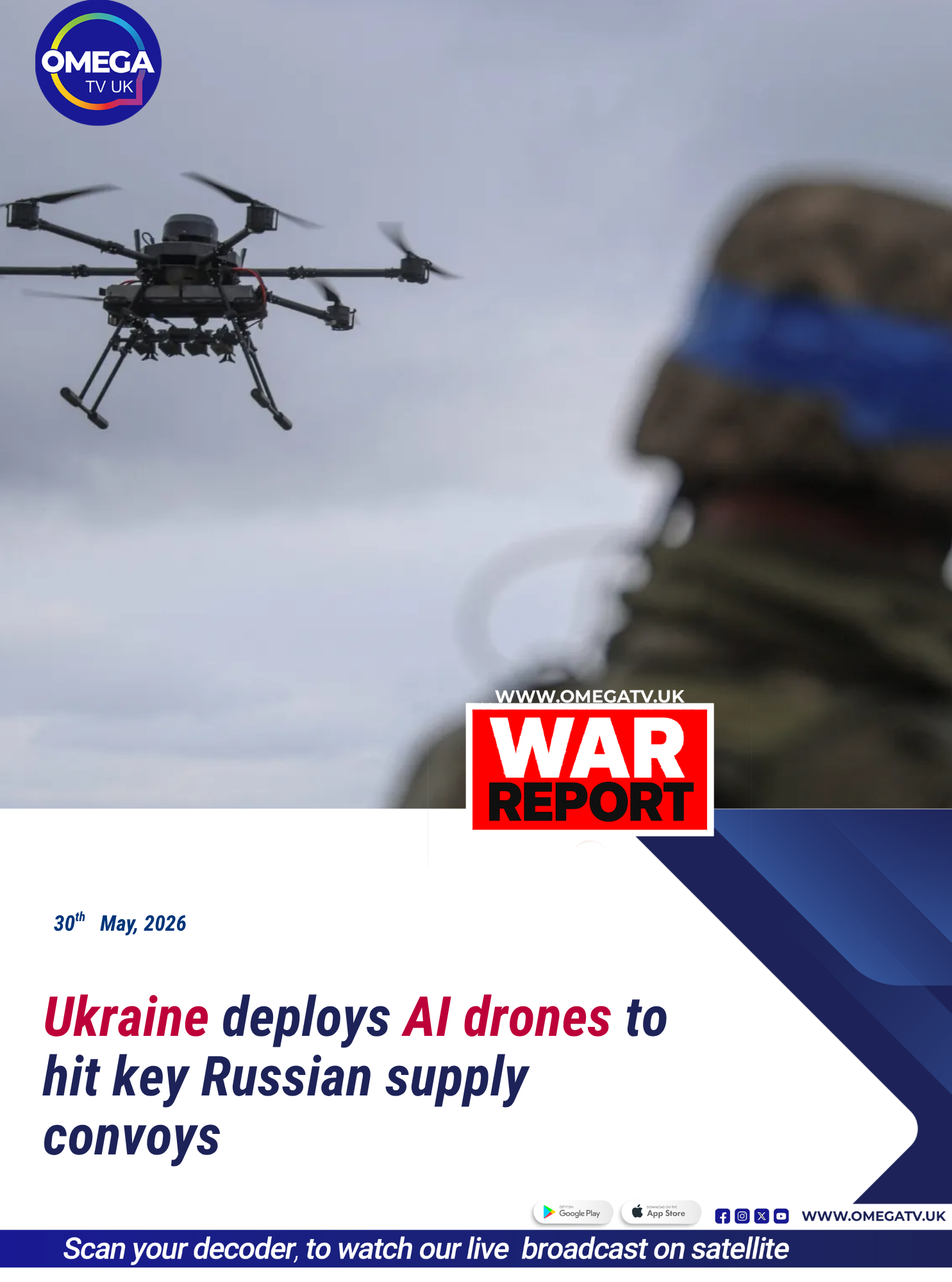
Ukraine is intensifying its efforts to disrupt Russian military supply lines using advanced artificial intelligence-powered drone technology, marking a significant shift in the battlefield dynamics of the war.

According to military analysts and verified footage reviewed by BBC Verify, Ukrainian forces have carried out a growing number of long-range drone strikes targeting Russian logistics convoys transporting fuel, ammunition and food to troops stationed in occupied areas of Ukraine. At least 14 separate incidents were documented over the past week alone.
The attacks have focused on strategic routes linking Russia to occupied territories in southern Ukraine, including Crimea, Mariupol and Melitopol. These roads are considered vital lifelines for Russian forces operating along the front lines.
Experts say the strikes are part of Ukraine’s broader “logistics lockdown” strategy, designed to weaken Russia’s ability to sustain offensive operations by disrupting supply chains far behind the battlefield.
Ukraine’s Defence Minister, Mykhailo Fedorov, said the objective is to increase pressure on Russian forces by targeting critical support infrastructure in the rear areas.
Military analysts note that Ukraine is now using AI-enabled drone systems such as the Hornet platform, which can identify and track targets with greater accuracy. The technology has reportedly been trained using thousands of hours of footage of Russian military vehicles and equipment collected since the start of the war.
Unlike traditional drones, these systems can travel long distances, operate with reduced human input and resist electronic jamming. Some are also capable of using satellite communication networks to maintain contact with operators over extended ranges.
Open-source intelligence analysts have confirmed the destruction of numerous vehicles more than 20 kilometres from the front line, while some estimates suggest the actual number of successful strikes may be considerably higher.
The impact is already being felt on the battlefield. Analysts say Russia has been forced to adapt by reducing convoy sizes and altering transport routes in an attempt to minimise losses. Some vehicles are now travelling on dirt roads and through fields to avoid detection.
According to experts, disrupting supply routes can be just as important as destroying tanks or military bases. Modern armies rely heavily on a continuous flow of fuel, ammunition, food and equipment to maintain combat operations.
Research from military think tanks suggests a single brigade can require hundreds of tonnes of supplies every day. Any disruption to those deliveries can affect troop readiness and operational effectiveness.
The latest developments come as battlefield assessments indicate that Ukraine is beginning to regain more territory than it is losing for the first time since 2023. While front-line changes remain relatively small, analysts believe Ukraine’s expanding drone capabilities are helping shift momentum by targeting Russian support networks rather than engaging solely in direct combat.
The Institute for the Study of War (ISW) argues that Ukraine’s growing drone superiority is reducing Russia’s ability to move personnel and supplies efficiently. This has made it increasingly difficult for Russian forces to maintain pressure across multiple sectors of the front.
However, analysts caution that the advantage may not last indefinitely. Russia is expected to develop new countermeasures and defensive tactics to reduce the effectiveness of AI-guided drone operations.
For now, Ukraine’s technological innovation is emerging as one of its most effective tools in challenging Russia’s military logistics and reshaping the battlefield after more than four years of conflict.