Ethiopia Acquires Russian Fighter Jets Amid Renewed Fighting in Tigray
Ethiopia has announced the acquisition of advanced Russian fighter jets as renewed fighting in the northern Tigray region and rising tensions with neighbouring Eritrea increase security concerns across the Horn of Africa.

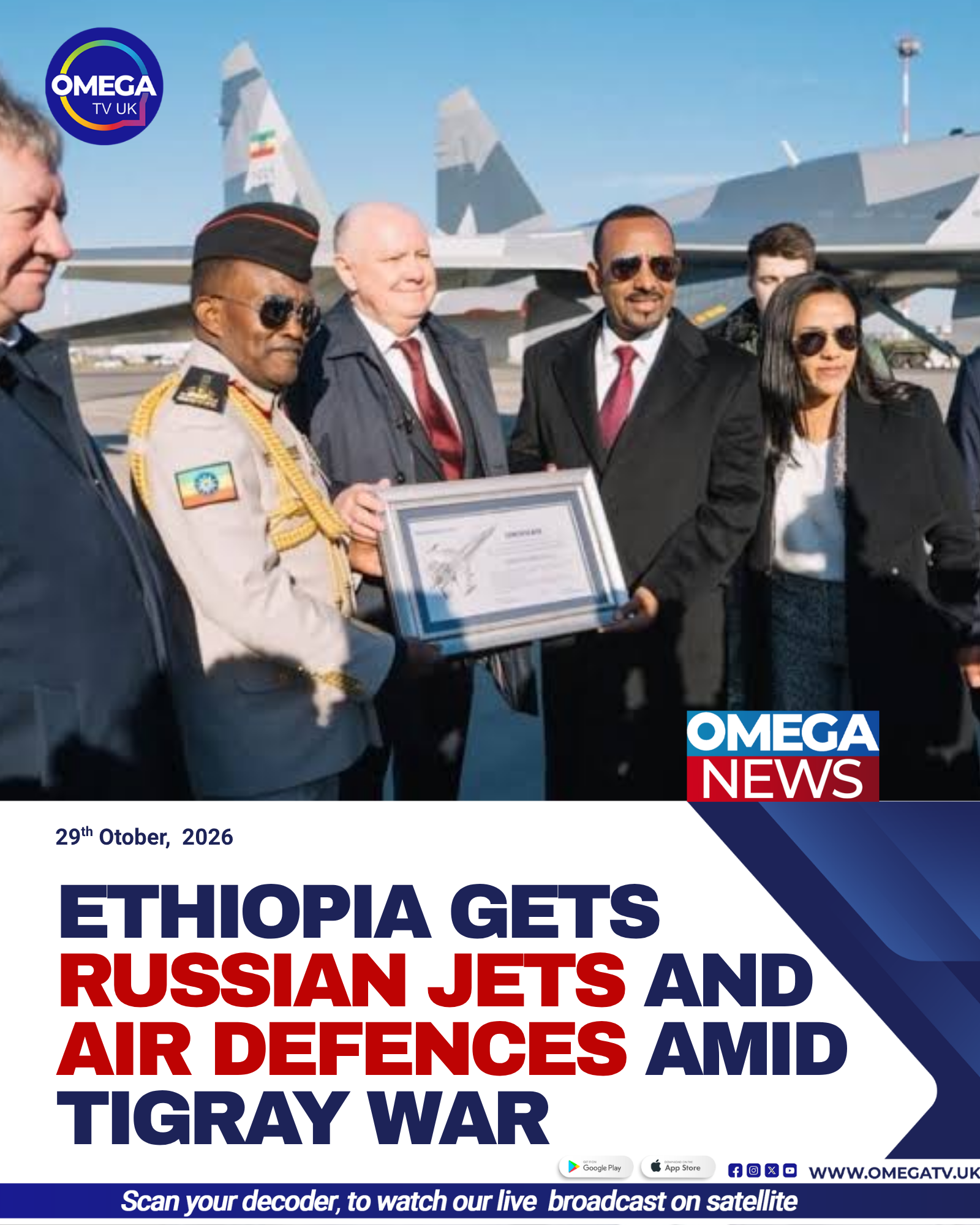
Prime Minister Abiy Ahmed announced on Wednesday, 28 October, that Ethiopia had received the first batch of Su-35 fighter jets under an existing agreement with Russia. He also confirmed plans to acquire four S-400 air defence system batteries from Moscow.
While Abiy referred to a total of 12 Su-35 aircraft under the agreement, Russia’s state-owned arms exporter told Reuters that the initial delivery consisted of two jets. The timing of the remaining deliveries and the arrival of the S-400 systems have not been announced. <Cite refs={[“turn803625news28″,”turn803625search9”]}/>
The announcement came as Abiy attended the Russia-Africa Summit in Moscow, where he praised Russian President Vladimir Putin for facilitating the delivery ahead of schedule.
The Ethiopian leader described the acquisition as a milestone in strengthening the country’s defence capabilities, arguing that modern military equipment was essential to protecting national sovereignty and deterring external threats.
Ethiopia strengthens its military capabilities
The Su-35 is a Russian-made multirole fighter designed for air-to-air combat and ground-attack missions. Its advanced radar and manoeuvrability allow it to engage aircraft and other potential threats over long distances.
The planned S-400 systems are designed to intercept aircraft, cruise missiles and certain other airborne threats, potentially strengthening Ethiopia’s ability to defend important military installations and infrastructure.
Abiy said Ethiopia needed to develop modern military capabilities to remain secure in a region facing growing instability.
He also highlighted the importance of unmanned aerial vehicles, which Ethiopia has used extensively in previous conflicts, including drones sourced from Turkey and China.
Military intelligence analyst Qalaab Segatu told BBC Amharic that the acquisition indicated Ethiopia was preparing for potential external conflicts as well as continuing to confront internal security challenges.
He argued that combining modern fighter aircraft with air defence systems could improve the country’s ability to protect major cities and strategic infrastructure, including the Grand Ethiopian Renaissance Dam.
Renewed fighting in Tigray
The military purchases come as fighting has intensified in northern Ethiopia, where renewed clashes involving federal forces and the Tigray People’s Liberation Front (TPLF) have raised fears of another prolonged conflict.
The latest escalation follows the 2022 agreement that ended the devastating two-year war between the Ethiopian government and Tigrayan forces. Both sides have accused each other of violating the agreement.
The previous conflict killed hundreds of thousands of people and caused widespread displacement and destruction.
Ethiopia also faces insecurity in the neighbouring Amhara region, where armed groups continue to challenge federal authority.
Tensions with Eritrea add to regional concerns
Relations between Ethiopia and Eritrea have deteriorated amid accusations by Addis Ababa that Eritrea is supporting armed groups opposed to the Ethiopian government. Eritrea denies the allegations.
The two countries have a complicated history, having fought a devastating border war between 1998 and 2000 before entering a period of improved relations in 2018.
Eritrea became independent in 1993 after a decades-long struggle, leaving landlocked Ethiopia without direct access to the sea.
Abiy has increasingly described maritime access as an existential issue for Ethiopia, raising concerns in Eritrea and other neighbouring countries about the potential consequences for regional stability.
Closer military ties with Russia
Ethiopia and Russia have expanded military cooperation in recent years, including through a 2021 agreement covering military training and technological cooperation.
The latest aircraft acquisition represents a further step in that relationship as Ethiopia seeks to modernise its armed forces.
However, the financial terms of the fighter-jet agreement, the aircraft’s intended bases and the delivery schedule for the remaining equipment have not been disclosed.
The purchases could strengthen Ethiopia’s air capabilities, but their wider impact will depend on the delivery of the equipment, the military’s ability to operate and maintain it, and developments in the country’s internal conflicts.
With tensions rising across the Horn of Africa, Ethiopia’s military modernisation is likely to remain closely watched by neighbouring countries and international partners.