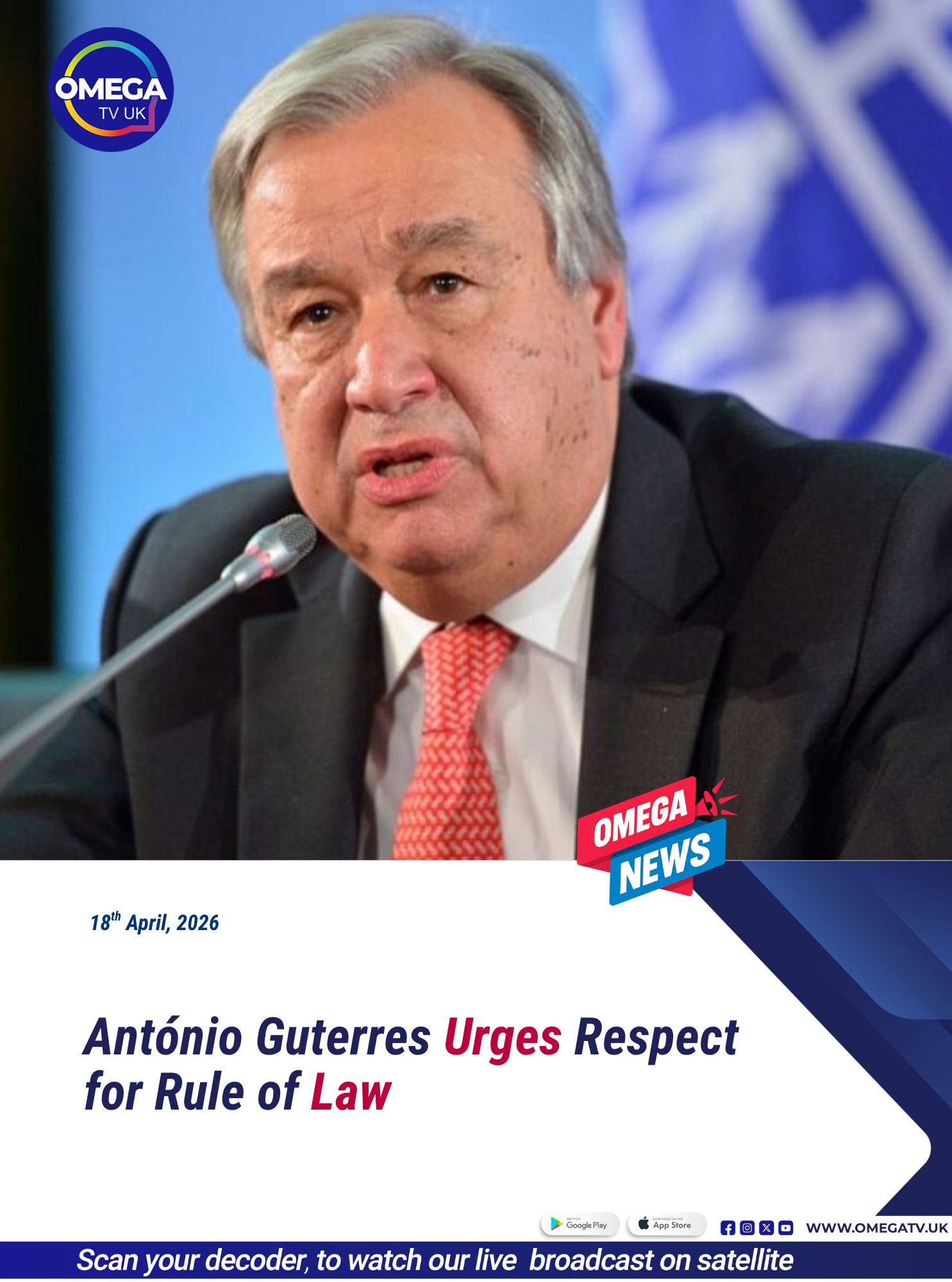
UN Chief Warns Global Law Is “Breaking Down” at ICJ 80th Anniversary Amid Rising Conflicts

United Nations Secretary-General Antonio Guterres has issued a stark warning about the state of international law, saying the global legal system is “falling apart” as conflicts intensify around the world.
Speaking at the 80th anniversary of the International Court of Justice in The Hague, Guterres urged world leaders to recommit to the rule of law, warning that failure to do so could lead to greater instability and widespread consequences.
Addressing dignitaries gathered in the court’s Great Hall, he stressed that the world is at a critical turning point. He warned that when nations abandon legal frameworks in favour of power, the effects can quickly spread across borders.
“When the law of force replaces the force of law, instability becomes contagious, conflicts spill across borders, economic shocks reverberate around the world, and the most vulnerable always suffer first and suffer most,” Guterres said.
His remarks come at a time when the international legal system is facing increasing pressure from ongoing global crises. Among the most significant challenges is the continued war in Ukraine, where Russia has been accused of violating an ICJ order related to its military actions.
The conflict has become a key example of how international rulings can be ignored, raising concerns about the effectiveness of global legal institutions in enforcing their decisions.
At the same time, the ICJ is also dealing with legal issues connected to the war in Gaza, further highlighting the strain on international courts as geopolitical tensions rise.
Beyond armed conflicts, Guterres pointed to other pressing global issues, including climate change, which are increasingly being brought before international courts as countries seek legal accountability for environmental damage.
The Secretary-General emphasised that the current situation represents a defining moment for the international system. He urged nations to choose between a future guided by legal principles or one driven by unchecked power.
“Today we face our own moment of crisis and our own moment of choice,” he said. “A choice between a future governed by the rule of law or a future driven by raw power.”
He added that it is precisely during times of global strain that adherence to international law becomes most critical. Without it, he warned, the risk of escalating conflicts and economic disruption increases significantly.
The ICJ, often referred to as the world’s highest court, plays a central role in resolving disputes between states and interpreting international law. However, it relies on countries to comply voluntarily with its rulings, which can limit its ability to enforce decisions.
Guterres’ speech reflects growing concerns within the international community about the weakening of multilateral systems and the challenges facing global governance structures.
As the ICJ marks 80 years since its establishment, the anniversary serves as both a celebration of its role and a reminder of the challenges ahead. The court has historically been a key pillar in maintaining international legal order, but its authority depends heavily on the willingness of nations to respect its judgments.
With conflicts continuing in multiple regions and global tensions showing little sign of easing, Guterres’ message underscores the urgent need for renewed commitment to international cooperation and legal accountability.