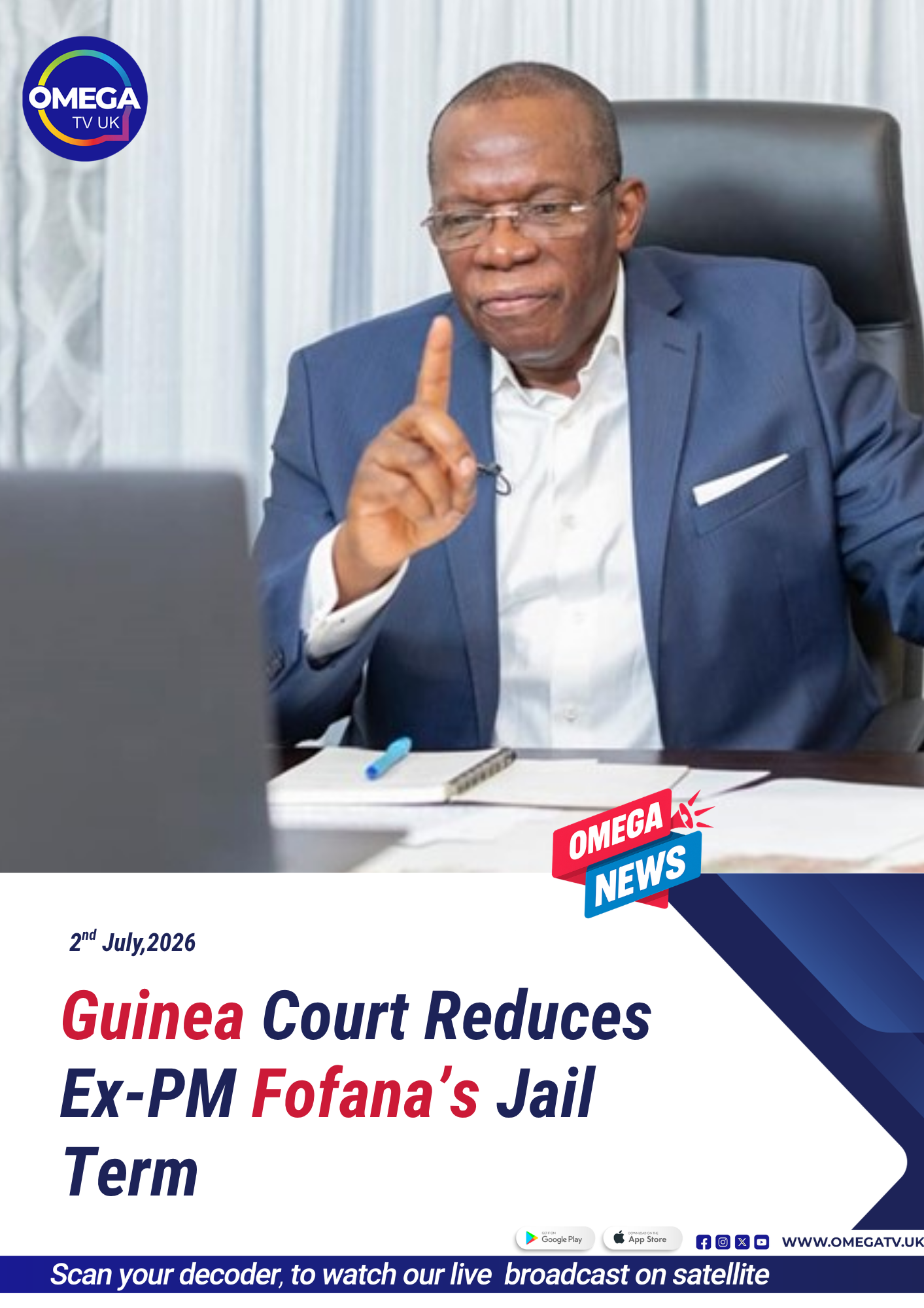
Guinea Appeals Court Reduces Ex-PM Ibrahima Kassory Fofana’s Prison Sentence
A Guinean appeals court has reduced the prison sentence of former Prime Minister Ibrahima Kassory Fofana in one of the country’s most high-profile corruption cases, clearing the way for his release after spending more than four years in detention.

The court reduced Fofana’s sentence from five years to three years and nine months. While judges overturned his conviction for embezzlement of public funds, they upheld guilty verdicts for illicit enrichment and money laundering.
Because Fofana has remained in detention since April 2022, including time spent receiving medical treatment in a clinic, the revised sentence means he has effectively completed his prison term.
Despite the reduction in his sentence, the court maintained significant financial penalties. Fofana was ordered to pay three billion Guinean francs, equivalent to approximately $340,000, to the state. The court also approved the confiscation of part of his assets as part of the ruling.
The former prime minister had been accused of misusing around 15 billion Guinean francs that had been allocated to COVID-19 response efforts and socio-economic development programmes.
Fofana served as Guinea’s prime minister under former President Alpha Condé from May 2018 until the government was overthrown in a military coup in September 2021.
His case was prosecuted by the Court for the Repression of Economic and Financial Offences (CRIEF), a special anti-corruption tribunal established after the military takeover to investigate allegations of financial crimes involving former government officials.
The prosecution has been one of the most closely watched cases under Guinea’s military-led administration, which has made fighting corruption a central part of its agenda since taking power.
Authorities have argued that the anti-corruption campaign is aimed at improving accountability and recovering public funds allegedly lost through corruption.
However, the campaign has also attracted criticism from opposition groups and human rights organisations, which argue that it has coincided with growing political restrictions under the military government led by President Mamady Doumbouya.
Since assuming power, the government has suspended several political parties, maintained a ban on public demonstrations introduced in 2022, and increased pressure on opposition leaders and civil society organisations.
Human rights groups have also raised concerns over arrests, convictions, reports of forced exile, and the disappearance of opposition activists, questioning the broader political climate during Guinea’s ongoing transition.
The appeals court’s decision marks another significant development in Guinea’s efforts to address alleged corruption involving former senior officials while debate continues over the balance between accountability, justice, and political freedoms.