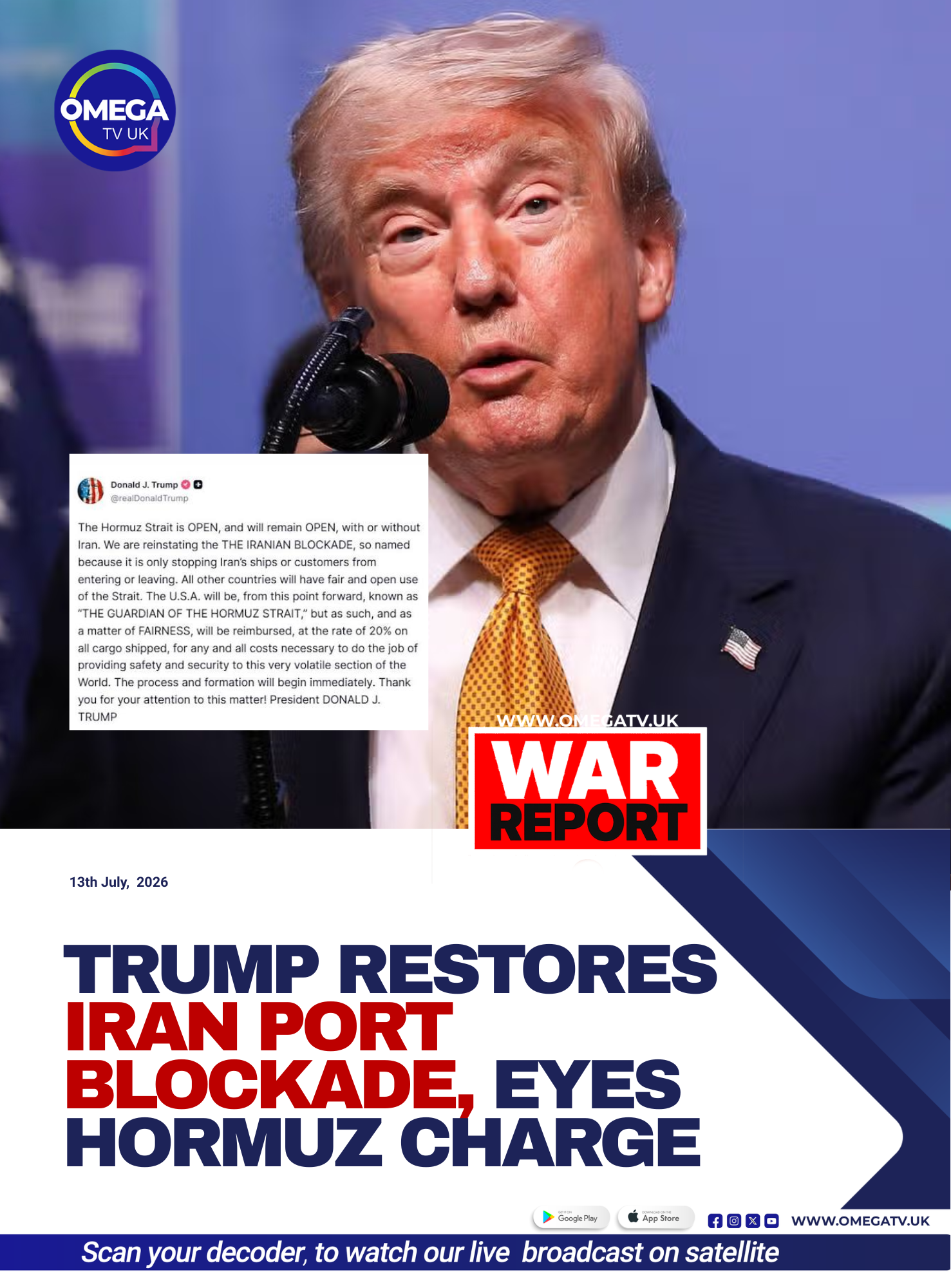
US President Donald Trump has announced the reinstatement of a naval blockade on Iranian ports and introduced a controversial plan to impose a 20% charge on all cargo passing through the Strait of Hormuz.

The announcement comes after several days of escalating military exchanges between the United States and Iran, raising concerns about regional stability and the global energy market.
In a post on his Truth Social platform, Trump declared that the United States would become the “Guardian of the Hormuz Strait” and said all cargo passing through the strategic waterway would be subject to a 20% fee to cover security costs.
The blockade, according to Trump, is intended to prevent “Iran’s ships or customers” from using the route while allowing other nations to continue accessing the waterway.
The Strait of Hormuz is one of the world’s most important shipping lanes, with a significant percentage of global oil and liquefied natural gas supplies passing through it. Any disruption in the region often triggers concerns over energy prices and international trade.
The latest developments follow renewed military exchanges between Washington and Tehran. The United States said it targeted Iranian air defence systems, missile sites, coastal radar installations and drone facilities.
Iran responded by launching strikes on US military installations in Kuwait, Jordan and Bahrain, while also targeting radar systems in Oman, according to Iranian officials.
US Central Command later confirmed that American forces would resume blockading maritime traffic entering and exiting Iranian ports.
Iran’s Foreign Minister Abbas Araghchi responded by saying countries providing secure passage through the strait should be compensated but insisted Iran would remain the true “guardian” of the strategic waterway.
International maritime authorities have also raised concerns about Trump’s proposal. The International Maritime Organization said there is no legal basis under international law for imposing mandatory tolls on ships simply for transiting through an international strait.
The announcement has sparked questions about how the policy would be implemented and whether US allies would support paying the proposed charges.
The Strait of Hormuz has remained at the centre of tensions between Iran and the United States in recent months. Iran previously restricted shipping through the route following military strikes by the US and Israel, causing a sharp decline in maritime traffic and pushing global oil prices higher.
The United States had earlier lifted its blockade as part of a ceasefire agreement with Iran, but disputes over the strait’s control led to renewed hostilities.
Analysts warn that Trump’s latest move could further complicate efforts to restore peace in the region and may place additional pressure on global energy markets.
The renewed tensions are also expected to have political consequences in the United States, where rising fuel prices remain a major concern for voters ahead of the midterm elections.
As diplomatic efforts continue, the future of one of the world’s most important shipping routes remains uncertain.