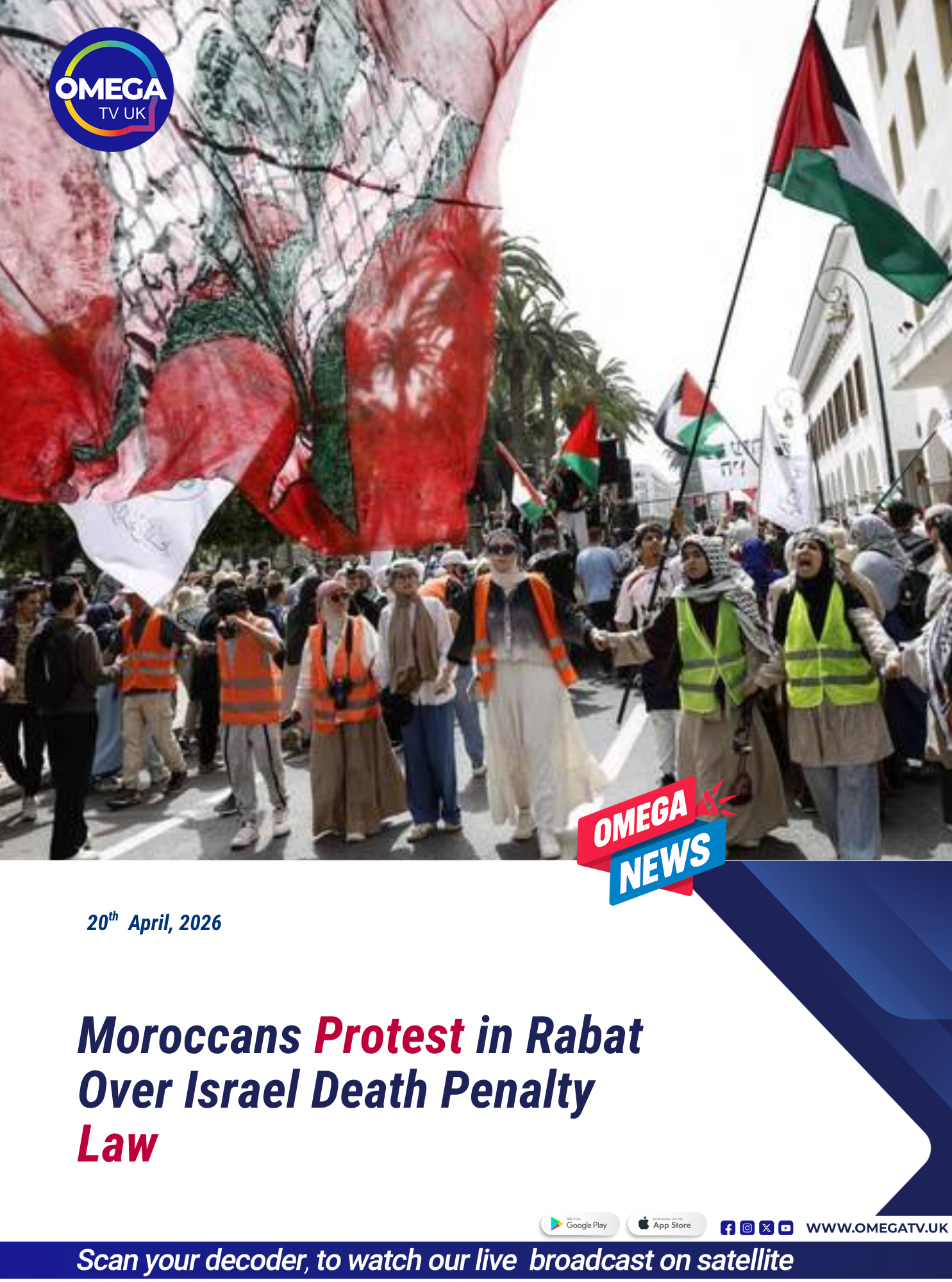
Protesters rally in Rabat against Israeli death penalty law

Thousands of demonstrators have taken to the streets of Rabat to protest against a controversial Israeli law that could allow the execution of Palestinians convicted of deadly attacks, in a show of solidarity with the Palestinian cause.
An estimated 5,000 people marched along Mohammed V Avenue in the Moroccan capital on Sunday, waving Palestinian and Moroccan flags while chanting slogans condemning both the proposed legislation and Israel’s ongoing military actions in Gaza. The protest reflected growing public anger across parts of the region over developments linked to the Israeli-Palestinian conflict.
The demonstration was organised by the National Action Group for Palestine, a coalition that brings together a wide range of political and civil society groups, including Islamist and left-wing organisations. Some participants were also linked to the Justice and Development Party, which has historically supported pro-Palestinian causes.
Participants described the rally as part of a broader movement aimed at showing solidarity with Palestinians, particularly those who could be affected by the new law. Many voiced concern that the legislation would significantly expand the use of capital punishment and disproportionately impact Palestinians living in the occupied West Bank.
“Protests and boycotts are the least we can do,” one student marcher said, highlighting the sense of responsibility felt by many attendees to speak out against what they see as injustice. Others echoed similar sentiments, arguing that international pressure is necessary to prevent further escalation.
The law at the centre of the controversy would reportedly make the death penalty the default sentence for Palestinians convicted of carrying out attacks classified as terrorism by Israeli military courts. It would also extend the possibility of capital punishment within civilian courts under certain conditions, marking a significant shift in legal policy.
Critics argue that the measure risks creating a dual legal system, where Palestinians and Israelis are subject to different standards of justice. Human rights organisations have raised concerns that such a framework could violate international legal norms and exacerbate tensions in an already volatile region.
The legislation has drawn widespread criticism beyond Morocco. The Palestinian Authority, alongside various international human rights groups and foreign governments, has condemned the move, warning that it could further inflame the conflict and undermine prospects for peace.
In addition to opposing the law, demonstrators in Rabat also expressed frustration over Morocco’s decision to normalise diplomatic relations with Israel in 2020. Many called on the government to reconsider its position, especially in light of the ongoing war in Gaza.
Chants during the march reflected this dual focus, with protesters criticising both Israeli policies and Morocco’s diplomatic stance. Some participants argued that maintaining ties with Israel under current circumstances sends the wrong message and undermines solidarity efforts.
The protest remained largely peaceful, with a strong presence of flags, banners and coordinated chants. It also highlighted the enduring resonance of the Palestinian القضية within Moroccan society, where public support for Palestinian rights remains widespread.
Observers note that while Morocco has maintained official diplomatic relations with Israel, public opinion on the issue is often more critical, leading to periodic demonstrations such as the one seen in Rabat.
The rally comes at a time of heightened regional tension, as developments in Gaza and the West Bank continue to draw international attention. For many protesters, the demonstration was not just about a single law but part of a broader call for justice, accountability and an end to policies they view as oppressive.
As debates over the proposed legislation continue, the scenes in Rabat underscore the deep emotional and political connections that the Israeli-Palestinian conflict continues to evoke far beyond its immediate