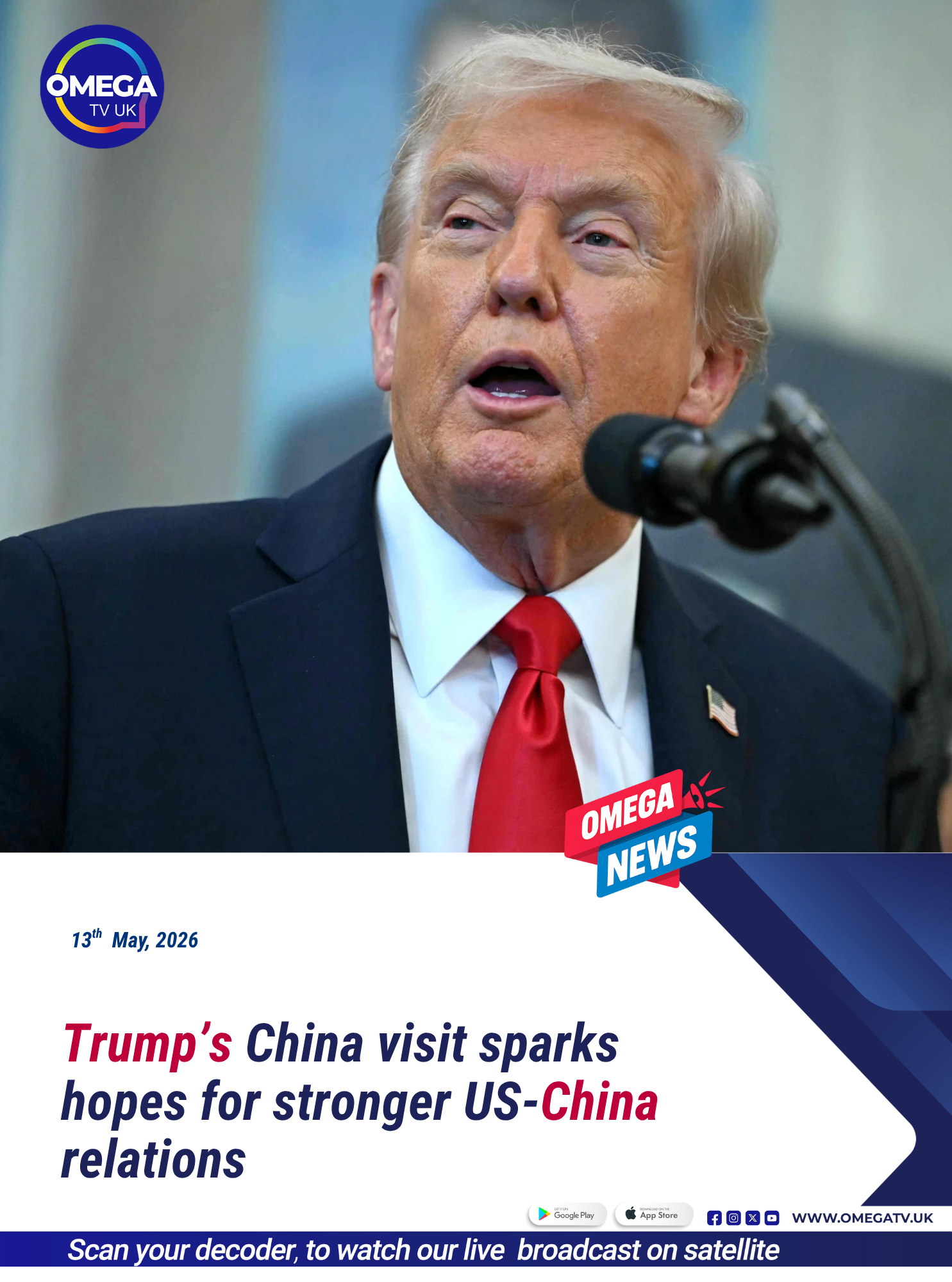
Trump’s Upcoming China Visit Raises Hopes for More Stable U.S.-China Relations
Business leaders, academics, and international officials are expressing cautious optimism ahead of U.S. President Donald Trump’s upcoming state visit to China, with many hoping the trip will help stabilize relations between Washington and Beijing while boosting economic cooperation.

At the invitation of Chinese President Xi Jinping, Trump is scheduled to visit China from May 13 to 15. The visit is being closely watched globally, as the United States and China remain the world’s two largest economies and central pillars of global trade and financial stability.
Trump and Xi first met in 2017, during a year marked by reciprocal state visits that shaped the tone of their early diplomatic relationship. Their most recent meeting took place in October 2025 in Busan, South Korea, where both leaders discussed bilateral and regional issues.
Over the years, direct engagement between the two presidents has remained a key feature of China-U.S. diplomacy, helping maintain communication despite recurring tensions over trade, technology, Taiwan, and broader geopolitical competition.
Since Trump’s return to office, Xi has reportedly held five phone conversations with the U.S. president, discussing bilateral cooperation as well as major international developments.
Observers say the upcoming visit comes at a particularly important time, with the global economy facing continued uncertainty, supply chain disruptions, geopolitical tensions, and concerns over slowing growth.
Business leaders have emphasized that improved cooperation between the two powers would have far-reaching benefits.
John E. Drew, chairman of the World Trade Centers Association, highlighted the scale of the economic relationship between the two nations.
“The biggest trading partners in the world are China and the United States,” he said, stressing that both countries need to work together in a more transparent and constructive way to strengthen their economies and contribute to global prosperity.
Analysts also believe the meeting could reduce international anxiety by signaling renewed diplomatic engagement between Washington and Beijing.
Anthony Moretti, associate professor and department head at the School of Communication and Media at Robert Morris University, said the international community is hoping for a positive outcome.
“Anytime you get the U.S. president and the Chinese president together, it’s good news,” he said, noting that stronger engagement between the two countries could help ease global instability.
Agricultural and export sectors are also watching the visit closely. Jim Sutter, CEO of the U.S. Soybean Export Council, said he has observed genuine interest from both governments and businesses in improving the bilateral relationship.
He noted that while differences will remain, stronger cooperation would benefit both economies and the wider global market.
“I think there is this recognition that we are better together,” Sutter said, arguing that practical collaboration is more beneficial than prolonged economic conflict.
International institutions have echoed similar views. At a briefing in New York, Farhan Haq, deputy spokesperson for the United Nations Secretary-General, welcomed efforts by both governments to manage differences through dialogue.
“The United States and China are two of the main economic powerhouses of the world,” Haq said, adding that any successful effort to resolve policy differences would be beneficial globally.
Experts in Europe have also pointed to growing economic interdependence as a reason both countries must prioritize communication.
Jasper Roctus, senior associate fellow at the Royal Institute for International Relations in Brussels, said today’s deeply interconnected global economy makes even economic conflicts significantly more costly than in previous decades.
“The price of conflict, even economic conflict, is much higher than it used to be,” he said, emphasizing the importance of continued engagement despite disagreements.
From the Global South perspective, the summit is being watched with particular interest. Sizo Nkala, a research fellow at the Center for Africa-China Studies at the University of Johannesburg, said the relationship between China and the U.S. has major implications for developing economies.
He noted that China and the U.S. together account for more than 40 percent of global GDP, meaning policy decisions made by both governments can significantly impact countries such as South Africa and others across the developing world.
Nkala said countries in the Global South are hoping the meeting produces a positive outcome and demonstrates that both leaders remain committed to managing their relationship responsibly.
As Trump prepares to arrive in Beijing, expectations remain measured but hopeful that renewed high-level diplomacy could help bring greater predictability to one of the world’s most consequential bilateral relationships.